
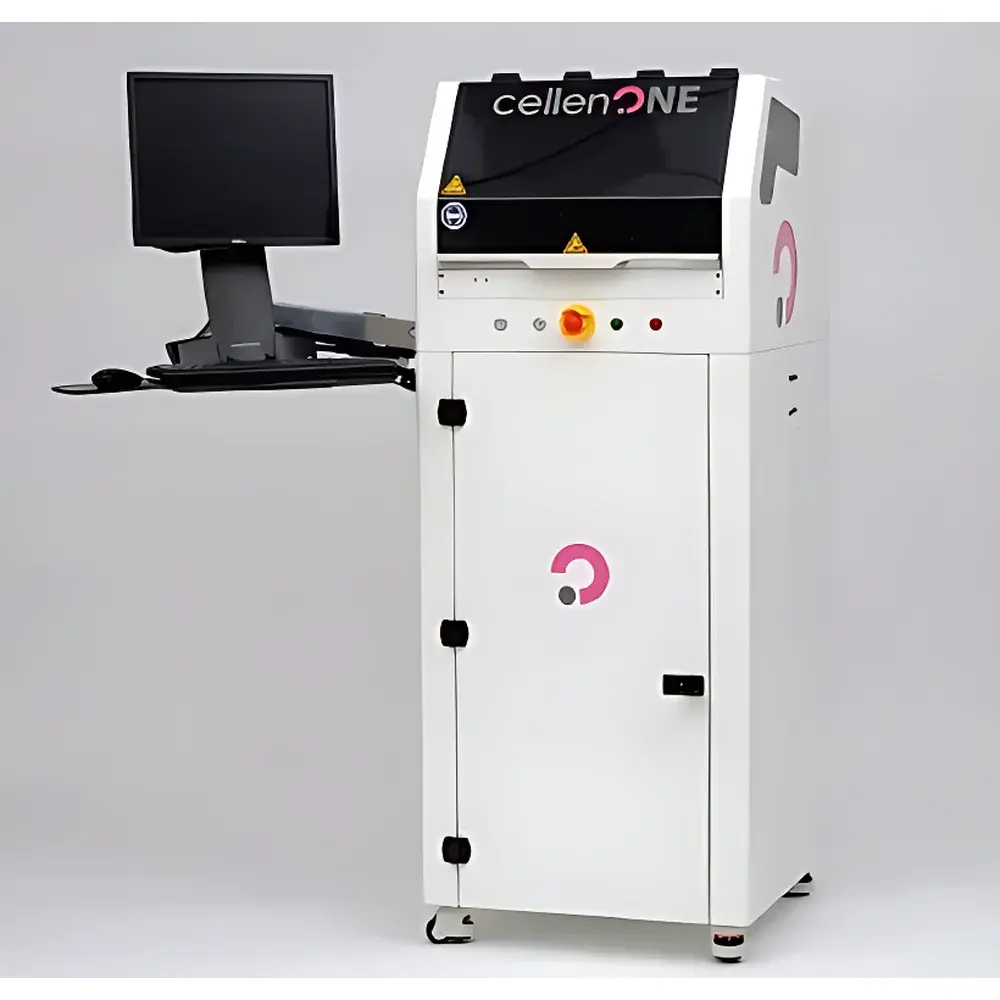
cellenONE X1 Single-Cell Dispensing and Printing System
| Origin | France |
|---|---|
| Manufacturer Type | Authorized Distributor |
| Origin Category | Imported |
| Model | X1 |
| Pricing | Available Upon Request |
Overview
The cellenONE X1 is an automated, vision-guided single-cell dispensing and printing system engineered for high-fidelity isolation of viable, intact single cells—designed specifically for applications in single-cell sequencing library preparation, monoclonal cell line development, and spatially resolved microarray generation. Unlike conventional fluorescence-activated cell sorting (FACS) or microfluidic droplet-based platforms that rely on Poisson distribution statistics—introducing multi-cell occupancy bias and limiting low-input sample utility—the cellenONE X1 employs piezoelectric acoustic dispensing coupled with real-time brightfield imaging to achieve deterministic, position-resolved single-cell deposition. Each dispensed nanoliter-scale droplet is optically verified prior to ejection; only droplets containing exactly one morphologically intact cell are directed into user-specified wells (e.g., 96-, 384-, 1536-, or 5184-well plates, including custom microfabricated substrates). Non-conforming events—including empty droplets or those containing ≥2 cells—are automatically rejected and returned to the source reservoir, enabling full sample recovery and iterative re-sorting without loss of material. This closed-loop visual feedback architecture ensures traceability, reproducibility, and compliance with GLP-aligned experimental documentation requirements.
Key Features
- Piezoelectric acoustic dispensing technology delivering gentle, non-contact cell handling—minimizing shear stress and preserving viability, especially critical for fragile primary cells and stem cell populations.
- Real-time optical monitoring of nozzle region with integrated high-resolution imaging: every dispense event is captured, timestamped, and archived as part of the audit trail.
- Deterministic single-cell placement: >95% single-cell deposition accuracy confirmed per well, with post-sort viability consistently exceeding 85% across validated cell types.
- Ultra-low input capability: functional down to 1 µL suspension volumes containing as few as 50 total cells—eliminating the minimum cell number constraints typical of FACS systems (which generally require ≥20,000 cells).
- Nanoliter-scale reagent dispensing (down to 10 nL precision) enables open-platform library construction workflows, significantly reducing consumable costs in scRNA-seq, scATAC-seq, and targeted amplification protocols.
- Flexible substrate compatibility: supports standardized microtiter formats (96–5184-well), as well as user-defined microstructures fabricated via photolithography or soft lithography.
Sample Compatibility & Compliance
The cellenONE X1 has demonstrated robust performance across a broad spectrum of biological specimens, including immortalized cell lines (CHO, HEK293T, HeLa, A549, PC3, H1975, HepaRG, Jurkat), primary human cells (PBMCs—including CD4+/CD8+ T cells and CD19+ B cells—fibroblasts, keratinocytes, melanocytes, cardiomyocytes, HUVECs, neural stem cells), isolated nuclei from fresh-frozen (FF) and FFPE tissue sections, and synthetic calibration particles (2–30 µm diameter microspheres, including antibody-conjugated barcoded beads). The system operates within ISO 13485–aligned manufacturing controls and supports instrument qualification documentation packages compliant with FDA 21 CFR Part 11 for electronic records and signatures when deployed in regulated environments. Audit logs include image metadata, dispensing coordinates, timestamps, and operator ID—facilitating GxP-aligned data integrity assessments.
Software & Data Management
The cellenONE Control Suite provides intuitive, scriptable workflow orchestration with built-in image analysis algorithms for cell morphology assessment, contrast-based segmentation, and confidence scoring per dispense event. All acquired images and metadata are stored in vendor-neutral TIFF/JSON format, supporting integration with LIMS and ELN platforms via standard API endpoints. Software supports user-defined pass/fail criteria (e.g., size, roundness, intensity threshold), dynamic plate mapping, and batch processing with error recovery protocols. Full version control, role-based access, and electronic signature capture are implemented to meet ALCOA+ principles (Attributable, Legible, Contemporaneous, Original, Accurate) required under ICH-GCP and ISO/IEC 17025 frameworks.
Applications
- Single-cell RNA sequencing (scRNA-seq) library initiation with minimal input and maximal cell recovery.
- Monoclonal antibody discovery: high-efficiency isolation of antigen-specific B cells or hybridoma clones with preserved viability and proliferative capacity.
- CRISPR screening validation: precise allocation of edited cells into multiwell arrays for phenotypic readout.
- Organoid and spheroid seeding: controlled deposition of single progenitor cells into 3D culture scaffolds.
- Microarray-based spatial transcriptomics: programmable patterning of heterogeneous cell mixtures at defined micron-scale coordinates.
- Low-volume enzymatic reactions: nanoliter-scale mixing of cells with reverse transcription or tagmentation reagents to reduce batch effects and cost-per-sample.
FAQ
What is the minimum viable cell concentration required for reliable operation?
The system functions effectively with input suspensions as low as 50 total cells in 1 µL—no pre-enrichment or concentration steps are necessary.
Does the cellenONE X1 support fluorescent cell identification?
No—cellenONE X1 relies exclusively on label-free brightfield imaging and morphological criteria. Fluorescence-based gating is not supported; users requiring marker-based selection must perform upstream staining and apply morphological proxies during image analysis.
Can the system be integrated into automated liquid handling workflows?
Yes—via standard RS-232 and Ethernet interfaces, the X1 supports synchronization with third-party robotic arms and plate handlers using industry-standard command protocols (e.g., SLAS/ANSI-compliant ASCII commands).
Is regulatory documentation available for IQ/OQ/PQ validation?
Comprehensive qualification templates—including test scripts, acceptance criteria, and traceability matrices—are provided upon request and align with ASTM E2500 and ISO/IEC 17025 guidance for analytical instrument verification.
What maintenance intervals are recommended for the dispensing head?
The piezoelectric dispenser requires no routine calibration; cleaning is performed automatically between runs using ethanol/water flush cycles. Nozzles are disposable and replaced per 100 hours of cumulative operation or after processing highly viscous samples.





