
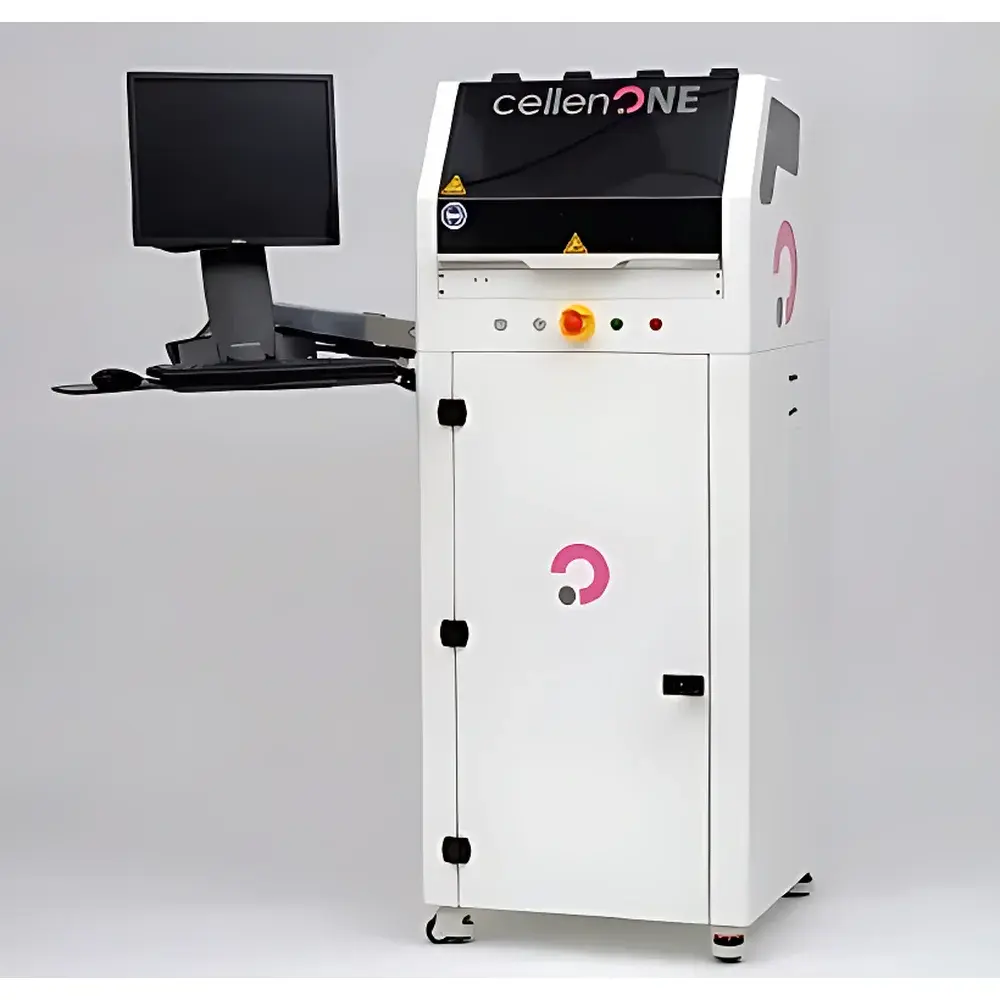
cellenONE X1 Single-Cell Dispensing System
| Origin | France |
|---|---|
| Manufacturer Type | Authorized Distributor |
| Origin Category | Imported Instrument |
| Model | cellenONE X1 |
| Pricing | Available Upon Request |
Overview
The cellenONE X1 Single-Cell Dispensing System is an automated, vision-guided precision instrument engineered for high-fidelity isolation and deposition of rare single cells—designed specifically for demanding applications in single-cell genomics, monoclonal antibody development, and functional cell screening. Unlike conventional flow cytometry (FACS) or microfluidic platforms constrained by Poisson distribution statistics, the cellenONE X1 employs piezoelectric acoustic dispensing coupled with real-time optical monitoring to achieve deterministic single-cell placement. Each dispensed droplet is imaged in situ at the nozzle aperture prior to ejection; only droplets containing exactly one viable cell are directed into designated wells—ensuring true single-cell resolution without statistical ambiguity. This closed-loop visual feedback architecture eliminates multi-cell events at the source, delivering >98% single-cell accuracy and >85% post-sort viability across diverse primary and immortalized cell types—including fragile populations such as cardiomyocytes, neural stem cells, and FFPE-derived nuclei.
Key Features
- Piezoelectric acoustic dispensing technology enabling gentle, non-contact cell transfer with minimal shear stress—critical for preserving clonogenic potential and transcriptional integrity.
- Real-time, high-resolution imaging of each droplet at the dispenser nozzle, with automatic classification (0/1/>1 cells per droplet) and conditional ejection logic.
- Full compatibility with standard microplate formats: 96-, 384-, 1536-, and 5184-well plates, plus custom-designed substrates including nanowell arrays and hydrogel-based micropatterned surfaces.
- Sub-microliter liquid handling capability (down to 10 nL per dispense), supporting ultra-low-volume library preparation workflows for scRNA-seq, scATAC-seq, and targeted amplification protocols.
- Integrated sample recovery loop: Unqualified droplets (e.g., empty or multi-cell) are returned to the source reservoir—enabling reprocessing and maximizing cell utilization efficiency.
- Traceable experimental record: Every dispensing event is timestamped and accompanied by a captured image, satisfying GLP-aligned documentation requirements for reproducibility and audit readiness.
Sample Compatibility & Compliance
The cellenONE X1 accommodates a broad spectrum of biological specimens validated under routine laboratory conditions: mammalian cell lines (CHO, HEK293T, HeLa, A549, Jurkat), primary human cells (PBMC subsets, HUVECs, fibroblasts, keratinocytes, melanocytes, cardiomyocytes), dissociated nuclei from fresh-frozen and FFPE tissue sections, and calibrated polymeric microspheres (2–30 µm diameter) used for barcode tagging or calibration. The system operates within ISO 13485–aligned manufacturing standards and supports compliance with FDA 21 CFR Part 11 through optional electronic signature and audit trail modules. All fluidic pathways are sterilizable via ethanol flush or autoclavable components, ensuring cross-experiment contamination control per CLSI EP26-A guidelines.
Software & Data Management
The proprietary cellenONE Control Suite provides intuitive workflow configuration, real-time monitoring, and comprehensive data export (TIFF, CSV, JSON). Experimental parameters—including plate map definition, cell detection thresholds, dispensing speed, and image acquisition settings—are stored with metadata tags for version-controlled protocol management. Raw images and dispensing logs are archived locally with optional integration into LIMS environments via RESTful API. Software validation packages (IQ/OQ/PQ documentation) are available upon request to support GMP-regulated bioprocess development and QC release testing.
Applications
- High-efficiency monoclonal antibody discovery: Isolation of antigen-specific B cells or hybridomas directly into 384-well plates for downstream expansion and sequencing.
- Single-cell multi-omics library construction: Parallel dispensing of individual cells + barcoded reagents (e.g., RT primers, Tn5 transposase) into nanoliter reaction volumes.
- Rare cell population enrichment: Recovery of circulating tumor cells (CTCs) or tissue-resident immune subsets from low-input clinical samples (<50 cells).
- Microarray-based functional phenotyping: Precise seeding of single cells onto spatially encoded surfaces for time-resolved secretion or metabolic profiling.
- Nuclei isolation for epigenomic profiling: Viable nuclear suspensions from archived FFPE blocks, compatible with snATAC-seq and snRNA-seq pipelines.
FAQ
What minimum cell input volume does the cellenONE X1 require?
The system accepts sample volumes as low as 1 µL, with demonstrated performance down to 50 total cells—making it suitable for precious clinical or biopsy-derived material.
How does the cellenONE X1 ensure traceability for regulatory submissions?
Each dispensing event generates a timestamped image and log entry; full audit trails—including user actions, parameter changes, and hardware status—are exportable in CSV/JSON format for FDA 21 CFR Part 11 compliance.
Can the system handle viscous or aggregated samples?
Yes—optional syringe pump integration and adaptive focus algorithms accommodate heterogeneous suspensions, including partially lysed tissues and nuclei preps with variable debris content.
Is third-party software integration supported?
The platform offers native API access for integration with major bioinformatics pipelines (e.g., CellxGene, Seurat, 10x Genomics Space Ranger) and enterprise LIMS systems.
What maintenance protocols are recommended for long-term reliability?
Daily ethanol flush of dispensing channels, monthly nozzle calibration using NIST-traceable microspheres, and annual preventive service by certified cellenion engineers—documented in accordance with ISO/IEC 17025 requirements.
Related Products



