
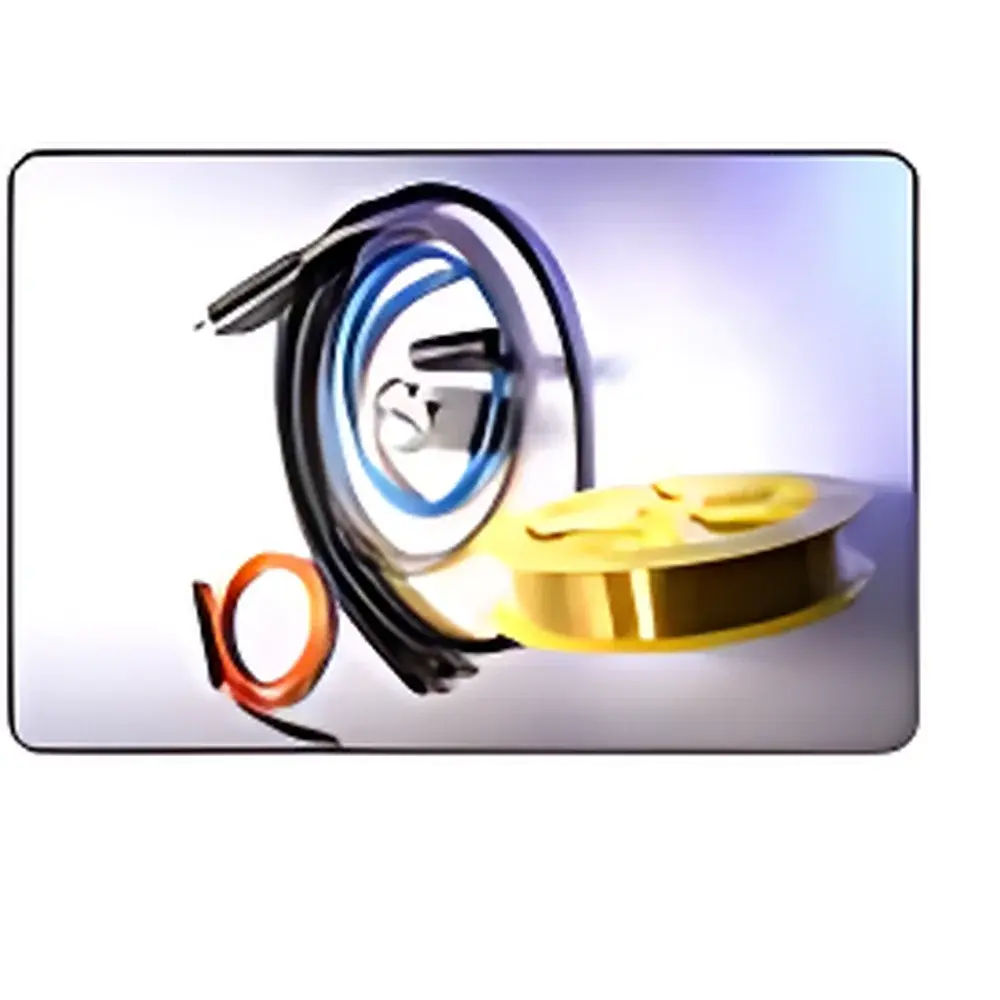
CeramOptec Optran UV/WF Series Silica/Silica Optical Fiber (200–2400 nm)
| Origin | Germany |
|---|---|
| Manufacturer Type | Distributor |
| Origin Category | Imported |
| Model | Silica Fibers |
| Pricing | Upon Request |
Overview
The CeramOptec Optran UV/WF Series Silica/Silica Optical Fiber is a high-purity, all-silica (SiO₂/SiO₂) waveguide engineered for broadband transmission across the ultraviolet, visible, and near-infrared spectral regions—from 200 nm to 2400 nm. Designed using low-OH (≤1 ppm) fused silica core and cladding, this fiber exhibits exceptionally low intrinsic absorption in both the deep-UV and extended NIR ranges, enabling stable, high-fidelity light delivery in demanding spectroscopic, sensing, and laser coupling applications. Its all-glass construction ensures excellent radiation hardness, long-term photostability, and compatibility with vacuum and ultra-clean environments. Unlike plastic-clad or polymer-coated alternatives, the Optran UV/WF series maintains mechanical integrity and optical performance under prolonged UV exposure and elevated thermal loads—making it a reference-grade solution for R&D laboratories, analytical instrumentation OEMs, and metrology facilities requiring traceable, reproducible optical signal transfer.
Key Features
- Ultra-broad spectral transmission range: 200–2400 nm (validated per IEC 60793-1-42 and ISO 11995)
- Low-OH fused silica composition (OH content ≤1 ppm), minimizing water-related absorption peaks at 1400 nm, 1900 nm, and 2200 nm
- Numerical aperture options: Standard NA = 0.22; custom configurations available at NA = 0.12, 0.28, 0.30, 0.37, 0.44, and 0.53
- Core/cladding diameters offered in standard configurations (e.g., 200/230 µm, 400/440 µm, 600/660 µm), with tight geometric tolerances (<±1 µm)
- High laser damage threshold (>10 J/cm² @ 266 nm, 10 ns pulses) and resistance to solarization (per MIL-STD-883 Method 1019.10)
- Available with polyimide coating for continuous operation up to +400 °C, or acrylate for general-purpose use
- Compliant with RoHS 2015/863/EU and REACH (EC) No. 1907/2006 regulations
Sample Compatibility & Compliance
This fiber is routinely integrated into spectrophotometers (e.g., Agilent Cary, PerkinElmer Lambda), UV-Vis-NIR microplate readers, fluorescence lifetime imaging systems (FLIM), and process analytical technology (PAT) platforms. It meets critical requirements for GLP/GMP-compliant installations when used with validated connectors (SMA 905, FC/PC) and proper cable management. The Optran UVNS variant—specifically qualified for >40,000 hours of uninterrupted 254 nm irradiation—supports FDA 21 CFR Part 11–aligned validation protocols where photostability documentation is mandatory. All fibers are supplied with full material certification, spectral attenuation curves (measured per IEC 61280-4-1), and batch-specific test reports traceable to NIST standards.
Software & Data Management
While the fiber itself is a passive component, its performance data—including wavelength-dependent attenuation, numerical aperture verification, and bend-loss characterization—is fully compatible with industry-standard optical modeling tools such as Lumerical MODE, COMSOL Multiphysics (Wave Optics Module), and Thorlabs’ FIBERCALC. CeramOptec provides downloadable spectral transmission datasets (CSV format) and calibration-ready S-parameters for integration into LabVIEW-based DAQ systems and MATLAB-driven spectral analysis workflows. For regulated environments, raw spectral data logs can be archived with timestamped metadata and electronic signatures in accordance with ALCOA+ principles.
Applications
- UV-Vis-NIR absorbance and reflectance spectroscopy in pharmaceutical QC labs (aligned with USP , EP 2.2.25)
- Laser-induced breakdown spectroscopy (LIBS) probe arms operating at 193 nm (ArF), 248 nm (KrF), and 1064 nm (Nd:YAG)
- In-line process monitoring in semiconductor wet benches and chemical vapor deposition reactors
- Fluorescence excitation/detection in confocal microscopy and flow cytometry systems
- Calibration transfer between reference spectrometers and field-deployable sensors
- High-temperature combustion diagnostics using polyimide-coated variants
FAQ
What is the maximum power handling capability of the Optran WF fiber at 1550 nm?
At 1550 nm, with proper mode conditioning and clean terminations, the fiber supports CW power levels up to 5 W (core diameter ≥400 µm) without thermal lensing or coating degradation.
Can this fiber be spliced using standard fusion splicers?
Yes—standard single-mode or multimode fusion splicers with silica-compatible arc programs (e.g., Fujikura FSM-100P, Vytran GPX-3400B) achieve splice losses <0.1 dB when optimized for pure-silica profiles.
Is there a version qualified for Class 100 cleanroom assembly?
All Optran UV/WF fibers are manufactured and packaged in ISO Class 5 cleanrooms; certificates of conformance include particle count data per ISO 14644-1.
Do you provide cut-to-length assemblies with terminated connectors?
Yes—custom assemblies with SMA 905, FC/PC, or ST connectors are available with IL/RL testing reports and individual serial-number traceability.
How does OH content affect transmission above 1800 nm?
OH concentrations >10 ppm introduce strong vibrational overtone absorption bands centered at 1383 nm, 1870 nm, and 2200 nm; the ≤1 ppm specification ensures minimal loss across the entire 200–2400 nm window.





