
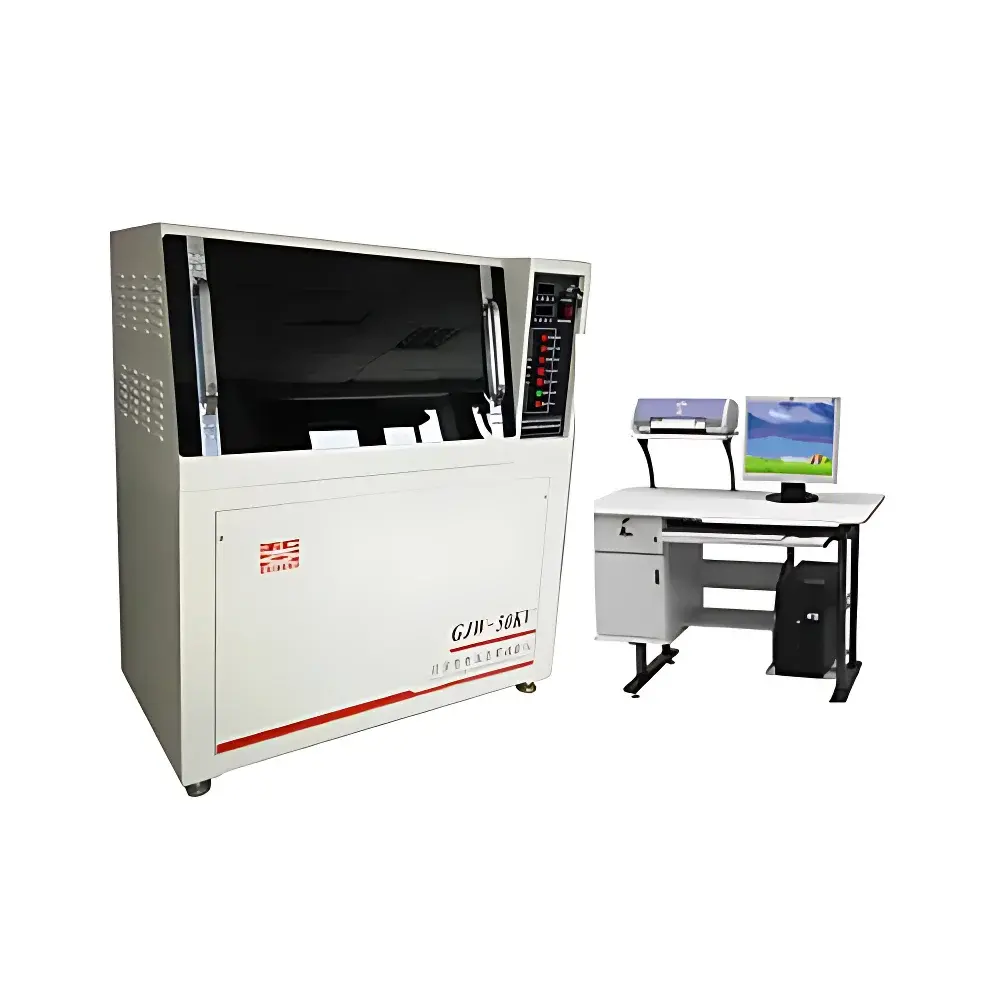
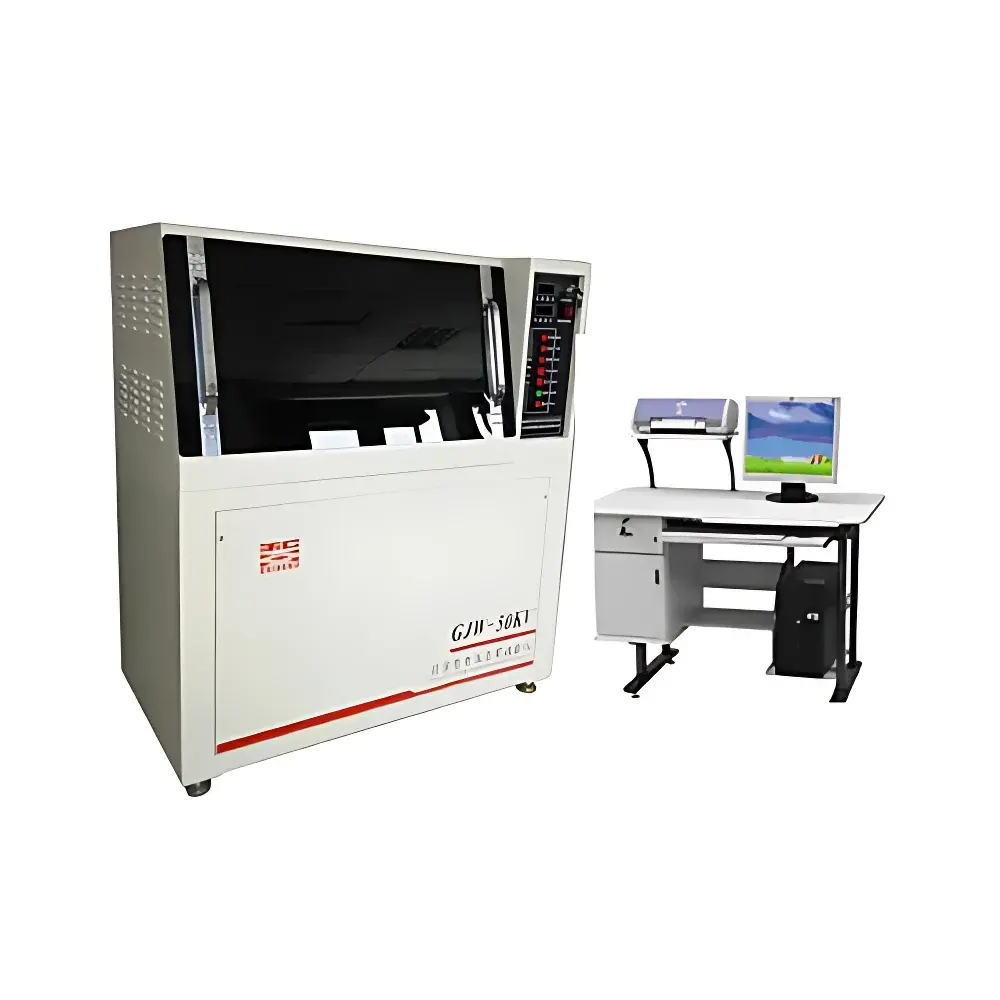
Changchun Intelligent GJW-50KV Voltage Breakdown Tester
| Brand | Changchun Intelligent |
|---|---|
| Origin | Jilin, China |
| Model | GJW-50KV |
| Output Voltage | AC/DC 0–50 kV |
| Measurement Range | 5–50 kV |
| Voltage Accuracy | ≤4% |
| Rise Rate | 0.4–10 kV/s |
| Hold Time | 0–4 h (no-load) |
| Leakage Current Setting | 1–30 mA |
| Power Input | AC 220 V ±10%, 50 Hz ±1% |
| Rated Capacity | 3 kVA |
| Dimensions (L×W×H) | 630×520×760 mm |
| Weight | 100 kg |
| Operating Temperature | 15–30 °C |
| Relative Humidity | 0–85% RH |
| Grounding Depth Requirement | ≥1.5 m |
Overview
The Changchun Intelligent GJW-50KV Voltage Breakdown Tester is a precision high-voltage testing system engineered for the quantitative evaluation of dielectric strength and voltage endurance in solid insulating materials. It operates on the fundamental principle of controlled voltage ramping until electrical breakdown occurs—defined as the point at which the material’s insulation resistance collapses under sustained electric stress, resulting in measurable current surge and arcing. Designed for compliance with international standard test methodologies, the instrument supports both AC (50 Hz) and DC voltage application modes, enabling rigorous assessment of insulation performance under conditions simulating real-world service environments—including power transmission components, aerospace composites, and medical device encapsulants.
Key Features
- Full computer-controlled operation via proprietary Windows-based software, supporting real-time data acquisition, dynamic curve plotting, and multi-sample comparative analysis with color-coded overlays and localized zoom functionality.
- Integrated six-level safety interlock architecture: main power switch, keyed HV disconnect, autoreturn variac reset, interlocked test chamber door, primary-side current-limited circuit breaker, and ground-fault leakage protection—ensuring full alignment with IEC 61010-1 and GB/T 2900.19 safety requirements.
- Dual-mode voltage generation: independently regulated AC (0–50 kV RMS) and DC (0–50 kV) outputs, each with programmable rise rate (0.4–10 kV/s), hold duration (0–4 hours, no-load), and adjustable trip current threshold (1–30 mA).
- Automated discharge management: integrated electrostatic discharge (ESD) module with audible/visual alarm triggered upon chamber opening post-DC test—preventing operator exposure to residual charge per IEC 61010-2-034 Clause 7.3.2.
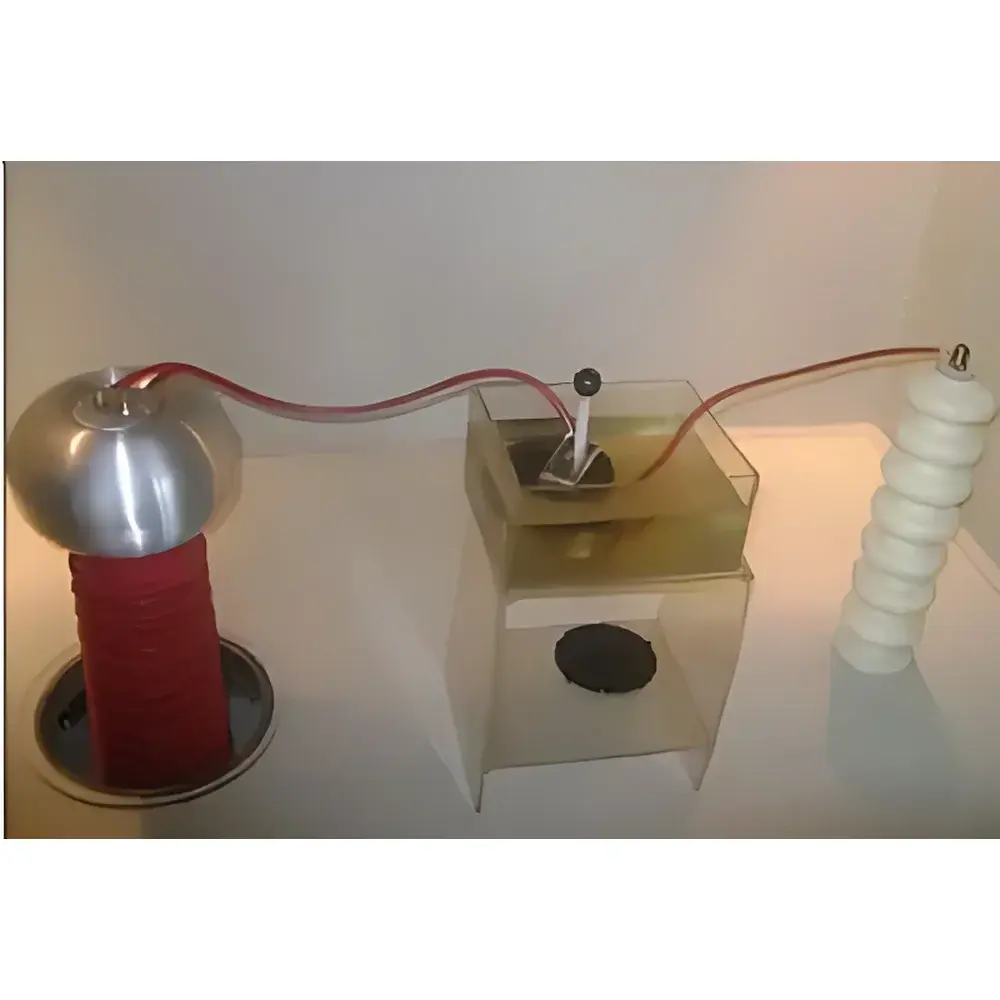
- Robust mechanical construction: stainless steel test chamber, oil-immersed electrode assembly (including Φ25 mm × 2 and Φ75 mm electrodes), and rigid grounding interface compliant with GB 50169 for low-impedance earth connection (≥1.5 m burial depth required).
- Stable output regulation: maintains voltage fidelity within ±4% error across full range despite ±10% mains fluctuation; optimized thermal design enables continuous 24/7 operational duty cycle without forced cooling or scheduled downtime.
Sample Compatibility & Compliance
The GJW-50KV accommodates a broad spectrum of non-conductive solid specimens up to 10 mm thickness, including but not limited to epoxy resins, polyimide films, silicone rubber compounds, ceramic substrates, glass laminates, and fiber-reinforced composites. Its test configuration conforms to the electrode geometry, environmental conditioning, and procedural controls mandated by ASTM D149 (Standard Test Method for Dielectric Breakdown Voltage of Solid Electrical Insulating Materials at Commercial Power Frequencies), GB/T 1408.1–2006 (equivalent to IEC 60243-1), GB/T 1408.2–2006 (DC-specific protocol), and GB/T 1695–2005 (for vulcanized rubber). All hardware and firmware are calibrated traceable to national metrological standards; documentation supports GLP-compliant audit trails and 21 CFR Part 11–ready electronic signatures when deployed with validated software configurations.
Software & Data Management
The embedded test suite provides role-based user access control, allowing administrators to assign parameter templates, test sequences, and report formats per operator profile—ensuring segregation of duties and preventing unauthorized configuration changes. Test logs record timestamped voltage, current, time-to-breakdown, ramp rate, and environmental metadata (ambient temperature/humidity). Export functions support native .CSV, Microsoft Excel (.xlsx), and Word (.docx) formats for integration into LIMS or QA documentation systems. Audit logging captures all user actions—including edits, deletions, and pass/fail adjudications—with immutable timestamps. Software validation packages—including IQ/OQ documentation—are available upon request to meet ISO/IEC 17025 laboratory accreditation requirements.
Applications
- Quality assurance of batch-produced insulating varnishes, potting compounds, and conformal coatings in electronics manufacturing.
- R&D evaluation of novel polymer blends and nanocomposite dielectrics for high-voltage capacitor and transformer applications.
- Regulatory submission testing for UL, CE, and CCC certification of medical equipment housings and surgical instrument insulation.
- Failure analysis of aged or thermally degraded insulation in utility-grade cable splices and bushings.
- Comparative lifetime modeling using step-stress voltage endurance tests per IEEE Std 930 methodology.
FAQ
What standards does this tester fully support?
ASTM D149, GB/T 1408.1–2006, GB/T 1408.2–2006, GB/T 1695–2005, and IEC 60243-1—all implemented via hardware design, electrode configuration, and software-enforced procedural constraints.
Is the system suitable for DC-only testing protocols?
Yes. The unit delivers stable, ripple-free DC output up to 50 kV with programmable ramp profiles and mandatory post-test discharge verification prior to chamber access.
How is data integrity ensured during long-duration voltage hold tests?
Continuous sampling at ≥10 Hz resolution, redundant storage (local SSD + optional network backup), and CRC-32 checksum validation prevent data corruption during multi-hour tests.
Can third-party LIMS systems interface with the instrument?
Yes—via TCP/IP socket communication using documented ASCII command set; REST API integration kits are available for custom middleware deployment.
What grounding specifications must be observed for safe operation?
A dedicated earth electrode buried ≥1.5 m in conductive soil, bonded to chassis with ≤4 Ω resistance measured per GB 50169, is mandatory—not optional—for electromagnetic compatibility and personnel safety.
Related Products



