
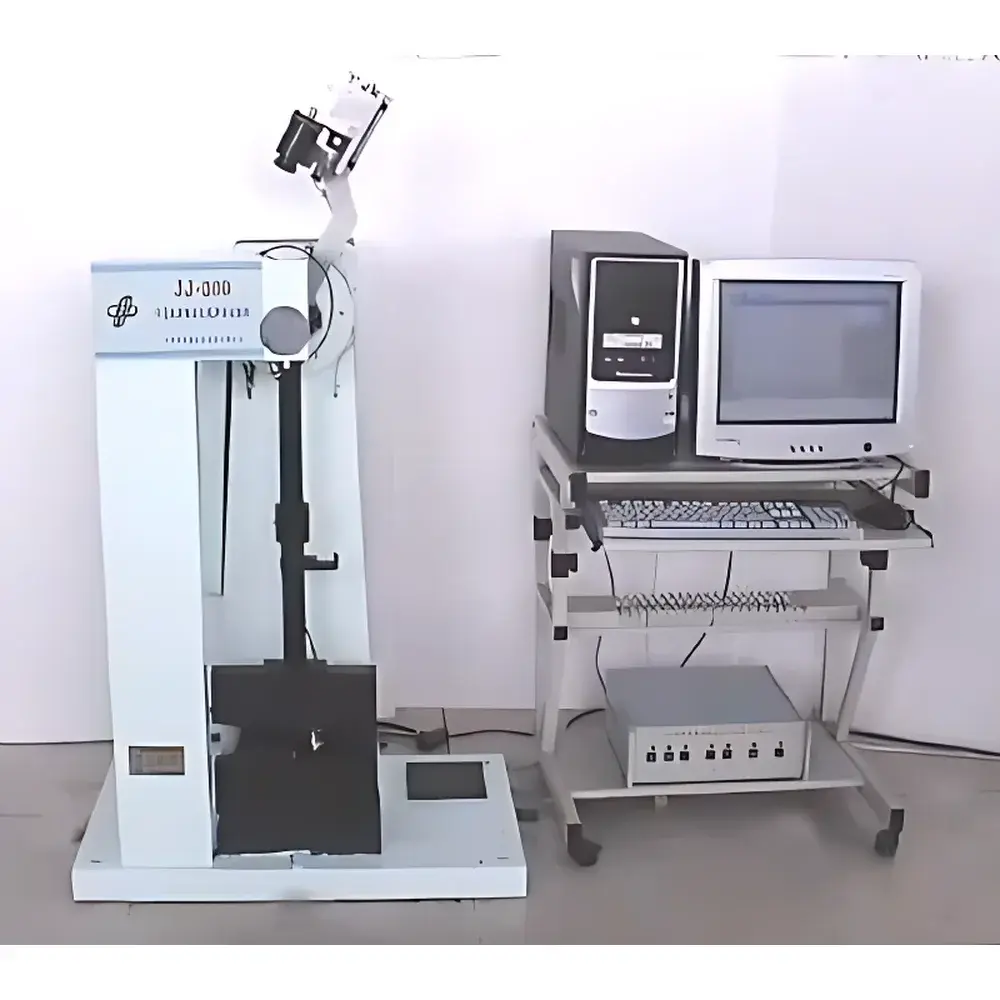
Changchun Intelligent JJ-300 Charpy Impact Testing Machine
| Brand | Changchun Intelligent |
|---|---|
| Origin | Jilin, China |
| Model | JJ-300 |
| Impact Energy Capacity | 300 J / 150 J |
| Standard Compliance | GB/T 229–2007, GB 3808 |
| Load Measurement Range | 20,000 N |
| Load Sampling Rate | 1.2 µs |
| Load Resolution | 1/4000 |
| Load Accuracy | ≤1% |
| Angular Displacement Resolution | 360°/10,000 |
| Impact Velocity | 5.0–5.5 m/s |
| Striking Edge Radius | R2–R2.5 mm, Included Angle: 30° ±1° |
| Anvil Span | 40 ±0.5 mm |
| Specimen Dimensions | 55 ±0.6 mm (L) × 10 ±0.1 mm (W) × 10 ±0.05 mm (thickness, unnotched) or 8 ±0.05 mm (remaining thickness, V-notch) |
| Low-Temperature Chamber Range | Ambient to –20 °C |
| Cooling Rate | 0.7–1.0 °C/min |
| Temperature Uniformity | ±2 °C |
| Data Acquisition | High-speed load + angular displacement dual-channel synchronized sampling |
| Software Platform | Proprietary impact analysis suite with curve visualization, energy integration, and comparative reporting |
Overview
The Changchun Intelligent JJ-300 Charpy Impact Testing Machine is a high-precision, dual-energy-capacity instrument engineered for standardized Charpy V-notch impact testing of metallic materials under controlled thermal conditions. It operates on the principle of pendulum impact mechanics, where a calibrated hammer strikes a notched specimen supported in a three-point bending (simply supported beam) configuration. The machine measures the energy absorbed during fracture—quantified as the area under the real-time load–displacement curve—enabling precise determination of material toughness, ductile-to-brittle transition behavior, and low-temperature embrittlement characteristics. Designed in strict accordance with GB/T 229–2007 (“Metallic Materials — Charpy Pendulum Impact Test”) and GB 3808 (“Pendulum Impact Testing Machines — Verification of Testing Machines”), the JJ-300 integrates synchronized high-speed dual-channel data acquisition (load and angular displacement) to reconstruct dynamic force–time and energy–deformation profiles with microsecond-level temporal resolution.
Key Features
- Two selectable impact energies: 300 J and 150 J, each with dedicated calibrated hammers meeting ISO 148-1 and ASTM E23 geometric and mass requirements.
- High-fidelity load measurement system with 20,000 N capacity, ≤1% full-scale accuracy, and 1.2 µs sampling interval—enabling capture of transient peak loads and post-yield fracture dynamics.
- Angular displacement encoder with 360°/10,000 resolution ensures precise correlation between hammer swing angle and kinetic energy conversion.
- Integrated low-temperature chamber (ambient to –20 °C), equipped with PID-controlled refrigeration unit, maintaining ±2 °C temperature uniformity across specimen zone at stabilization.
- Automated specimen ejection mechanism with manual centering fixture and standardized anvil span (40 ±0.5 mm) and support radius (R1–R1.5 mm).
- Striking edge geometry fully compliant with GB/T 229: radius R2–R2.5 mm, included angle 30° ±1°, ensuring reproducible notch root contact and minimal stress concentration variability.
- Modular hardware architecture supporting traceable calibration via NIST-traceable load cells and angular encoders; all mechanical components manufactured to ISO 2768-mK tolerances.
Sample Compatibility & Compliance
The JJ-300 accommodates standard Charpy specimens per GB/T 229–2007: 55 ±0.6 mm long, 10 ±0.1 mm wide, with either 10 ±0.05 mm unnotched thickness or 8 ±0.05 mm remaining ligament thickness after V-notch machining (45° ±1°, depth 2 ±0.05 mm, root radius 0.25 ±0.025 mm). Specimens are preconditioned in the integrated cooling chamber prior to impact, enabling systematic evaluation of temperature-dependent fracture behavior—including ductile-to-brittle transition curves (DBTT). The system satisfies metrological verification requirements of GB 3808 and supports audit-ready documentation for GLP-compliant laboratories. While primarily aligned with Chinese national standards, its mechanical specifications align with key international benchmarks including ISO 148-1, ASTM E23, and EN 10045-1—facilitating cross-referenced reporting in multinational quality assurance workflows.
Software & Data Management
The proprietary impact analysis software provides real-time acquisition, visualization, and post-processing of synchronized load and angular displacement signals. Each test generates a time-stamped digital record containing raw waveform data, calculated absorbed energy (J), maximum load (N), and fracture type classification (ductile, brittle, or mixed). Data export is supported in CSV, XML, and PDF formats—with embedded metadata (operator ID, specimen ID, test temperature, calibration date, and instrument serial number). Audit trails log all user actions, parameter modifications, and report generation events in compliance with basic data integrity principles. Though not natively 21 CFR Part 11 certified, the software architecture supports integration with enterprise LIMS platforms via TCP/IP API and allows manual export for inclusion in FDA-submitted analytical reports or ISO/IEC 17025 accreditation packages.
Applications
- Quality control of structural steels, pressure vessel alloys, pipeline materials, and weldments in energy, petrochemical, and heavy manufacturing sectors.
- Research into low-temperature embrittlement mechanisms in ferritic steels and advanced high-strength alloys.
- Validation of heat treatment parameters and microstructural homogeneity through DBTT mapping.
- Comparative assessment of fracture resistance across batch lots, supplier materials, or post-weld heat treatment variants.
- Supporting failure analysis investigations where impact toughness deviation correlates with service-induced cracking or catastrophic fracture.
FAQ
Does the JJ-300 comply with ISO 148-1 for Charpy testing?
Yes—the striking edge geometry, anvil span, specimen dimensions, and energy calibration procedures conform to the dimensional and metrological requirements of ISO 148-1:2016, with documented equivalency to GB/T 229–2007.
Can the system perform tests below –20 °C?
No—the integrated cooling unit is rated for operation down to –20 °C. For sub-zero applications beyond this range, external cryogenic chambers or liquid nitrogen immersion fixtures must be used with manual specimen transfer.
Is calibration certificate included with delivery?
A factory calibration report is supplied with each unit, covering load cell linearity, angular encoder resolution, and energy verification at both 150 J and 300 J levels. Third-party accredited calibration (e.g., CNAS or A2LA) is available upon request.
What operating system is required for the analysis software?
The software is compatible with Windows 10 (64-bit) and Windows 11 (64-bit); .NET Framework 4.8 and Visual C++ Redistributables are automatically installed during setup.
How is specimen alignment verified before impact?
A precision centering gauge and adjustable specimen holder ensure repeatable positioning within ±0.1 mm lateral tolerance; cross-checks are performed using the supplied 40 mm span calibration block and optical alignment aid.



