
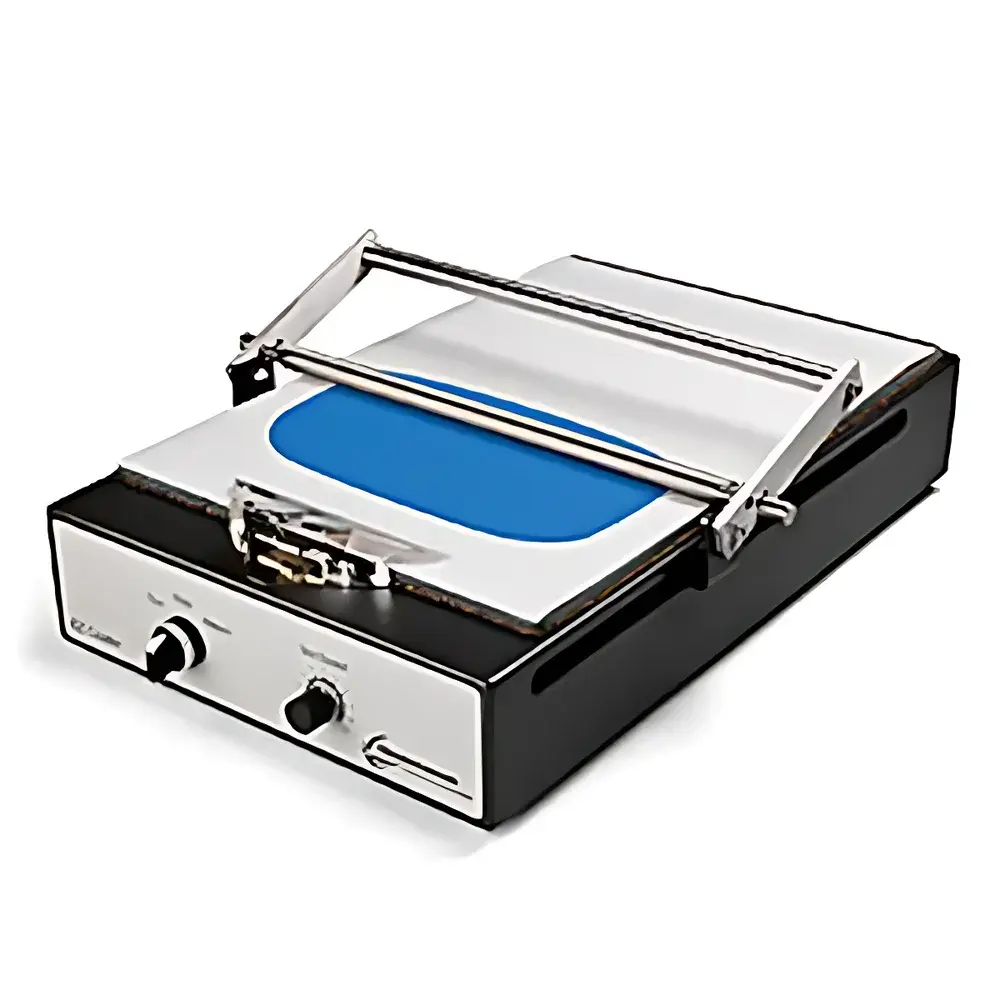
ChemInstruments EC-200 Motorized Variable-Speed Drawdown Coater
| Origin | USA |
|---|---|
| Manufacturer Type | Authorized Distributor |
| Origin Category | Imported |
| Model | EC-200 |
| Price | Upon Request |
| Coating Bed Dimensions | 300 mm × 340 mm |
| Coating Speed Range | 0.38–11.4 m/min |
| Coating Rod Diameter | 13 mm |
| Coating Rod Length | 410 mm |
| Maximum Coating Load | 600 g |
| Operating Temperature Range | 0–70 °C |
| Input Voltage | 85–265 V AC, 50/60 Hz |
| Unit Dimensions (L×W×H) | 560 × 380 × 180 mm |
| Net Weight | 13 kg |
| Optional Accessories | Wire-Wound Rods (various wire diameters) |
Overview
The ChemInstruments EC-200 Motorized Variable-Speed Drawdown Coater is an engineered solution for standardized thin-film sample preparation in R&D, quality control, and regulatory testing laboratories. It operates on the principle of controlled rod-over-substrate drawdown—where a precision wire-wound rod traverses a liquid-coated substrate at a defined linear velocity, shearing excess material to leave behind a uniform wet film whose final dry thickness correlates directly with rod geometry and fluid rheology. This method is widely adopted per ASTM D823, ISO 2808, and ASTM D1210 for evaluating coating viscosity, leveling behavior, drying characteristics, and film integrity across adhesives, industrial coatings, printing inks, sealants, and functional dispersions.
Key Features
- Motor-driven, digitally adjustable speed control (0.38–11.4 m/min) ensures precise shear-rate application during drawdown, minimizing operator-induced variability.
- Optically flat float glass coating bed (300 mm × 340 mm active area) provides dimensional stability and thermal uniformity, critical for reproducible film formation and post-cure evaluation.
- Ergonomic swing-arm rod holder with indexed loading slots enables rapid rod interchange—supporting rapid method development across multiple wire diameters (e.g., 13 mm OD rods, 410 mm length).
- Integrated foam sheet support system accommodates non-rigid or flexible substrates (e.g., films, foils, nonwovens), extending applicability beyond rigid panels.
- Wide operating temperature range (0–70 °C) permits environmental simulation during coating—essential for assessing low-temperature flow or high-temperature sag resistance.
- Universal AC input (85–265 V, 50/60 Hz) ensures compatibility with global lab power infrastructure without external transformers.
Sample Compatibility & Compliance
The EC-200 supports coated substrates up to 340 mm wide and 300 mm long—including metal panels, glass slides, PET films, paperboard, and composite laminates. Its mechanical design conforms to ISO/IEC 17025 requirements for equipment suitability in accredited testing labs. When used with traceable wire-wound rods (calibrated per ASTM D1210 Annex A1), the system delivers measurement repeatability ≤ ±2.5% RSD for wet film thickness under controlled ambient conditions. The unit’s construction—stainless steel hardware, chemical-resistant anodized aluminum frame, and sealed motor housing—meets general laboratory safety standards (ANSI Z535, IEC 61000-6-3) and supports GLP-compliant documentation workflows.
Software & Data Management
While the EC-200 operates as a standalone electromechanical instrument without embedded firmware or touchscreen interface, its analog speed control potentiometer and digital RPM display (via integrated tachometric feedback) enable direct integration into validated lab systems. Users may log coating parameters—including speed, ambient temperature, rod ID, substrate lot number, and operator ID—into LIMS or ELN platforms using standard CSV templates. For FDA-regulated environments, audit trails for speed settings and maintenance records (per manufacturer-recommended intervals) satisfy 21 CFR Part 11 requirements when paired with controlled electronic documentation practices.
Applications
- Formulation screening of water-based and solvent-borne coatings for automotive OEM and refinish applications.
- Viscosity-thickness correlation studies for UV-curable inks in packaging gravure and flexographic development.
- Adhesion and crosslink density assessment of pressure-sensitive adhesives (PSAs) via peel and shear testing on standardized drawdown films.
- Accelerated weathering and corrosion resistance evaluation of protective coatings on ASTM D609 cold-rolled steel panels.
- QC release testing of sealant consistency batches per ASTM C920, where film uniformity directly impacts joint performance metrics.
FAQ
What wire-wound rod sizes are compatible with the EC-200?
The EC-200 accepts standard 410 mm-length rods with 13 mm outer diameter; common wire diameters include 0.004″, 0.006″, 0.008″, 0.010″, and 0.012″ (per ASTM D1210). Rods must be certified for traceable calibration.
Can the EC-200 be used for hot-melt adhesive application?
Yes—provided the adhesive remains stable between 0–70 °C and exhibits sufficient open time; optional heated substrate plates (not included) may be integrated externally for thermal control.
Is the float glass bed replaceable, and what is its tolerance?
The 6-mm-thick optical float glass is user-replaceable; surface flatness is specified at λ/2 per 25 mm over the full 300 × 340 mm area (verified per ISO 10110-7).
Does the EC-200 meet CE or UKCA marking requirements?
The unit complies with EU Machinery Directive 2006/42/EC and EMC Directive 2014/30/EU when supplied with CE-marked power supply components; UKCA alignment follows identical technical basis.
What maintenance is required for long-term accuracy?
Monthly inspection of rod contact surfaces, biannual lubrication of carriage rails, and annual verification of speed calibration against a NIST-traceable tachometer are recommended per ChemInstruments’ Maintenance Protocol EC-200-MP-2023.




