
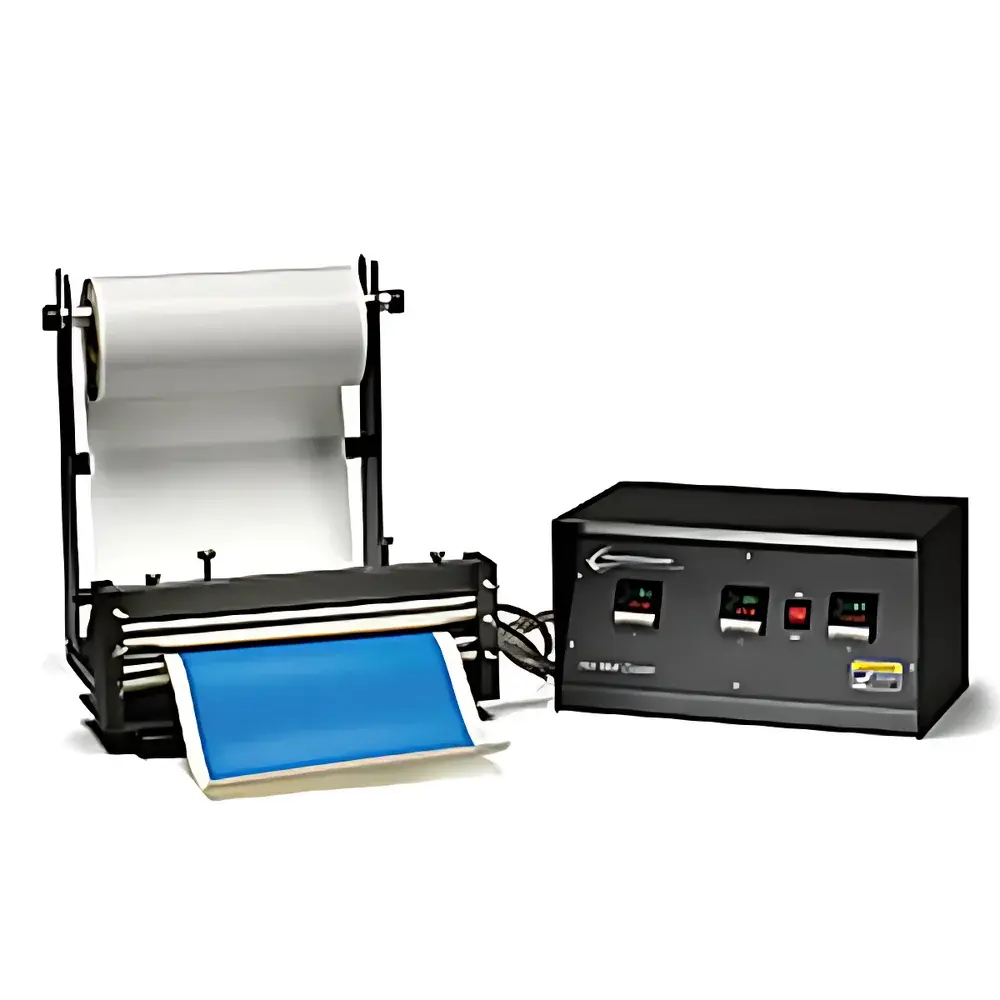
ChemInstruments HLC-101 Hot Melt Laboratory Drawdown Coater
| Origin | USA |
|---|---|
| Manufacturer Type | Authorized Distributor |
| Origin Category | Imported |
| Model | HLC-101 |
| Pricing | Upon Request |
Overview
The ChemInstruments HLC-101 Hot Melt Laboratory Drawdown Coater is an engineered benchtop system designed for reproducible, temperature-controlled application of thermoplastic hot melt adhesives (HMAs) onto flexible substrates. It operates on the knife-over-roll principle—a gravure-adjacent coating methodology where molten adhesive is metered between two precision-ground stainless steel rolls and transferred to a moving web under controlled gap and thermal conditions. Unlike solvent-based or UV-curable systems, the HLC-101 eliminates volatile organic compound (VOC) handling and curing infrastructure, making it ideal for R&D labs and quality control environments requiring rapid iteration of adhesive formulations, substrate compatibility testing, and thickness-dependent bond performance evaluation. Its modular architecture supports seamless integration with complementary equipment—including the ChemInstruments Benchtop Laboratory Laminator—enabling end-to-end label construction workflows from adhesive deposition through lamination.
Key Features
- Precision dual-roll coating head: Two 303 stainless steel rolls, ground to ≤0.5 µm surface finish, ensure uniform shear history and minimal adhesive degradation during metering.
- Triple-zone PID temperature control: Independent controllers regulate the adhesive reservoir (up to 204 °C), transfer roll zone, and coating head—each maintaining ±1 °C stability across the operational range (60–204 °C).
- Adjustable coating width: Teflon-coated edge guides support variable web widths from 70 mm to 300 mm; length is unconstrained by machine geometry, accommodating extended web runs for statistical process validation.
- High-resolution wet-film thickness control: Mechanically indexed gap adjustment enables precise coating mass targeting from 25 g/m² to 1,500 g/m²—calibrated via gravimetric verification per ASTM D1359 and ISO 2808 Annex B.
- Robust thermal management: Three 500 W cartridge heaters integrated into the 125 g-capacity aluminum alloy reservoir (anodized for corrosion resistance) provide rapid melt initiation and stable thermal hold during continuous operation.
- Modular mechanical design: Includes unwind stand, heated reservoir, dual-roll applicator, and optional pneumatic 3-inch mandrel with braking mechanism for tension-sensitive webs.
Sample Compatibility & Compliance
The HLC-101 accommodates a broad spectrum of thermoplastic substrates—including PET, PP, PE, paper, foil, and nonwovens—as well as reactive HMAs (e.g., polyurethane-based moisture-cure systems) and ethylene-vinyl acetate (EVA) formulations. All wetted components comply with FDA 21 CFR §177.1520 for indirect food contact applications when used with compliant adhesives. The system’s thermal control architecture meets IEC 61000-6-2 (EMC immunity) and IEC 61000-6-3 (EMC emission) standards. Temperature logging functionality supports GLP/GMP-aligned data integrity requirements when paired with validated external recording software.
Software & Data Management
While the HLC-101 operates via analog/manual interface for maximum operational simplicity and regulatory transparency, its three independent temperature zones are equipped with RS-485 Modbus RTU outputs (optional adapter kit available). This enables integration with LabVIEW, MATLAB, or SCADA platforms for time-synchronized thermal profiling, audit trail generation, and automated calibration verification. All temperature setpoints and real-time readings are traceable to NIST-traceable reference thermocouples (Type K, Class 1), supporting 21 CFR Part 11-compliant electronic record retention when deployed with validated third-party data acquisition systems.
Applications
- Rapid screening of HMA rheology–substrate adhesion relationships under elevated temperature conditions.
- Development of pressure-sensitive label constructions requiring precise coat-weight repeatability (e.g., tamper-evident, repositionable, or high-tack specialty labels).
- QC release testing of incoming adhesive batches against target viscosity–temperature profiles (measured offline via rotational rheometry).
- Accelerated aging studies correlating initial coat weight distribution with long-term delamination onset (per ASTM D3330 and FINAT FTM 2).
- Process parameter mapping for scale-up to pilot or production-scale roll-to-roll coaters.
FAQ
What is the minimum recommended web speed for consistent coating uniformity?
For hand-drawn operation, consistent results are achieved at linear speeds ≥0.3 m/min; automated drive modules (sold separately) support speeds up to 5 m/min with servo-controlled tension feedback.
Can the HLC-101 handle filled or pigment-loaded hot melts without clogging?
Yes—provided particle size remains <25 µm and filler loading does not exceed 30 wt%, the dual-roll geometry and heated flow path prevent sedimentation-induced blockage.
Is calibration documentation provided with the instrument?
Each unit ships with a factory calibration certificate covering temperature sensors and mechanical gap indexing, traceable to ISO/IEC 17025-accredited laboratories.
What maintenance intervals are recommended for sustained accuracy?
Roll surface inspection and light polishing every 200 operating hours; reservoir cleaning after each adhesive change using approved thermal solvents (e.g., mineral spirits or d-limonene); annual PID controller verification.
Does the system support nitrogen purging for oxygen-sensitive adhesives?
A custom inert-gas manifold port can be added to the reservoir cover upon request, enabling controlled N₂ blanket operation during processing of thermally labile formulations.




