
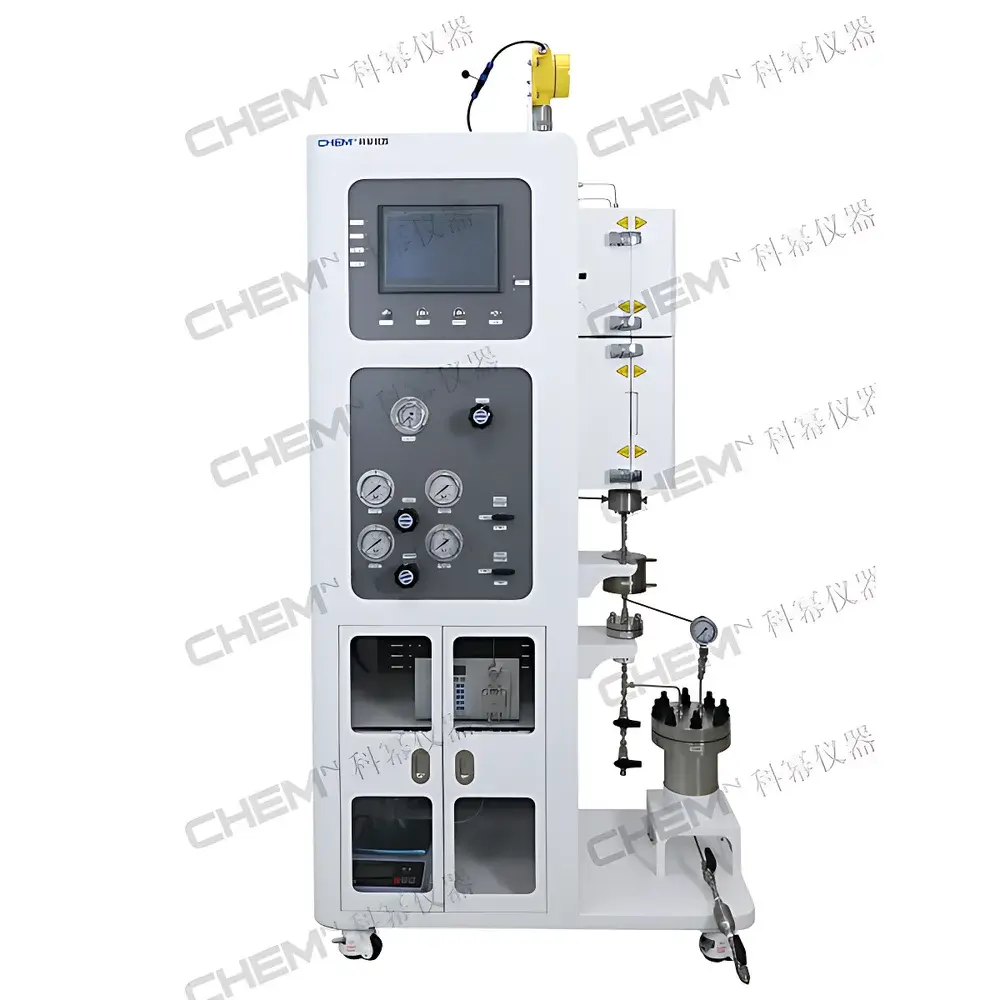
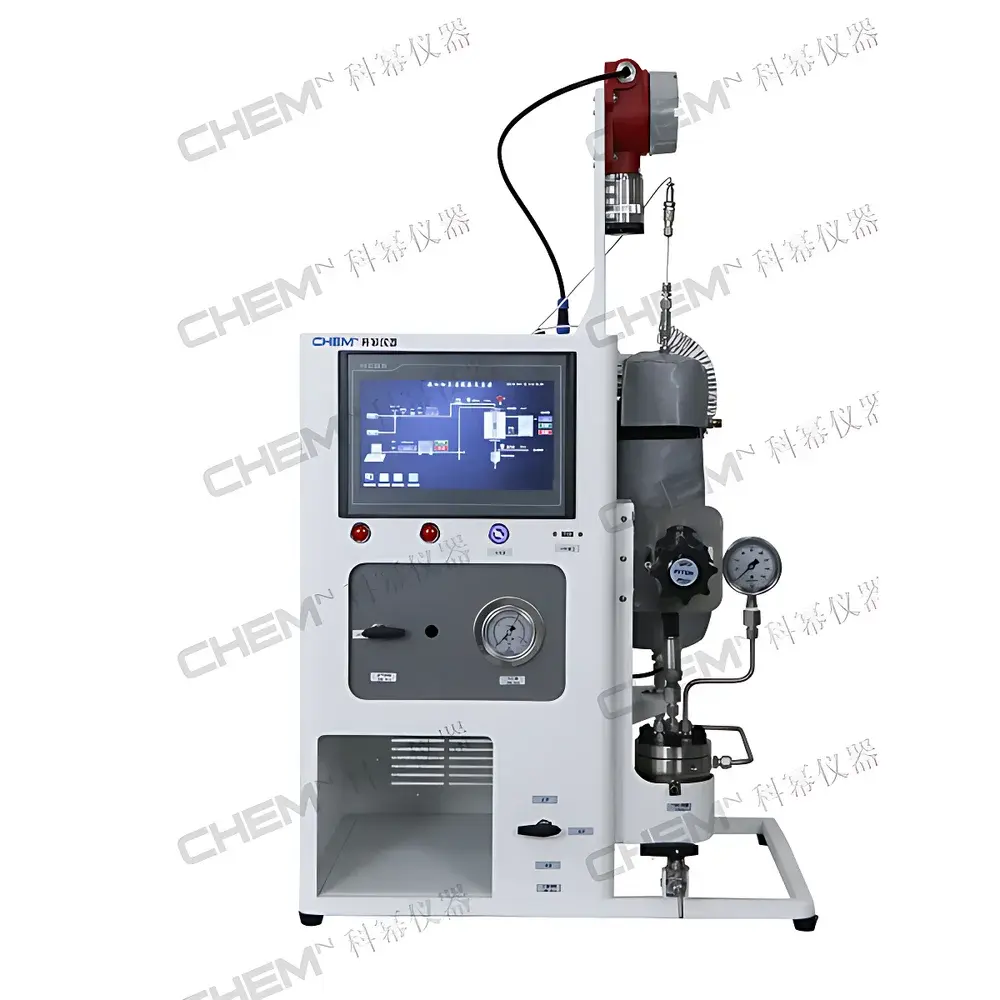
Chemn KMCFRF-L2G3-300 Liquid-Phase Hydrogenation Fixed-Bed Catalyst Evaluation System
| Brand | Chemn |
|---|---|
| Origin | Anhui, China |
| Manufacturer Type | Authorized Distributor |
| Country of Origin | China |
| Model | KMCFRF-L2G3-300 |
| Pressure Rating | 10 MPa |
| Maximum Reaction Temperature | 300 °C |
| Catalyst Bed Volume | 1–5 mL |
| Heating Configuration | Triple-Zone Electric Furnace (for main reactor) / Oil-Jacketed Bath (for desktop variant) |
| Control Interface | 10.1″ TFT Touchscreen + PC-Based Remote Software |
| Safety Compliance | Dual-Stage Over-Temperature/Over-Pressure Interlock, Real-Time H₂ & Combustible Gas Monitoring |
| Modularity | Fully Modular Reactor Tube, Customizable Length & ID |
| Online Sampling | Integrated Liquid Phase Online Sampling Valve System |
| Remote Operation | Yes, via Ethernet-connected SCADA-grade control software |
Overview
The Chemn KMCFRF-L2G3-300 is a high-integrity, bench-scale fixed-bed catalyst evaluation system engineered for quantitative kinetic and stability assessment under liquid-phase hydrogenation conditions. It operates on the principle of continuous-flow heterogeneous catalysis, where gaseous H₂ and liquid-phase reactants co-feed through a packed catalyst bed under precisely controlled temperature, pressure, and residence time. The system supports fundamental studies in CO₂ hydrogenation to methanol or C₂₊ oxygenates, CO hydrogenation (e.g., Fischer–Tropsch synthesis), and selective hydrogenation of unsaturated organic compounds (e.g., nitroarenes, alkenes, carbonyls) in solvent media. Its dual-pressure architecture—comprising independent high-pressure (up to 10 MPa) and ambient-pressure subsystems—enables rigorous thermodynamic and mass-transfer characterization across wide operating envelopes. The reactor core employs Couette-type flow geometry with minimal dead volume (< 0.15 mL), ensuring high fidelity in residence time distribution (RTD) and eliminating lag-phase artifacts during transient response experiments.
Key Features
- Triple-zone electric furnace (main reactor) or oil-jacketed bath (desktop configuration), delivering ±0.5 °C thermal uniformity within a 50 mm isothermal zone at 300 °C
- Integrated preheater module featuring vaporization chamber and static mixing coil for complete liquid feed汽化 and homogeneous gas–liquid pre-mixing prior to catalyst bed entry
- Modular fixed-bed reactor tube (standard 1/4″ OD SS316L) with customizable length (50–300 mm) and internal diameter (3–8 mm), enabling precise catalyst loading (1–5 mL) and tailored L/D ratios
- Dual-stage safety interlock: real-time monitoring of temperature, pressure, and combustible gas concentration (H₂, CH₄) with programmable alarm thresholds and automatic shutdown (valve closure, heater deactivation, vent activation)
- 10.1″ industrial-grade TFT touchscreen HMI with animated process flow diagram, data logging (1 Hz resolution), and intuitive parameter mapping for flow rates, setpoints, and alarm states
- High-purity fluid handling: Swagelok® or Parker Autoclave threaded fittings, bellows-sealed needle valves, and Hastelloy-C276 wetted parts for H₂ compatibility and long-term corrosion resistance
Sample Compatibility & Compliance
The KMCFRF-L2G3-300 accommodates a broad spectrum of solid catalysts—including supported metals (Pd/C, Ru/TiO₂, Ni/Al₂O₃), metal oxides (Cu/ZnO/Al₂O₃), and structured monoliths—under representative process conditions. Liquid feeds include water, alcohols, esters, and aromatic solvents; gaseous feeds cover H₂, CO, CO₂, N₂, and synthetic syngas mixtures. All pressure-retaining components conform to ASME B31.3 Process Piping standards and PED 2014/68/EU Category IV requirements. Temperature and pressure transducers are NIST-traceable and certified to IEC 61508 SIL 2 for functional safety. Data acquisition meets FDA 21 CFR Part 11 requirements for electronic records and signatures when operated with optional audit-trail-enabled software.
Software & Data Management
Control and data acquisition are managed via Chemn’s proprietary CatalystLab™ software suite, deployable on Windows-based engineering workstations. The software provides closed-loop PID control of up to six independent process variables (H₂ flow, liquid pump rate, three-zone temperatures, system pressure), synchronized with timestamped acquisition of >20 analog/digital signals. Raw data export is supported in CSV, HDF5, and MATLAB .mat formats. Optional modules include reaction kinetics modeling (Power Law, Langmuir–Hinshelwood fitting), real-time conversion/yield calculation, and GLP-compliant electronic lab notebook (ELN) integration. Remote access is secured via TLS 1.2 encrypted WebSocket tunneling, supporting simultaneous multi-user supervision from off-site locations.
Applications
- Kinetic parameter estimation (TOF, Ea, adsorption constants) for liquid-phase hydrogenation reactions under industrially relevant pressures (0.1–10 MPa)
- Catalyst deactivation profiling via time-on-stream (TOS) analysis over 100+ hours with automated periodic online sampling
- Gas–liquid mass transfer coefficient (kLa) quantification using dynamic step-change methods
- Screening of bifunctional catalysts in cascade reactions (e.g., hydrolysis–hydrogenation of cellulose derivatives)
- Validation of microkinetic models against experimental data under differential and integral reactor conditions
- Method development for ASTM D7941 (catalyst activity testing in low-pressure hydrogenation) and ISO 11540 (catalyst stability under cyclic thermal stress)
FAQ
What is the maximum allowable catalyst bed height for standard operation?
Standard reactor tubes support up to 150 mm bed height; custom configurations extend to 300 mm with reinforced thermal insulation and axial temperature gradient compensation.
Can the system be configured for trickle-bed operation?
Yes—by installing a calibrated distributor plate and adjusting liquid flow dynamics, the unit supports both fixed-bed and trickle-bed hydrodynamic regimes per ASTM D7213.
Is third-party calibration documentation provided with shipment?
Each unit ships with factory calibration certificates for all pressure transducers (0–12 MPa range), RTDs (–20 to 350 °C), and mass flow controllers (H₂: 0–500 sccm, N₂: 0–2000 sccm), traceable to national metrology institutes.
Does the software support automated method sequencing for unattended overnight runs?
Yes—CatalystLab™ includes scriptable sequence engines that execute multi-step protocols (e.g., ramp-hold-pulse-sampling cycles) with full fault recovery logic and email/SMS alerting.
What materials are used for the high-pressure reactor tube and end fittings?
Reactor tube: Seamless SS316L or Inconel 625 (optional); end fittings: Swagelok® SS-4S6M or Parker Autoclave 1/4″ VCO™ with gold-plated copper gaskets for H₂ service.



