
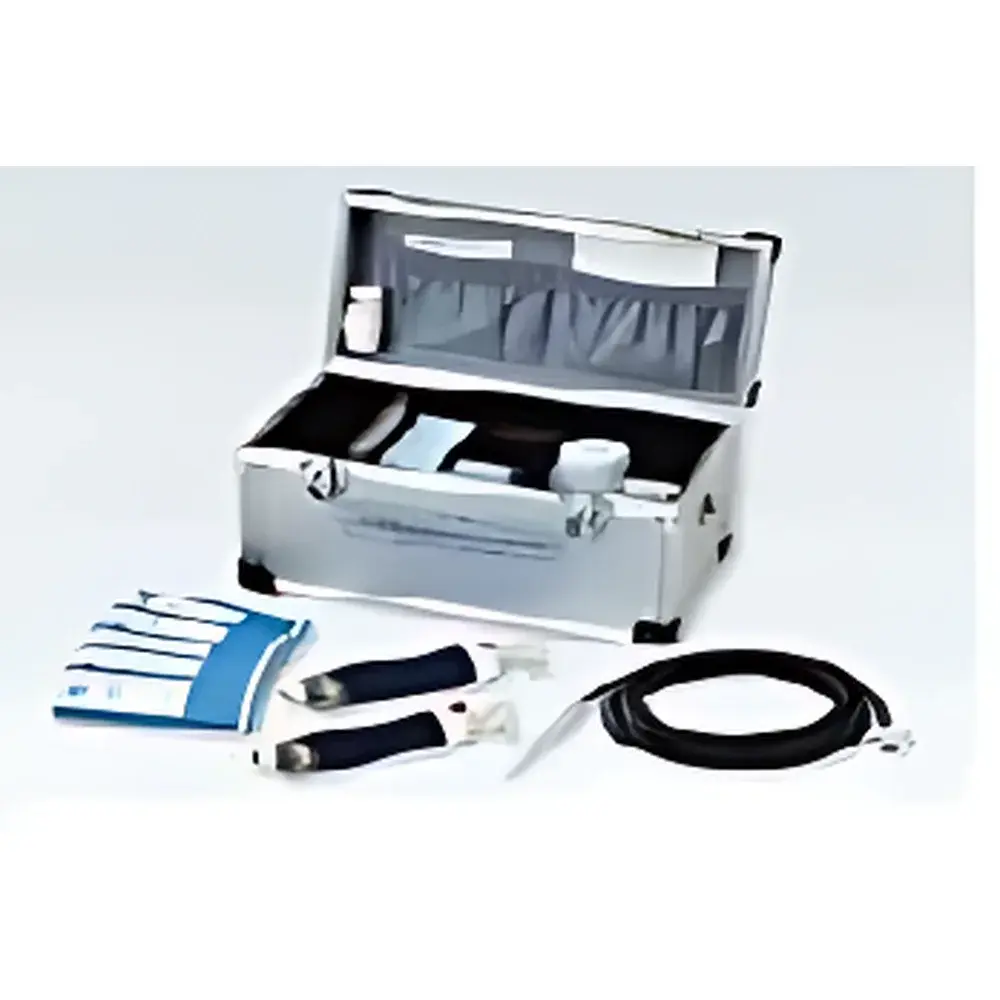
ChemSafe™ Nuclear & Chemical Emergency Response Detection Kit
| Origin | Beijing, China |
|---|---|
| Manufacturer Type | Authorized Distributor |
| Regional Origin | Domestic (PRC) |
| Pricing | Available Upon Request |
| Radiation Detection Capabilities | X-ray, γ-ray, α-particle, β-particle |
| Gas Sampling Volume | 100 mL per draw |
| Detection Tube Length | Standard 100–150 mm |
| Enclosure Material | Anodized Aluminum Alloy (IP65-rated) |
| Weight (Fully Loaded) | ~8.2 kg |
Overview
The ChemSafe™ Nuclear & Chemical Emergency Response Detection Kit is a field-deployable, integrated rapid-assessment system engineered for first responders, HAZMAT teams, civil defense units, and industrial safety personnel operating in high-risk CBRN (Chemical, Biological, Radiological, Nuclear) environments. Unlike laboratory-based analytical platforms, this kit employs colorimetric gas detection tubes—calibrated glass ampoules containing reagent-coated silica gel—and solid-state radiation survey instrumentation to deliver immediate qualitative and semi-quantitative hazard identification without electrical power, network connectivity, or consumable gases. Its operational principle relies on stoichiometric reaction kinetics (for chemical vapors) and ionization chamber detection (for ionizing radiation), enabling real-time triage decisions during time-critical incidents such as chemical spills, clandestine lab exposures, radiological dispersal device (RDD) events, or confined-space entry assessments. Designed in accordance with IAEA Safety Standards Series No. RS-G-1.7 and aligned with OSHA 29 CFR 1910.120 (HAZWOPER) field screening requirements, the system prioritizes operator safety, method reproducibility, and regulatory traceability.
Key Features
- Modular, All-in-One Field Deployment: Compact anodized aluminum enclosure (480 × 360 × 180 mm) houses all components—including dual AP-20 manual piston pumps, SH-5N 5-meter remote sampling probe, precision tube cutter, spent-tube containment vessel, and full-face respirator—ensuring rapid mobilization and minimal setup time.
- Dual-Mode Hazard Identification: Simultaneous chemical vapor analysis via >120 certified colorimetric detection tubes (e.g., Cl₂, NH₃, H₂S, CO, NO₂, SO₂, organic solvents) and ionizing radiation assessment using a calibrated Geiger-Müller counter capable of distinguishing α, β, γ, and X-ray emissions across energy ranges from 20 keV to 1.5 MeV.
- Intrinsically Safe Operation: Manual air sampling eliminates ignition risks in flammable atmospheres (ATEX Zone 0/1 compatible); no batteries, lasers, or heating elements required—compliant with IEC 60079-0 for explosive environments.
- Quantitative Speed & Repeatability: Each 100 mL air draw yields visual endpoint readings within 30–120 seconds; inter-lot calibration verification ensures ±7–15% measurement uncertainty across specified concentration ranges (per ISO 8519:2021 for colorimetric tube validation).
- Remote Sampling Capability: SH-5N polyether ether ketone (PEEK)-reinforced tubing enables safe probing up to 5 meters from hazardous zones—critical for tank headspace evaluation, sewer line inspection, or post-blast debris assessment.
- Regulatory Documentation Support: Includes bilingual (English/Japanese) operation manuals, standardized job aid diagrams (ISO 20471-compliant), and traceable lot numbers for each detection tube batch—facilitating GLP-aligned recordkeeping and audit readiness.
Sample Compatibility & Compliance
The kit supports direct analysis of ambient air, headspace vapors, and surface-emitted radionuclides without sample preparation. Detection tubes are validated per ASTM D5402 (vapor phase) and ISO 16000-26 (indoor air), covering VOCs, inorganic acids, oxidizers, and asphyxiants at concentrations ranging from 0.1 ppm to 10,000 ppm. Radiation detection complies with ANSI N42.33-2022 (portable radiation detectors) and meets minimum performance criteria outlined in IEC 62401:2012 for emergency response instruments. All components—including the respirator—meet EN 136:2023 (full-face mask) and EN 14387:2016 (gas filter class ABEK-P3). The system is not intended for continuous monitoring but for discrete, event-driven hazard characterization under ISO/IEC 17025-accredited field protocols.
Software & Data Management
This is a hardware-only, non-digital field tool—no embedded firmware, Bluetooth, or cloud interface is included. However, printed reference charts (included in kit) provide linear calibration curves and interference matrices for >120 analytes. Users may document results manually using the standardized reporting templates (per NFPA 472 Annex B) or integrate findings into enterprise EHS platforms (e.g., Intelex, Sphera) via scanned log sheets. Optional QR-coded tube lot labels enable digital traceability when paired with internal LIMS systems. No FDA 21 CFR Part 11 electronic signature functionality is provided, as the system operates outside regulated GxP production environments.
Applications
- Rapid hazard screening prior to hot-work permits or confined-space entry (OSHA 1910.146)
- Post-incident reconnaissance following transportation accidents involving chlorine, ammonia, or hydrocarbon carriers
- Verification of decontamination efficacy after chemical agent exposure (e.g., sarin, VX simulants)
- Baseline radiological surveys near nuclear facilities, scrap metal yards, or medical isotope handling sites
- Environmental due diligence during brownfield redevelopment or mining site assessments
- Field validation of fixed gas detection system alarms (per ISA 84.00.01)
FAQ
What standards govern the accuracy of the colorimetric detection tubes?
Each tube batch undergoes independent verification per ISO 8519:2021, with certificate-of-analysis documentation supplied. Accuracy is defined as ±7–15% of full-scale reading within the stated range, validated against NIST-traceable gas standards.
Can the radiation detector differentiate between natural background and artificial isotopes?
It identifies total count rate and dose rate (µSv/h), but does not perform gamma spectroscopy. Isotope-specific identification requires lab-based HPGe analysis; this unit provides rapid gross activity screening only.
Is the kit suitable for indoor air quality (IAQ) compliance testing?
Yes—for initial screening per ISO 16000-26—but not for final compliance certification, which requires accredited gravimetric or GC-MS methods.
How often must detection tubes be replaced?
Tubes have a shelf life of 24 months from manufacture date (printed on packaging); exposure to humidity >80% RH or temperatures >40°C accelerates reagent degradation.
Does the system include calibration services?
Radiation detector calibration is performed annually by ISO/IEC 17025-accredited labs; gas pump flow rate verification (100 ± 5 mL) is user-performed using the included syringe calibrator before each deployment.







