
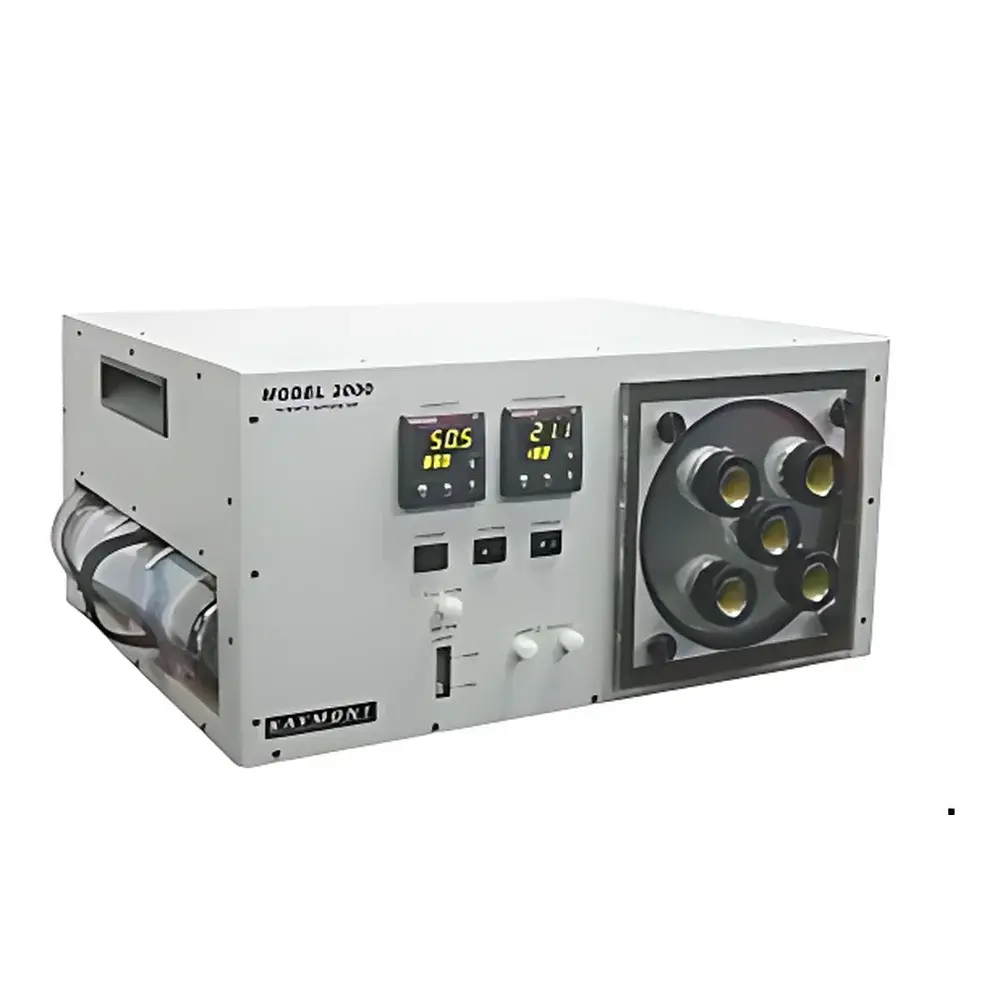
ChemTron M-2000 Precision Humidity and Temperature Calibration Chamber
| Brand | ChemTron |
|---|---|
| Origin | Germany |
| Model | M-2000 |
| Instrument Type | Humidity & Temperature Calibration Chamber |
| Humidity Range | 10–95 %RH (at 23 °C) |
| Temperature Range | 10–50 °C |
| Humidity Accuracy | ±1 %RH (10–90 %RH), ±2 %RH (>90 %RH) |
| Temperature Accuracy | ≤±0.2 °C |
| Chamber Humidity Stability | ±0.2 %RH (20–25 °C) |
| Chamber Temperature Stability | ±0.1 °C |
| Chamber Humidity Uniformity | ±0.3 %RH |
| Chamber Temperature Uniformity | ±0.2 °C |
| Humidity Setpoint Response Time (Δ30 %RH) | <10 min |
| Cooling Rate | 1.0 °C/min (ambient 23 °C) |
| Heating Rate | 3.0 °C/min (ambient 23 °C) |
| External Gas Flow Rate | up to 3 L/min (requires external temperature-stable loop) |
| Dimensions (W×D×H) | 450 × 360 × 210 mm |
| Net Weight | 13 kg |
| Digital Interface | RS232 / RS485 (optional) |
| Calibration Certificate | NVLAP-accredited |
| Reference Standard | Dual-Pressure Humidity Generator |
Overview
The ChemTron M-2000 is a compact, high-stability humidity and temperature calibration chamber engineered for metrological traceability in laboratory and quality assurance environments. Unlike conventional saturated salt systems or large-scale humidity generators, the M-2000 employs a closed-loop, microprocessor-controlled thermohygrometric system that directly regulates relative humidity (RH) and air temperature within a precisely defined test chamber—eliminating reliance on empirical conversion formulas and associated uncertainty propagation. Its operational principle integrates Peltier-based active cooling/heating with precision capacitive RH sensing and platinum RTD temperature measurement, enabling rapid equilibration (<10 minutes for Δ30 %RH) and long-term stability (≤±0.2 %RH at 20–25 °C). Designed for compliance with ISO/IEC 17025 requirements for calibration laboratories, the M-2000 serves as a primary reference standard for verifying hygrometers, data loggers, environmental monitoring probes, and continuous emission monitoring sensors under controlled, repeatable conditions.
Key Features
- Direct RH control architecture—no dew point or vapor pressure conversion required, minimizing systematic error sources
- High-resolution stability: ±0.1 °C temperature uniformity and ±0.2 %RH humidity stability over 20–25 °C operating range
- Fast dynamic response: achieves ±0.3 %RH setpoint deviation within <10 minutes for 30 %RH step changes
- Factory-calibrated dual-sensor system with annual RH drift <1 %RH (verified per IEC 60751 and ISO 8503-2)
- Modular external gas recirculation capability (up to 3 L/min) compatible with JULABO and other certified thermostatic loops
- Optional RS232/RS485 digital interface supporting SCPI command protocol for integration into automated calibration workflows
- Five standardized probe ports (Ø25, Ø18, Ø15, Ø5 mm) enabling simultaneous multi-instrument validation
- NVLAP-accredited calibration certificate supplied with each unit (Lab Code: 200605-0)
Sample Compatibility & Compliance
The M-2000 accommodates a broad range of humidity and temperature sensing devices—including capacitive, resistive, chilled-mirror, and polymer-film hygrometers—as well as standalone data loggers, HVAC transmitters, and pharmaceutical environmental monitoring probes. Its chamber geometry and airflow design comply with ASTM E2234 (“Standard Practice for Calibration of Hygrometers”) and ISO 17025:2017 Clause 6.4.3 regarding environmental condition control during calibration. All factory calibrations are traceable to NIST via dual-pressure humidity standards operated in accordance with ISO 8503-1 and VDI/VDE 3541. The instrument meets CE marking requirements under the EU Measuring Instruments Directive (MID 2014/32/EU) for Class II humidity standards and supports GLP/GMP audit readiness through configurable data logging and user-accessible calibration history.
Software & Data Management
The optional ChemTron CalControl™ software provides full remote operation via RS232/RS485, enabling programmable ramp-and-soak profiles, real-time parameter visualization, and automated report generation compliant with FDA 21 CFR Part 11 (electronic signatures, audit trail, role-based access). Raw sensor outputs—including chamber RH, temperature, and external loop feedback—are timestamped at 1 Hz resolution and exportable in CSV or XML formats. For integration into enterprise LIMS or MES platforms, the device supports Modbus RTU protocol and includes configurable alarm thresholds with relay output for out-of-specification event notification. All calibration events are logged with operator ID, date/time stamp, environmental metadata, and uncertainty budget documentation per GUM (JCGM 100:2008).
Applications
- Primary calibration of portable and fixed-mount hygrometers in accredited metrology labs
- Periodic verification of environmental monitoring systems in cleanrooms (ISO 14644-1), pharmaceutical manufacturing (EU GMP Annex 1), and vaccine cold chain logistics
- Validation of humidity sensors used in stability testing chambers (ICH Q5C) and accelerated aging studies
- Traceable inter-laboratory comparison exercises coordinated under EURAMET or APMP frameworks
- Research-grade characterization of novel humidity-sensitive materials and thin-film sensors
- Supporting ISO/IEC 17025 internal audits through documented uncertainty budgets and stability trend analysis
FAQ
What reference standard is used for factory calibration of the M-2000?
The M-2000 is calibrated against a dual-pressure humidity generator traceable to NIST SRM 2370, with uncertainty contributions evaluated per GUM (JCGM 100:2008) and reported in the included NVLAP certificate.
Can the M-2000 be used for calibrating dew point meters?
Yes—the chamber’s direct RH control allows derivation of dew point values at any temperature within its operating range (10–50 °C); however, for primary dew point calibration, users should cross-validate against a chilled-mirror reference per ISO 8503-3.
Is external temperature stabilization mandatory for recirculation mode?
Yes—external loop temperature must remain stable within ±0.1 °C to maintain chamber humidity accuracy; integration with JULABO FP50 or similar thermostats is recommended and validated.
Does the M-2000 support automated calibration sequences per ISO 17025 requirements?
Yes—when paired with CalControl™ software and optional digital interface, it enables fully auditable, script-driven calibration protocols with electronic signatures, version-controlled procedures, and automatic uncertainty propagation.
How frequently is recalibration recommended?
Annual recalibration is advised under normal use; however, stability monitoring using internal reference checks every 3 months is recommended to verify ongoing performance against initial NVLAP-certified specifications.



