
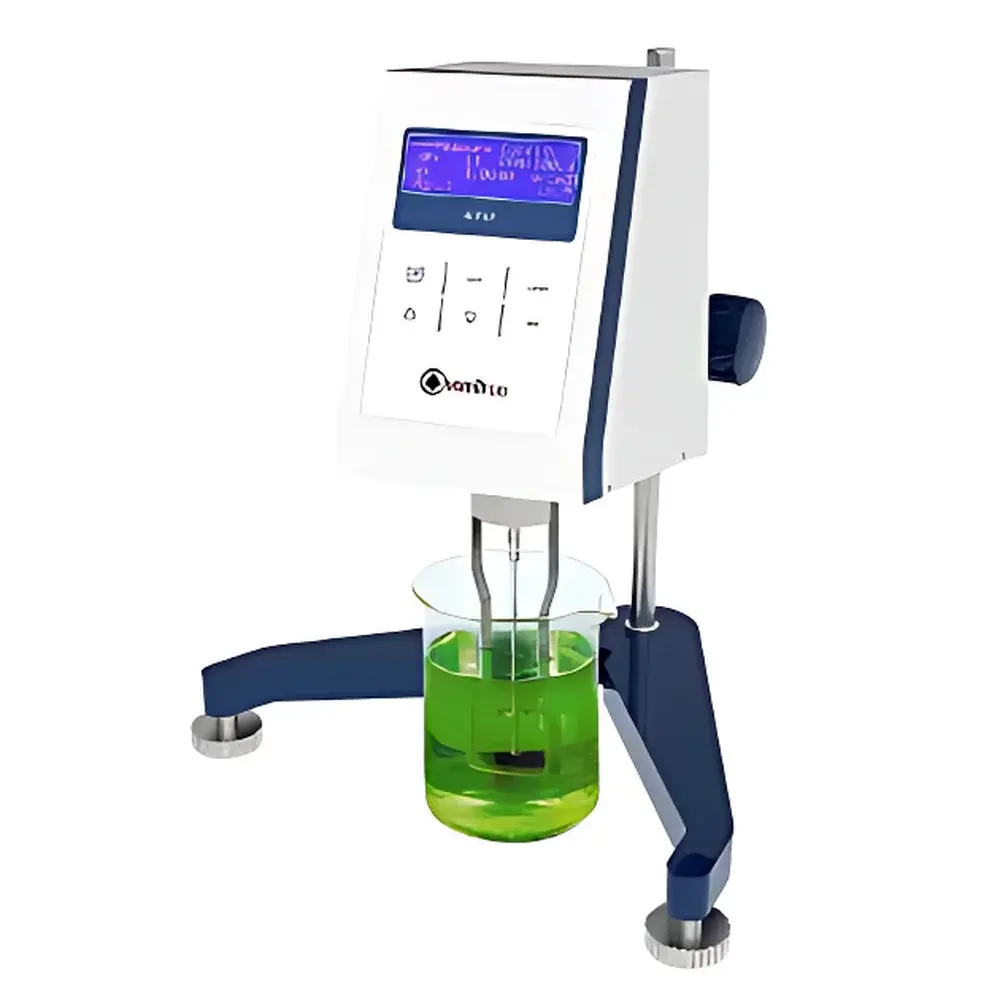
ChemTron ALPHA Standard Rotational Viscometer
| Brand | ChemTron |
|---|---|
| Origin | Germany |
| Model | ALPHA |
| Instrument Type | Benchtop Rotational Viscometer |
| Viscosity Range | 60 – 40,000,000 cP |
| Temperature Range | 0–100 °C |
| Temperature Resolution | 0.1 °C |
| Temperature Accuracy | ±0.1 °C |
| Speed Range | 0.3–100 rpm |
| Speed Steps | 18 |
| Viscosity Accuracy | ±1% of full scale |
| Viscosity Repeatability | ±2% of full scale |
| Display Resolution | 0.01–1 cP |
| Power Supply | 100–240 V AC, 50/60 Hz |
| Interface | USB-B |
| Compliance | CE, RoHS |
| Language Support | 7 languages (including English, German, French, Spanish, Italian, Chinese, Japanese) |
Overview
The ChemTron ALPHA Standard Rotational Viscometer is a benchtop instrument engineered for precision measurement of dynamic viscosity in Newtonian and non-Newtonian fluids under controlled temperature conditions. Based on the principle of rotational viscometry—applying a defined torque to a spindle immersed in the sample and measuring the resulting angular velocity—the ALPHA delivers reliable shear-dependent rheological data across a broad viscosity spectrum (60–40,000,000 cP). Its robust architecture supports routine quality control, R&D validation, and process development in chemical, pharmaceutical, food, polymer, and coatings laboratories. Designed for operational stability at elevated temperatures up to 100 °C, the system integrates a high-resolution Peltier or external bath-compatible temperature interface (sensor optional), enabling thermally sensitive viscosity profiling in compliance with ASTM D2196, ISO 2555, and USP .
Key Features
- Continuous speed adjustment from 0.3 to 100 rpm across 18 discrete steps, ensuring optimal shear rate selection for diverse fluid behaviors.
- Integrated LCD display showing real-time viscosity (cP or mPa·s), apparent viscosity, kinematic viscosity (cSt), shear stress & shear rate (with coaxial rotor option), temperature, rotor ID, % full-scale reading, and measurement confidence indicator.
- Dual auto-stop modes: torque-limited termination (user-defined target torque) and time-limited acquisition (programmable duration up to 999 seconds), enhancing reproducibility in comparative testing.
- Nine programmable measurement protocols stored onboard—supporting standardized workflows for QC release, batch consistency checks, or multi-point temperature sweeps.
- On-device calibration capability for both viscosity (using certified standard oils) and temperature (via reference sensor), traceable to national metrology institutes.
- USB-B interface for direct data export to PC; compatible with Windows-based data logging software supporting CSV and Excel export, audit trail generation, and GLP-compliant report templates.
- Seven-language UI—including English, German, French, Spanish, Italian, Japanese, and Simplified Chinese—facilitating international lab deployment and multilingual operator training.
Sample Compatibility & Compliance
The ALPHA accommodates a wide range of sample volumes and rheological profiles through interchangeable spindles (L-series for low-viscosity liquids; R/H-series for medium-to-high-viscosity pastes and gels). Optional accessories—including the APM small-sample adapter (0.5–2 mL), LCP ultra-low-viscosity adapter (down to 0.1 cP), and Heldal high-torque adapter—extend method flexibility without hardware replacement. All configurations comply with ISO/IEC 17025 requirements for test equipment verification. Temperature control (0–100 °C, ±0.1 °C accuracy) meets ASTM D445 and ISO 3104 prerequisites for kinematic viscosity derivation when density is entered manually. The unit carries CE marking and RoHS certification, confirming electromagnetic compatibility and hazardous substance restrictions per EU Directive 2014/30/EU and 2011/65/EU.
Software & Data Management
Data acquisition and analysis are supported via ChemTron’s proprietary PC software (included), which enables automated sequence execution, real-time graphing of viscosity vs. time/temperature/shear rate, and statistical evaluation (mean, SD, CV%). Raw datasets include timestamp, ambient conditions, operator ID, and instrument serial number—enabling full traceability. Audit trail functionality satisfies FDA 21 CFR Part 11 requirements for electronic records and signatures when configured with user access controls and digital signature modules. Export formats include .csv, .xlsx, and PDF reports with customizable headers, footers, and logo fields—suitable for internal SOP documentation or regulatory submissions.
Applications
- Pharmaceutical: Viscosity profiling of suspensions, ointments, and injectables per USP ; gelation kinetics of thermo-responsive hydrogels.
- Chemical manufacturing: Quality assurance of resins, adhesives, and surfactant solutions; monitoring polymerization viscosity rise.
- Food & beverage: Texture assessment of sauces, dairy products, and plant-based alternatives under shear-thinning conditions.
- Paints & coatings: Flow behavior analysis during application simulation (e.g., brushing, spraying) via controlled-shear-rate ramps.
- Academic research: Fundamental characterization of yield stress fluids, thixotropic recovery, and temperature-dependent activation energy (via Arrhenius modeling).
FAQ
Does the ALPHA support ASTM D1092 or ISO 3219 compliance?
Yes—when operated with calibrated spindles, validated temperature control, and documented calibration records, the ALPHA fulfills instrumental requirements for these standards.
Can I perform yield stress estimation with this instrument?
Yield stress quantification requires controlled-stress mode and specialized geometry (e.g., vane or serrated parallel plates); the ALPHA operates in controlled-rate mode only. Yield point approximation may be derived indirectly via flow curve extrapolation using optional coaxial rotor sets.
Is temperature control built-in or external?
The base unit does not include integrated heating/cooling; temperature regulation is achieved via external circulation baths or Peltier-based jacketed vessels (sold separately). A Pt100 sensor input port allows direct connection to third-party thermal systems.
What is the minimum sample volume required for standard L1–L4 spindles?
Standard operation requires ≥20 mL for full immersion; the APM adapter reduces this to 0.5 mL with minor trade-offs in low-shear accuracy.
How often should viscosity calibration be performed?
Per ISO/IEC 17025, calibration verification is recommended before each critical test series or daily in high-throughput environments. Full recalibration using NIST-traceable standard oils is advised every 6 months or after mechanical impact.



