
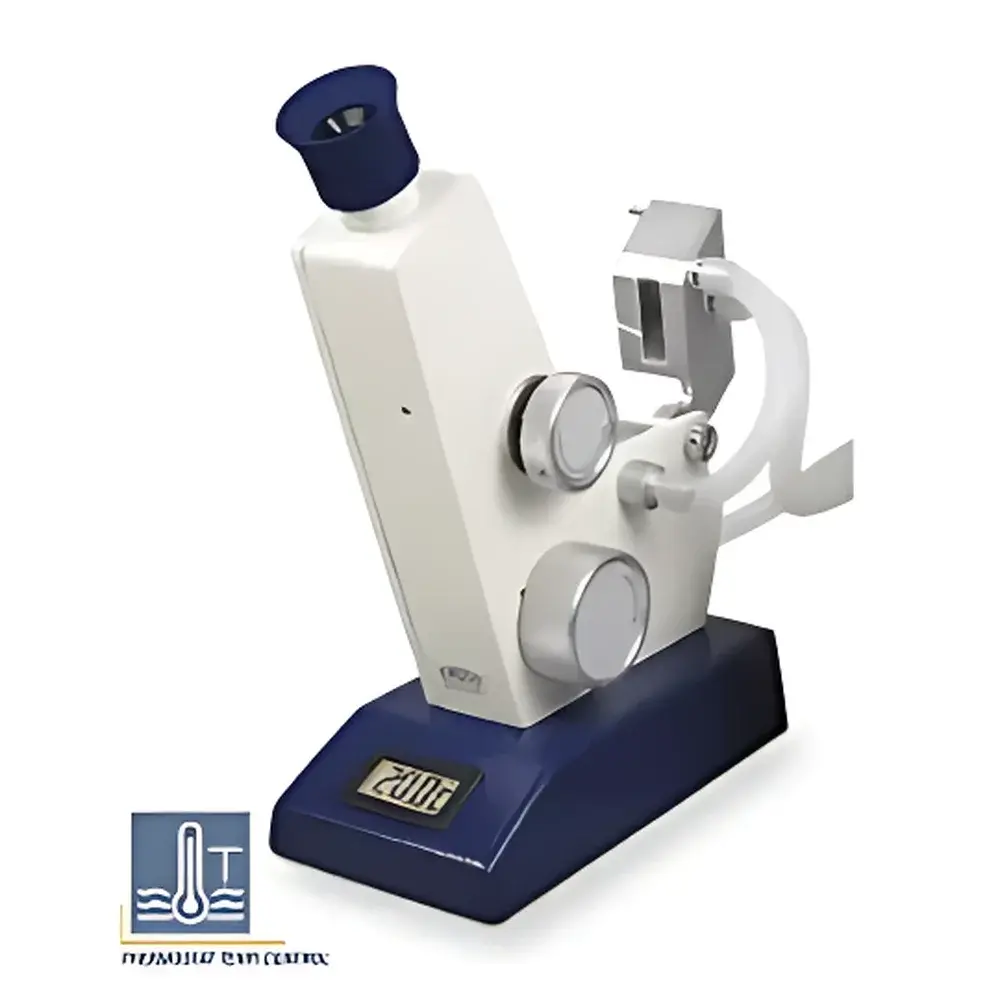
ChemTron AR4 Economical Abbe Refractometer
| Brand | ChemTron |
|---|---|
| Origin | Germany |
| Model | AR4 |
| Product Type | Benchtop Refractometer |
| Temperature Control | Yes |
| Digital Display | No |
| Measurement Range | 1.3000–1.7200 nD |
| Accuracy | ±0.0002 nD |
| Scale Division | 0.0005 nD |
| Temperature Sensor Range | 0–99 °C |
| Light Source | 590 nm LED (Sodium-D Equivalent) |
| Readout Method | Eyepiece with Graduated Scale Window |
| Dimensions | 10.0 × 27.0 × 19.0 cm |
| Weight | 2.5 kg |
| Calibration Standard | ASTM D1218 Compliant Calibration Plate |
Overview
The ChemTron AR4 Economical Abbe Refractometer is a precision optical instrument engineered for reliable, repeatable refractive index (nD) and % Brix measurements in routine laboratory, quality control, and educational environments. Based on the classical Abbe principle—utilizing total internal reflection at the interface between a high-refractive-index glass prism and the sample—the AR4 delivers traceable results without dependence on sample color, turbidity, or viscosity. Its dual-prism design integrates both illumination and measurement prisms within a thermally stabilized assembly, enabling direct coupling to external water baths or Peltier-based thermostats. This architecture ensures minimal thermal drift during extended measurement sessions, critical for compliance with standardized test methods requiring strict temperature control (e.g., ISO 21745, AOAC 932.12, and USP ). The fixed-wavelength 590 nm LED light source replicates the spectral output of a sodium-D line, eliminating spectral variability while offering >100,000 hours of operational lifetime—significantly exceeding traditional sodium vapor lamps.
Key Features
- Optically calibrated Abbe configuration with matched illumination and measuring prisms for consistent critical angle detection
- Integrated temperature-sensing circuitry (0–99 °C range) and dedicated prism cooling ports compatible with standard circulating chillers or water baths
- Mechanically adjustable ocular scale with fine-tuning knob for precise alignment of the shadow boundary line
- Robust all-metal housing with ergonomic benchtop footprint (10.0 × 27.0 × 19.0 cm) and low mass (2.5 kg) for stable placement on vibration-damped surfaces
- ASTM D1218-compliant calibration plate included for field verification and periodic recalibration without third-party intervention
- No electronic display required—optical readout via high-contrast graduated scale window and wide-field eyepiece ensures long-term reliability and zero software dependency
Sample Compatibility & Compliance
The AR4 accommodates a broad spectrum of sample types—including clear liquids, opaque suspensions, viscous pastes, and semi-solid gels—without preprocessing or dilution. Its large prism surface area (≥25 mm²) and shallow sample well geometry permit rapid loading of as little as 0.1 mL per measurement. The absence of digital electronics and reliance on passive optical detection renders it inherently immune to electromagnetic interference and suitable for use in hazardous locations where intrinsic safety is mandated. Regulatory alignment includes support for GLP-compliant documentation workflows through manual logbook entries tied to calibrated reference standards. While not equipped with electronic audit trails, its mechanical calibration traceability satisfies minimum requirements for ISO/IEC 17025-accredited laboratories performing non-automated refractometric analysis.
Software & Data Management
The ChemTron AR4 operates independently of software or computer interfaces. All measurements are recorded manually using the engraved scale and verified against certified reference fluids (e.g., distilled water at 20 °C: nD = 1.3330; sucrose solutions traceable to NIST SRM 84d). Laboratories integrating the AR4 into validated processes may document readings in LIMS or ELN systems via standardized templates aligned with FDA 21 CFR Part 11 Annex 11 principles—specifically, handwritten entries co-signed by analyst and reviewer, accompanied by instrument ID, calibration date, and environmental temperature logs. Optional accessories include a digital thermometer probe (PT100, ±0.1 °C) for concurrent ambient and prism temperature monitoring.
Applications
- Concentration determination of aqueous sugar solutions (Brix) in food, beverage, and biofuel production
- Quality assurance of glycerin, ethylene glycol, and other antifreeze formulations in automotive and HVAC sectors
- Pharmaceutical excipient verification (e.g., propylene glycol, sorbitol syrup) per USP monographs
- Refractive index profiling of polymer melts and resin precursors during R&D screening
- Educational demonstration of dispersion, Snell’s law, and temperature-dependent optical density relationships
- Field-deployable verification of solvent purity in chemical synthesis and extraction workflows
FAQ
What is the recommended calibration frequency for the AR4 under daily use?
For continuous operation in regulated environments, calibration verification using the included ASTM D1218 plate is advised before each shift or at least every 8 hours.
Can the AR4 measure samples above 60 °C directly?
No—sample temperature must be controlled externally; the prism assembly supports thermostatic coupling but does not generate heat. Samples >60 °C require pre-cooling or use of high-temperature-rated circulation systems.
Is the 590 nm LED replaceable by the user?
Yes—the LED module is socketed and field-replaceable using standard ESD-safe tools; replacement parts are supplied with photometric certification.
Does the AR4 comply with pharmacopeial refractometry requirements?
It meets the instrumental specifications outlined in USP and EP 2.2.6 for manual Abbe refractometers, including wavelength fidelity, scale resolution, and temperature correlation protocols.
How is measurement repeatability affected by operator technique?
Inter-operator variation is minimized through standardized focusing procedure and shadow-line alignment protocol; typical RSD across trained users is ≤0.2% for nD and ≤0.4% for Brix under controlled conditions.





