
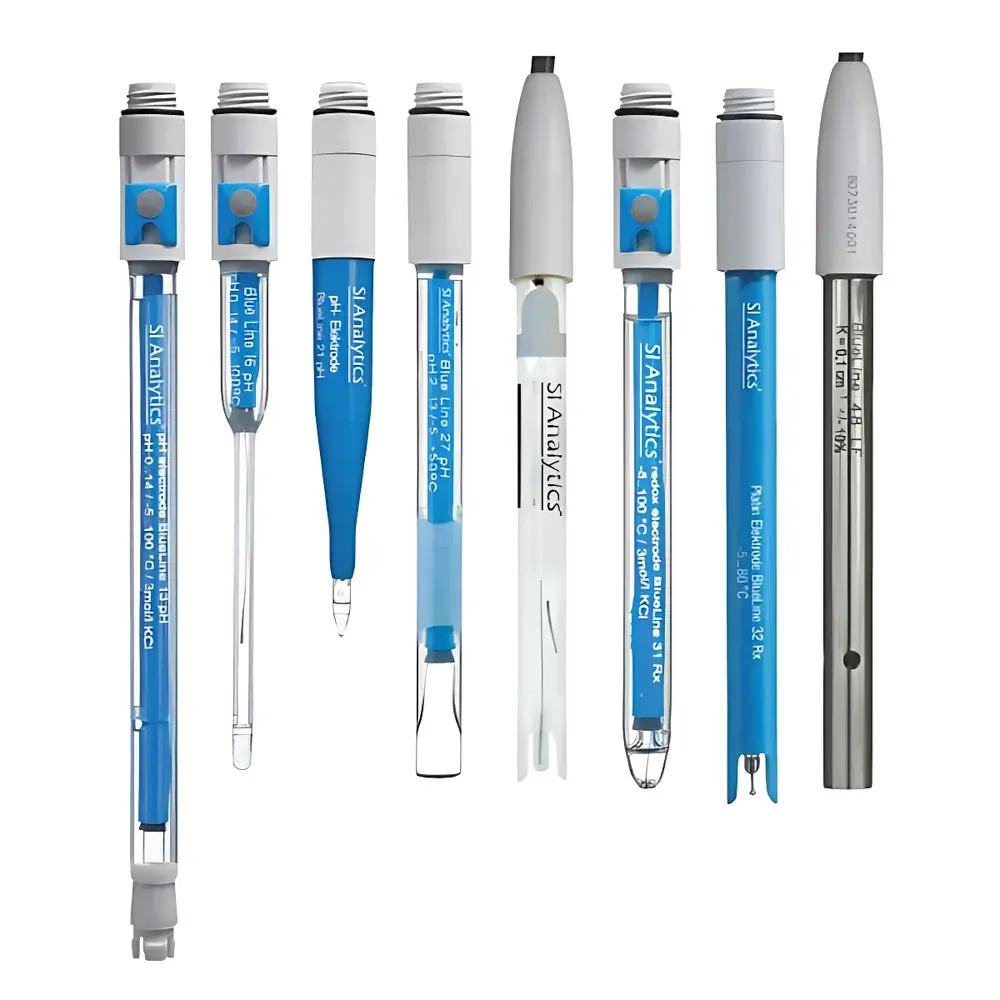
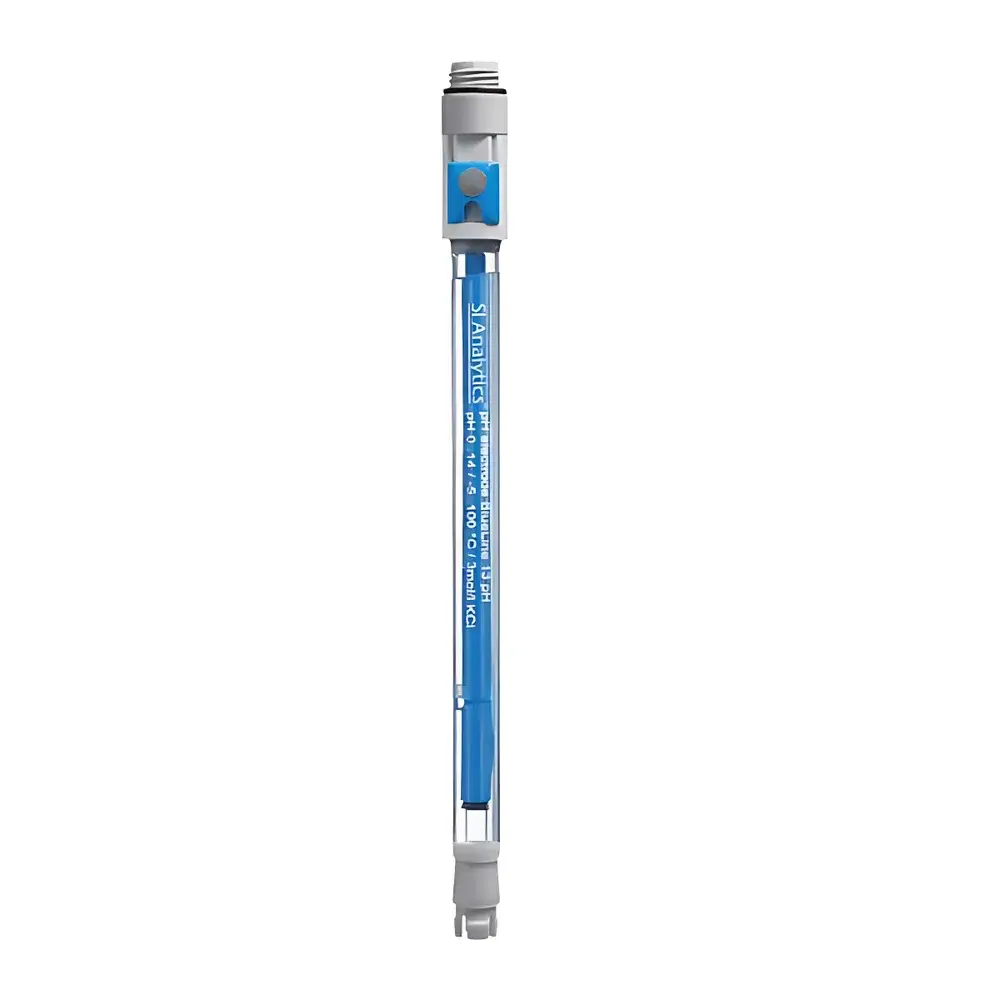
ChemTron BlueLine 13 pH Glass Electrode
| Brand | ChemTron |
|---|---|
| Origin | Germany |
| Model | BlueLine 13 pH |
| Electrolyte | KCl 3 mol/L |
| Reference System | Ag/AgCl spherical |
| Glass Type | A-glass |
| Body Material | Glass |
| Connection | Ground-joint (standard) |
| Total Length | 170 mm |
| Diameter | 12 mm |
| Temperature Range | −5 to +100 °C |
| pH Range | 0–14 |
| Compliance | ISO 8655-4, DIN 19263, ASTM D1293 |
Overview
The ChemTron BlueLine 13 pH Glass Electrode is a high-precision, laboratory-grade pH sensing element engineered for reproducible and stable potentiometric measurements in aqueous and mildly aggressive chemical environments. Based on the Nernst principle, this electrode employs a thin-walled A-type pH-sensitive glass membrane that generates a voltage differential proportional to hydrogen ion activity across the membrane interface. Paired with a robust spherical Ag/AgCl reference system and a saturated KCl (3 mol/L) electrolyte fill solution, the BlueLine 13 delivers rapid response times, low drift (<0.5 mV/h), and excellent long-term stability—critical for routine QC testing, titration endpoint detection, and calibration verification in regulated laboratories. Its ground-joint connection ensures secure, leak-tight integration with standard lab electrodes holders and flow cells, while its all-glass construction provides chemical resistance to most organic solvents, weak acids, and alkaline buffers within its operational pH and temperature envelope.
Key Features
- High-accuracy A-glass membrane optimized for broad pH range (0–14) and minimal alkali error below pH 12
- Spherical Ag/AgCl reference element with stable potential output and low junction potential variability
- 3 mol/L KCl internal electrolyte ensures consistent liquid junction potential and minimizes clogging risk in routine use
- Ground-joint (standard taper) mechanical interface compatible with universal electrode holders, immersion sleeves, and inline process adapters
- Thermal tolerance from −5 °C to +100 °C supports applications in heated digestions, sterilization validation, and environmental sample analysis
- Compliant with ISO 8655-4 (volumetric apparatus — Part 4: pH meters and electrodes) and DIN 19263 (electrochemical sensors for water analysis)
Sample Compatibility & Compliance
The BlueLine 13 is validated for use in aqueous solutions, buffered standards (e.g., pH 4.01, 7.00, 10.01 NIST-traceable), wastewater effluents, pharmaceutical formulations, food extracts, and mild industrial process streams. It is not recommended for non-aqueous media (e.g., pure ethanol or acetone), highly viscous suspensions, or samples containing sulfides, bromides, or iodides at concentrations exceeding 10 ppm—these may poison the Ag/AgCl reference or degrade the glass membrane. For GLP/GMP-regulated workflows, the electrode supports audit-ready documentation via traceable calibration logs and meets essential requirements of USP and EP 2.2.3 for pH measurement system qualification. When used with certified reference materials and calibrated per ASTM D1293 (Standard Test Method for pH of Water), it fulfills data integrity expectations under FDA 21 CFR Part 11 when paired with compliant data acquisition software.
Software & Data Management
While the BlueLine 13 operates as an analog sensor requiring external metering hardware (e.g., pH/mV meters with BNC or DIN inputs), its electrical characteristics—including high input impedance (>1012 Ω), low noise output (<1 µV RMS), and linear mV/pH slope (−59.16 ± 0.5 mV/pH at 25 °C)—are fully compatible with modern benchtop and portable analyzers featuring digital signal processing, automatic temperature compensation (ATC), and GLP-compliant data logging. When integrated into systems supporting sensor identification protocols (e.g., IDS-capable instruments), users benefit from auto-recognition, configuration recall, and firmware-matched calibration templates—reducing operator error and ensuring metrological traceability across multi-user environments.
Applications
- Routine calibration and verification of pH meters in ISO/IEC 17025-accredited testing laboratories
- Monitoring of buffer preparation consistency in biopharmaceutical manufacturing (e.g., cell culture media, purification eluents)
- Environmental compliance testing: surface water, groundwater, and treated wastewater per EPA Method 150.1 and ISO 10523
- Quality control of food and beverage products including dairy, soft drinks, and fermented goods
- Academic research involving kinetic studies where stable baseline potential and minimal thermal hysteresis are required
- Validation of cleaning-in-place (CIP) rinse endpoints in hygienic process equipment
FAQ
What is the recommended storage solution for the BlueLine 13 pH electrode?
Store immersed in 3 mol/L KCl solution or pH 4.01 buffer; never in deionized water or dry conditions.
Can this electrode be used in pressurized flow-through cells?
Yes—its ground-joint design and glass body support static pressures up to 1 bar; for continuous flow, ensure laminar flow rates ≤5 mL/min to avoid membrane stress.
How often should the electrolyte be refilled?
The BlueLine 13 is a sealed, maintenance-free electrode; no refilling is required—the 3 mol/L KCl fill is factory-sealed and designed for ≥12 months of typical lab use.
Does it comply with pharmacopeial requirements for pH measurement?
Yes—when used per USP , EP 2.2.3, and JP 2.05, and calibrated against certified reference standards, it satisfies instrument performance criteria for accuracy (±0.02 pH) and repeatability (±0.01 pH).
Is temperature compensation mandatory during measurement?
Yes—because the Nernst slope is temperature-dependent, accurate ATC using an integrated or co-located NTC sensor (e.g., 30 kΩ at 25 °C) is essential for measurements outside 20–25 °C.
Related Products





