
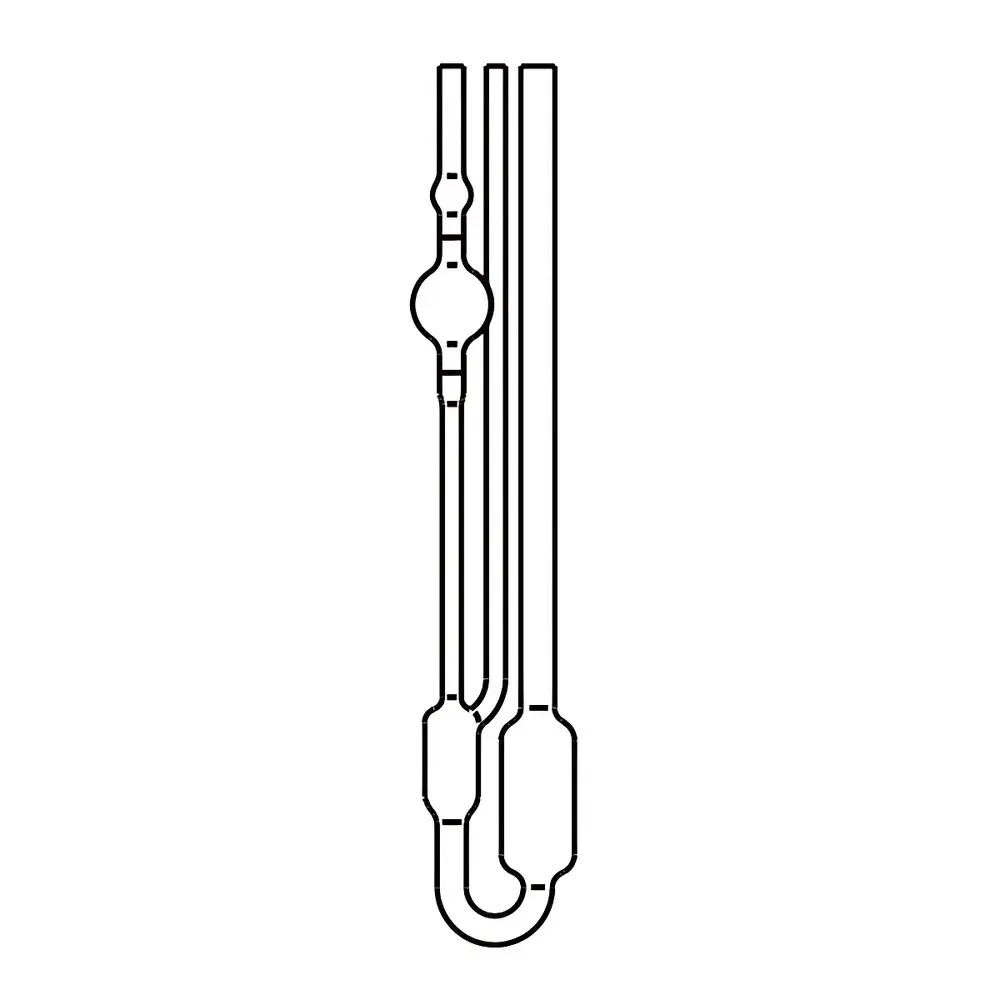
ChemTron CV003-100 / CV003-001 Ubbelohde Capillary Viscometer (DIN/ASTM Compliant)
| Brand | ChemTron |
|---|---|
| Origin | Germany |
| Manufacturer Type | Authorized Distributor |
| Origin Category | Imported |
| Model | CV003-100 / CV003-001 |
| Instrument Type | Portable Capillary Viscometer |
| Operating Environment | Ambient Temperature |
| Viscosity Range | 0.3 – 50,000 mm²/s (cSt) |
| Fill Volume | 11 mL |
| Accuracy | ±0.2% |
| Compliance | DIN 51562-1, ISO 3105, ASTM D445, ASTM D2515, ISO 3104, UNE 400313 |
Overview
The ChemTron CV003-100 and CV003-001 Ubbelohde capillary viscometers are precision-engineered glass instruments designed for the absolute kinematic viscosity measurement of Newtonian liquids via gravity-driven capillary flow. Based on the classical Ubbelohde principle—where fluid drains under gravity through a precisely dimensioned capillary suspended in a constant-temperature bath—the instrument delivers high reproducibility and traceable results essential for quality control, polymer characterization, lubricant specification, and pharmaceutical excipient validation. Unlike single-capillary designs, the Ubbelohde configuration features a separate reservoir arm that isolates the measured volume from hydrostatic pressure fluctuations, ensuring true capillary flow kinetics independent of sample volume. Each unit is individually calibrated against NIST-traceable standards and supplied with an accredited calibration certificate specifying its unique K-value (mm²/s²), enabling direct conversion of efflux time to kinematic viscosity (ν = K × t) per ISO 3105 and ASTM D445 protocols.
Key Features
- Two standardized configurations: DIN-compliant (CV003-100 series) and ASTM-compliant (CV003-001 series), each covering overlapping yet distinct K-value ranges from 0.001 to 100.0 mm²/s²
- Manufactured from borosilicate glass 3.3 (Duran®), resistant to thermal shock and chemical corrosion, with laser-etched scale markings for unambiguous meniscus reading
- Fixed fill volume of 11 mL ensures consistent hydrodynamic conditions across repeated measurements and eliminates volumetric pipetting error
- Integrated timing bulb design enables precise start/stop detection at defined meniscus positions, minimizing operator-dependent timing uncertainty
- Each viscometer is serialized and certified to ±0.2% accuracy against primary reference standards; calibration data includes temperature correction coefficients and uncertainty budget per ISO/IEC 17025
- Compatible with standard thermostatic baths (±0.01 °C stability recommended) and digital timers meeting ASTM D445 timing resolution requirements (0.01 s minimum)
Sample Compatibility & Compliance
These viscometers are validated exclusively for Newtonian fluids—including mineral oils, synthetic lubricants, organic solvents, polymer solutions (at dilute concentrations), and pharmaceutical-grade glycerol or propylene glycol. Non-Newtonian or particulate-laden samples are not suitable due to shear-rate dependence and potential capillary clogging. All models comply with internationally harmonized standards: DIN 51562-1 (German national implementation of ISO 3105), ASTM D445 (Standard Test Method for Kinematic Viscosity of Transparent and Opaque Liquids), ASTM D2515 (for low-viscosity hydrocarbons), and ISO 3104 (petroleum products). The instruments support GLP and GMP environments when used within documented SOPs, including audit-ready calibration records and traceability to national metrology institutes (e.g., PTB, NPL, NIST).
Software & Data Management
While the Ubbelohde viscometer itself is a passive, analog measurement device, ChemTron provides optional digital integration pathways. Compatible third-party timer systems—such as those supporting ASTM D445-compliant automated meniscus detection—can export timestamped efflux data to LIMS or ELN platforms via CSV or OPC UA. For regulated laboratories, ChemTron recommends pairing the CV003 series with 21 CFR Part 11–compliant electronic timers featuring user access controls, electronic signatures, and immutable audit trails. Raw efflux times, bath temperature logs, and calculated kinematic viscosity values must be retained for minimum retention periods defined by ISO/IEC 17025 (typically ≥5 years) and internal quality policies.
Applications
- Quality assurance of base oils and finished lubricants per API, SAE, and OEM specifications (e.g., SAE J300, ACEA)
- Determination of intrinsic viscosity and molecular weight of polymers (e.g., PET, PA6, PEEK) using Huggins or Kraemer extrapolation methods
- Batch release testing of injectables and ophthalmic solutions where viscosity impacts syringeability and droplet formation
- Monitoring thermal degradation of heat-transfer fluids and transformer oils through viscosity drift analysis
- Validation of solvent purity and consistency in fine chemical synthesis workflows
- Academic rheology education: demonstration of Poiseuille’s law, temperature–viscosity relationships (Arrhenius/WLF modeling), and intermolecular force correlations
FAQ
What distinguishes the DIN-type (CV003-100) from the ASTM-type (CV003-001) configuration?
The distinction lies in capillary geometry and nominal K-value assignment conventions: DIN models follow DIN 51562-1 dimensional tolerances and reporting formats, while ASTM models conform to ASTM D445 Annex A1 specifications—including minor differences in timing bulb volume and meniscus positioning criteria.
Can I use the same viscometer for both low- and high-viscosity samples?
No. Each CV003 unit is optimized for a specific K-value range. Selecting a model whose K-value yields efflux times between 100–600 seconds (per ASTM D445) ensures optimal precision; outside this window, timing errors dominate uncertainty.
Is cleaning and drying required between measurements?
Yes. Residual solvent or sample film alters surface tension and effective capillary radius. Recommended protocol: rinse three times with low-viscosity solvent (e.g., acetone), followed by forced-air drying or nitrogen purge; avoid ultrasonic cleaning unless validated for borosilicate glass integrity.
Does ChemTron provide recalibration services?
Yes. ChemTron’s accredited metrology lab offers periodic recalibration with full ISO/IEC 17025–compliant reports, including re-determination of K-value, uncertainty analysis, and verification of dimensional conformity per DIN 51562-1 Annex B.
How is traceability maintained for regulatory submissions?
Each unit ships with a calibration certificate referencing the issuing laboratory’s accreditation number (e.g., DAkkS, UKAS), measurement uncertainty (k=2), and linkage to national standards. Certificates are valid for 12 months under normal use conditions and must be renewed prior to expiry for continued compliance with ISO 9001, ISO 13485, or FDA audits.
Related Products



