
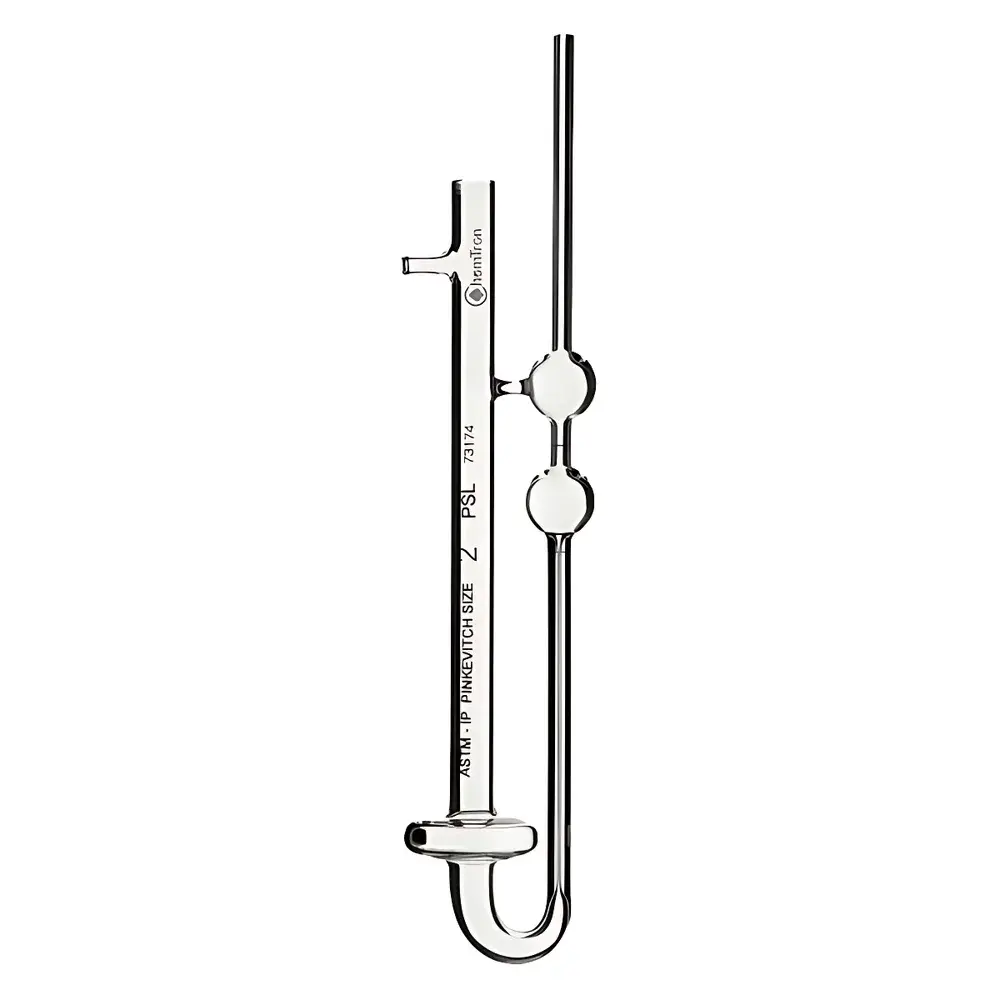
ChemTron CV005-001 Ubbelohde-Type Capillary Viscometer
| Brand | ChemTron |
|---|---|
| Origin | Germany |
| Model | CV005-001 |
| Instrument Type | Portable Capillary Viscometer |
| Viscosity Range | 0.6 – 30,000 mm²/s (cSt) |
| Capillary Diameter | 0.4 mm |
| Compliance | ASTM D445, ISO 3104, ISO 3105, GB/T 265, SH/T 0173 |
| Sample Requirement | Clear, Newtonian or near-Newtonian liquids |
| Operating Environment | Ambient temperature (15–30 °C) |
| Measurement Principle | Gravimetric capillary flow time |
Overview
The ChemTron CV005-001 is a precision-engineered Ubbelohde-type suspended-level capillary viscometer designed for accurate kinematic viscosity determination of transparent, low-to-medium-viscosity liquids. Based on the fundamental principle of Poiseuille flow under gravity-driven laminar conditions, it measures the time required for a fixed volume of liquid to flow between two precisely marked points in a calibrated glass capillary tube. The kinematic viscosity (ν, in mm²/s or cSt) is calculated using the formula ν = C × t, where C is the instrument constant (determined by calibration with certified reference oils) and t is the efflux time in seconds. This method conforms strictly to internationally recognized standards including ASTM D445, ISO 3104, ISO 3105, GB/T 265, and SH/T 0173—making it suitable for quality control laboratories operating under ISO/IEC 17025, GLP, or regulated manufacturing environments requiring traceable, repeatable viscosity data.
Key Features
- Ubbelohde geometry ensures constant hydrostatic head during efflux, eliminating dependence on sample volume and enabling highly reproducible measurements across operators and instruments.
- Manufactured in Germany to stringent optical and dimensional tolerances; each capillary is individually calibrated and supplied with a traceable certificate of calibration referencing NIST-traceable standard oils.
- Available in 13 interchangeable capillary sizes (CV005-001 to CV005-013), covering a total kinematic viscosity range from 0.6 to 30,000 mm²/s—enabling selection of optimal shear rate and measurement time for specific sample classes.
- Designed for benchtop or portable use: lightweight borosilicate glass construction, no power supply or electronics required, ideal for field testing, production line verification, or educational labs.
- Optimized for clarity-critical applications—only suitable for optically clear, particle-free liquids to ensure unambiguous meniscus detection and minimize scattering-related timing errors.
- Integrated thermal expansion compensation via standardized water bath immersion (±0.02 °C stability recommended), ensuring compliance with temperature-dependent viscosity reporting requirements per ISO 3104.
Sample Compatibility & Compliance
The CV005-001 is validated for use with Newtonian and pseudo-Newtonian fluids—including mineral oils, lubricants, solvents, fuels, light polymers, and pharmaceutical excipients—provided they are free of suspended solids, air bubbles, or haze. It is not suitable for opaque, thixotropic, or highly non-Newtonian samples. All models meet the dimensional and procedural specifications defined in ISO 3105 (glass capillary viscometers for kinematic viscosity) and ASTM D445 (standard test method for kinematic viscosity of transparent and opaque liquids). Calibration certificates include uncertainty budgets per ISO/IEC 17025 Annex A, and routine verification aligns with internal QC protocols supporting FDA 21 CFR Part 11–aligned documentation practices when paired with compliant timing systems.
Software & Data Management
While the CV005-001 operates as a standalone mechanical instrument, its integration into digital workflows is supported through third-party timing systems (e.g., automated phototimer units or smartphone-based high-speed video analysis) that log efflux times with timestamping, operator ID, and environmental metadata. When used with validated electronic timers meeting ISO 17025 traceability requirements, full audit trails—including raw timing data, calibration history, and calculation logs—can be maintained to satisfy GLP, GMP, or ISO 9001 documentation mandates. ChemTron provides detailed SOP templates aligned with ISO 3104 Annex B for manual or semi-automated operation, including temperature equilibration checks, cleaning validation, and outlier rejection criteria per ASTM E178.
Applications
- Quality assurance of base oils and finished lubricants in refinery and additive manufacturing facilities.
- Batch release testing of hydraulic fluids, transformer oils, and jet fuels per MIL-STD-2104 or DEF STAN 91-86.
- Raw material verification for cosmetics (e.g., silicone oils, esters) and food-grade processing oils (e.g., vegetable, mineral white oils).
- Educational demonstration of Newtonian fluid behavior, Hagen-Poiseuille law, and temperature–viscosity relationships in university physical chemistry labs.
- Field-based viscosity screening during equipment commissioning or preventive maintenance programs where portability and instrument independence are critical.
FAQ
What standards does the CV005-001 comply with?
It complies with ASTM D445, ISO 3104, ISO 3105, GB/T 265, and SH/T 0173 for kinematic viscosity measurement of transparent liquids.
Can it measure non-Newtonian fluids?
No—its design assumes laminar, time-independent flow; non-Newtonian behavior introduces shear-rate dependency not accounted for in the Ubbelohde calculation model.
Is temperature control mandatory?
Yes—kinematic viscosity is highly temperature-sensitive; measurements must be performed in a thermostatically controlled bath (typically 40 °C or 100 °C per ASTM D445) with stability ≤ ±0.02 °C.
How is calibration verified?
Using certified reference oils with known viscosity and uncertainty; calibration constants are recalculated biannually or after mechanical shock, per ISO 3105 Clause 8.
Why choose Ubbelohde over Ostwald or Cannon-Fenske designs?
The suspended-level configuration eliminates meniscus correction and ensures constant driving head—delivering superior repeatability (< 0.1% RSD) and reduced operator dependency.



