
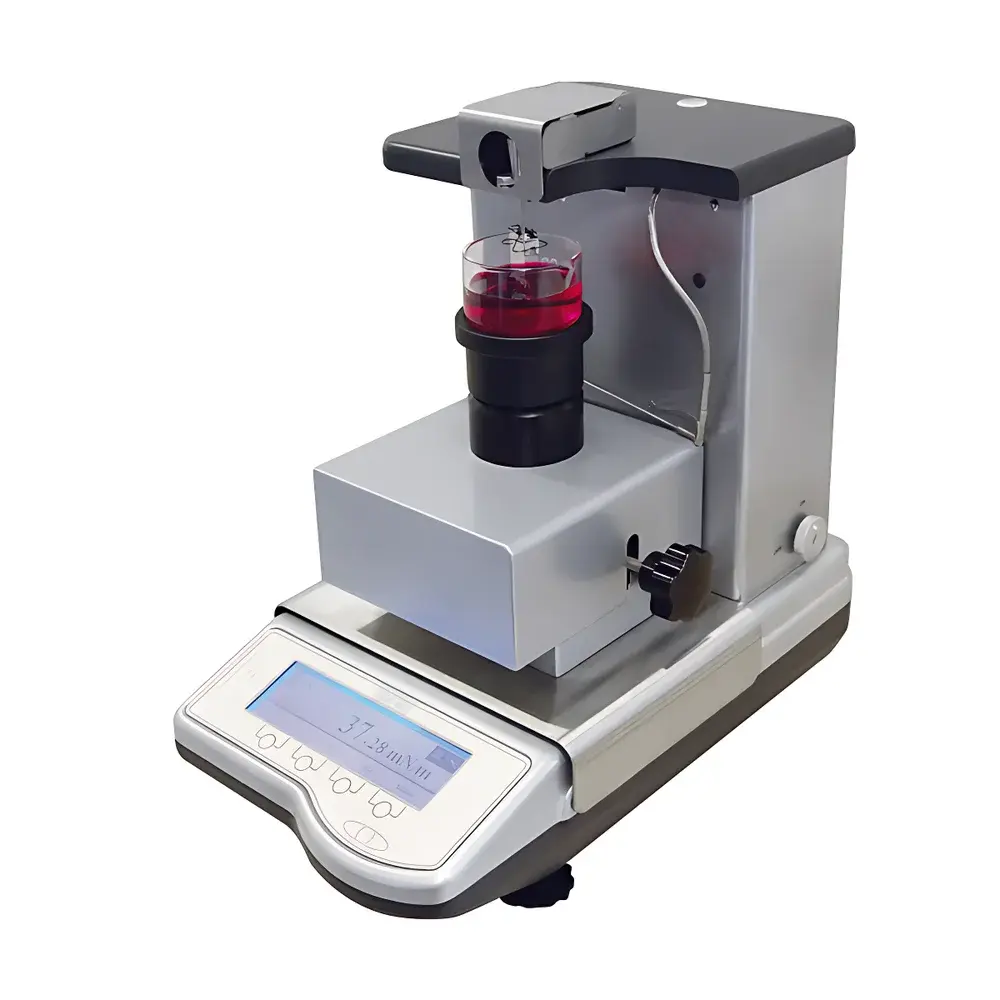
ChemTron DCA400 Dynamic Contact Angle Analyzer
| Brand | ChemTron |
|---|---|
| Origin | Germany |
| Model | DCA400 |
| Instrument Type | Benchtop Laboratory Analyzer |
| Contact Angle Measurement Range | 0–180° |
| Surface/Interfacial Tension Accuracy | ±0.02 mN/m |
| Measurement Method | Wilhelmy Plate Method |
| Tension Range | 1–1000 mN/m |
| Resolution | 0.01 mN/m |
| Maximum Sample Load | ≤110 g |
| Density Measurement Range (with optional accessories) | 0.5–2.25 g/cm³ |
| Density Readability/Repeatability | ±0.00005 g/cm³ |
| Power Supply | 230 V (−15% / +10%), 50 Hz, 10 VA |
| Dimensions (W × D × H) | 210 × 370 × 380 mm |
| Weight | 8 kg |
| Standard Accessories | Manual-adjustable motorized Z-stage, custom borosilicate glass plate (24 × 24 × 0.15 mm), platinum-iridium Wilhelmy plate, glass measurement beaker, temperature-controlled jacketed cup (optional), Du Noüy ring kit (optional) |
Overview
The ChemTron DCA400 Dynamic Contact Angle Analyzer is a precision benchtop instrument engineered for quantitative characterization of solid–liquid–gas interfacial phenomena. It operates on the Wilhelmy plate principle—a gravimetric method in which the vertical force exerted on a vertically immersed plate (typically platinum-iridium or specially treated glass) is measured as it is incrementally advanced into or withdrawn from a liquid phase. This force profile directly correlates to surface or interfacial tension and, when combined with high-resolution image-based contact angle analysis during dynamic immersion cycles, enables simultaneous acquisition of advancing and receding contact angles. The system is designed for rigorous laboratory environments where reproducibility, traceable calibration, and compliance with standardized test protocols are essential—particularly in R&D, quality control, and regulatory documentation workflows across materials science, pharmaceutical formulation, microelectronics fabrication, and environmental interface chemistry.
Key Features
- Motorized, software-controlled Z-axis stage with programmable immersion speed (21–1000 µm/s), enabling precise replication of dynamic wetting sequences for hysteresis analysis.
- Integrated high-sensitivity microbalance (±0.02 mN/m accuracy, 0.01 mN/m resolution) compliant with ASTM D971 and ISO 6295 for surface tension determination.
- Full 0–180° contact angle measurement range supported by real-time video capture and edge-detection algorithms optimized for low-contrast or volatile samples.
- Auto-calibration routine for both force transducer and optical axis alignment, reducing operator dependency and ensuring long-term measurement stability.
- Benchtop footprint (210 × 370 × 380 mm) with modular accessory support—including thermostatted jacketed cups, Du Noüy ring kits, and density measurement floats—for extended interfacial property profiling.
- Robust mechanical architecture featuring vibration-damped baseplate and thermally stable optical path, minimizing drift during extended kinetic measurements.
Sample Compatibility & Compliance
The DCA400 accommodates a broad spectrum of solid substrates—including wafers, polymer films, coated metals, porous membranes, and functionalized surfaces—as well as diverse liquid phases (aqueous solutions, organic solvents, surfactant formulations, and molten polymers). Its Wilhelmy plate geometry ensures compatibility with low-volume samples and high-viscosity systems where pendant drop methods may suffer from instability. All measurement routines adhere to internationally recognized standards: surface tension determinations align with ASTM D1331 (for interfacial tension) and ISO 1409; contact angle protocols follow ISO 27448 and ASTM D7334 (for surface energy mapping). When configured with audit-trail-enabled software and electronic signatures, the system supports GLP and GMP documentation requirements per FDA 21 CFR Part 11.
Software & Data Management
The proprietary ChemTron DCA Control Suite runs on Windows-based PCs and provides synchronized acquisition of force-time curves, contact angle kinetics, and environmental metadata (temperature, humidity, timestamp). Data files are saved in vendor-neutral CSV and XML formats, supporting third-party statistical analysis (e.g., JMP, MATLAB, Python pandas). The software includes preconfigured method templates for common applications—such as surfactant CMC determination, coating adhesion screening, and hydrophobicity ranking—and allows user-defined pass/fail criteria with automated report generation (PDF/Excel). Raw force data is stored with full sensor calibration history, and all modifications to measurement parameters are logged with operator ID and timestamp for full traceability.
Applications
- Surface energy quantification of plasma-treated polymer films used in medical device packaging.
- Dynamic contact angle hysteresis analysis of inkjet printhead nozzle surfaces to predict droplet ejection reliability.
- Interfacial tension profiling of oil–water–surfactant systems in enhanced oil recovery (EOR) formulation development.
- Quality assurance of anti-fouling coatings on reverse osmosis membranes via advancing/receding angle repeatability testing.
- Characterization of nanomaterial dispersion stability through time-resolved interfacial tension decay kinetics.
- Regulatory submission support for topical pharmaceuticals, where contact angle data informs excipient–substrate affinity and film-forming behavior.
FAQ
What measurement principles does the DCA400 employ?
It combines Wilhelmy plate tensiometry for surface/interfacial tension with high-magnification side-view imaging and tangent-based contact angle calculation during controlled immersion cycles.
Is the system compatible with temperature-controlled measurements?
Yes—when equipped with the optional jacketed measurement cup and external chiller, the DCA400 maintains thermal stability within ±0.1°C over standard laboratory conditions.
Can the DCA400 be integrated into automated lab workflows?
It supports RS-232 and USB virtual COM port communication, enabling script-driven control via LabVIEW, Python, or custom SCADA systems.
Does the software meet regulatory data integrity requirements?
With optional 21 CFR Part 11 module enabled, it provides role-based access control, electronic signatures, and immutable audit trails for all measurement events and parameter changes.
What maintenance is required for long-term accuracy?
Annual recalibration of the microbalance and optical alignment verification are recommended; platinum plates require periodic cleaning in piranha solution or oxygen plasma, per ASTM E2577 guidelines.



