
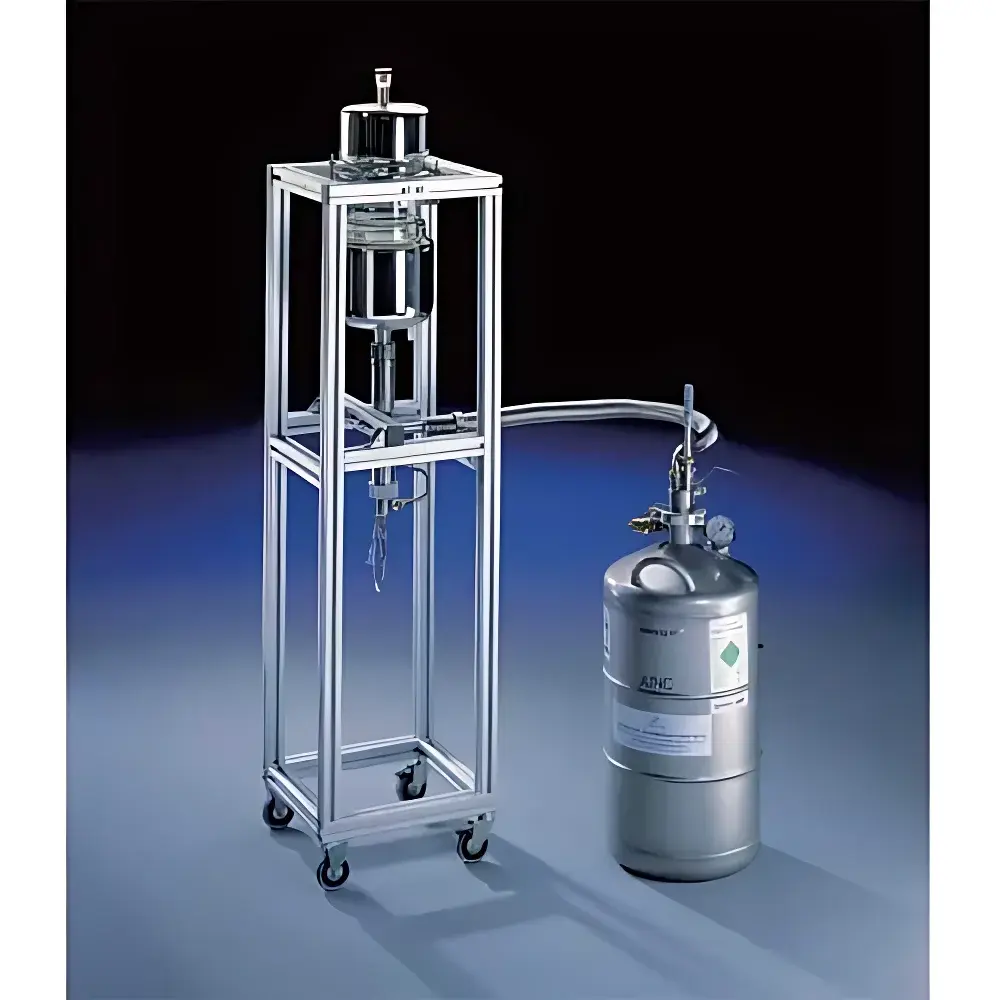
ChemTron KALTGAS Ultra-Low Temperature Reaction Testing System
| Brand | ChemTron |
|---|---|
| Origin | Germany |
| Model | KALTGAS |
| Temperature Range | −170 °C to +120 °C |
| Temperature Stability | ±0.1 °C (standard configuration) / ±0.2 °C (typical systems I–VI) |
| LN₂ Evaporator Power | 500 W or 1000 W (Jet-type) |
| Heater Power | 400 W to 630 W |
| LN₂ Consumption | 0.8 L/h to 22 L/h |
| Cryogenic N₂ Delivery Line | V2A stainless steel, 1.5–1.8 m, flexible, vacuum-insulated |
| Connection to LN₂ Dewar | KF NW 50 |
| Reactor Vessel | 2 L total / 1.5 L usable volume, vacuum-jacketed with sight strip |
| Reactor Lid | Three NS 29/32 ports (central + two lateral) |
| Frame Material | Anodized aluminum |
| Compliance | Designed for GLP-compliant laboratory environments |
Overview
The ChemTron KALTGAS Ultra-Low Temperature Reaction Testing System is an engineered solution for precise, dynamic thermal control of chemical reactions and material testing across an exceptionally wide operational range—from −170 °C to +120 °C. Unlike conventional compressor-based cryogenic systems, KALTGAS employs controlled vaporization of liquid nitrogen (LN₂) to generate a stable, high-velocity stream of ultra-cold gaseous nitrogen. This direct-gas cooling principle leverages the large enthalpy of vaporization of LN₂ (199 kJ/kg at 77 K) and rapid heat transfer coefficients achievable in gas–liquid or gas–solid interfaces—enabling sub-minute cooling to cryogenic temperatures unattainable by mechanical refrigeration alone. The system integrates a jet-type LN₂ evaporator, ICC (Intelligent Cascade Control) temperature regulation architecture, and a dedicated nitrogen safety management module to ensure reproducible thermal profiles under both open-bath and closed-reactor configurations. Its modular design supports integration into existing synthesis platforms, calorimeters, spectroscopic cells, or custom test chambers while maintaining ISO/IEC 17025-aligned thermal stability (±0.1 °C in base configuration; ±0.2 °C across six standardized system variants).
Key Features
- Jet-type LN₂ evaporator with adjustable mass flow control (500 W or 1000 W nominal power), enabling rapid thermal ramping and stable low-temperature gas delivery
- Intelligent Cascade Control (ICC) algorithm delivering ±0.1 °C temperature stability in reactor liquid phase and ±0.2 °C in chamber-based configurations
- Vacuum-jacketed 2 L reactor vessel (1.5 L working volume) with integrated optical sight strip for real-time visual monitoring
- Triple-port NS 29/32 lid (central + dual lateral) supporting simultaneous probe insertion, gas inlet/outlet, and pressure monitoring
- V2A (1.4301) stainless steel cryogenic delivery line (1.5–1.8 m), flexible and vacuum-insulated, minimizing parasitic heat leak and condensation risk
- KF NW 50 flanged interface for secure, leak-tight connection to standard 20–300 L LN₂ dewars
- Dual-mode reactor cooling: jacketed circulation or internal coil immersion—optimized for viscosity-sensitive or exothermic reaction control
- Integrated safety subsystem including overpressure relief, LN₂ flow rate limiter, and automatic shut-off upon vacuum loss or temperature deviation
Sample Compatibility & Compliance
The KALTGAS platform accommodates diverse sample formats—including glass or stainless-steel reaction vessels, quartz spectroscopic cells, polymer film holders, and metal alloy test coupons—without requiring modification to the core thermal delivery architecture. Its open-system purge mode enables surface cooling of air-sensitive catalysts or cryo-SEM substrates, while closed-loop configurations support pressurized or inert-atmosphere reactions per ASTM D618 or ISO 291 environmental conditioning protocols. All electrical components comply with IEC 61000-6-3 (EMC) and IEC 61000-6-4 (industrial immunity). The system’s temperature logging and setpoint history are configurable for audit-ready records aligned with FDA 21 CFR Part 11 requirements when paired with ChemTron’s optional validated software package. Mechanical construction adheres to PED 2014/68/EU for pressure equipment up to 6 bar, and vacuum insulation meets ISO 21028-1 standards for cryogenic containment integrity.
Software & Data Management
KALTGAS operates via ChemTron’s proprietary TCS-3000 Thermal Control Suite, a Windows-based application supporting multi-channel real-time logging (≥10 Hz sampling), programmable ramp/soak profiles, and automated calibration verification against NIST-traceable Pt100 sensors (Class A, IEC 60751). Data export is native to CSV, HDF5, and .tdms formats, with optional integration into LabArchives ELN or Siemens Desigo CCMS via OPC UA 1.04. Audit trails record operator ID, timestamp, parameter changes, and alarm events—fully compliant with GLP Annex 11 and GMP Annex 11 documentation requirements. Firmware updates are delivered via signed binary packages with SHA-256 hash validation, ensuring integrity during remote maintenance.
Applications
- Kinetic studies of low-temperature organic transformations (e.g., lithiation, Diels–Alder cycloadditions below −100 °C)
- Cryogenic polymerization process development and vitrification onset analysis
- Thermal stress testing of aerospace composites and battery electrolytes
- In situ FTIR or Raman spectroscopy of transient intermediates stabilized below −150 °C
- Calibration validation of cryogenic thermocouples and resistance thermometers per ITS-90
- Accelerated aging of pharmaceutical excipients under controlled humidity-free sub-zero conditions
- Superconductivity screening of novel materials using resistivity vs. temperature sweeps
FAQ
What LN₂ dewar sizes are compatible with KALTGAS systems?
Standard KF NW 50 interface supports dewars ranging from 20 L to 300 L. Larger dewars (>100 L) require optional height-adjustable support stands to maintain optimal siphon geometry.
Can KALTGAS be integrated with third-party reactors or analytical instruments?
Yes—via the standardized V2A delivery line and KF NW 50 interface, KALTGAS serves as a standalone cold-gas source for external systems including Parr reactors, Netzsch DSC units, or Bruker VT-NMR probes.
Is vacuum insulation maintained during extended operation at −170 °C?
Vacuum integrity is continuously monitored via integrated Pirani gauge feedback; automatic re-evacuation triggers if pressure exceeds 1×10⁻² mbar, ensuring sustained thermal performance over 72+ hour continuous runs.
How does KALTGAS achieve ±0.1 °C stability in liquid-phase cooling?
Through dual-sensor ICC control: one Pt100 embedded in the reactor fluid path, another in the LN₂ gas stream upstream of the coil—enabling feedforward compensation for evaporator load fluctuations.
Are explosion-proof variants available for solvent-based reactions?
ATEX-certified versions (II 2G Ex db IIB T4 Gb) are offered for Groups IIA–IIB atmospheres; hazardous-area wiring follows IEC 60079-14 guidelines and requires site-specific zone classification review.



