
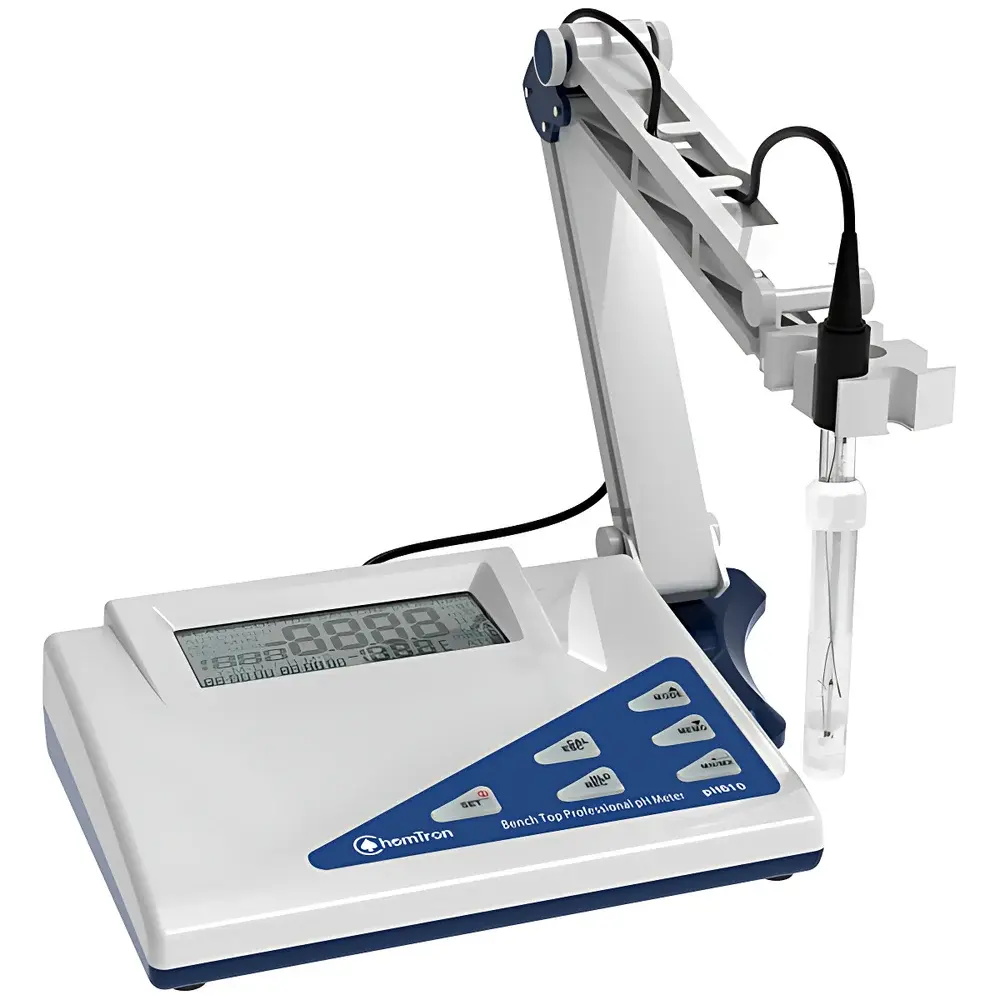
ChemTron pH610 Standard Benchtop pH Meter
| Brand | ChemTron |
|---|---|
| Origin | Germany |
| Model | pH610 |
| Measurement Range | 0–14 pH |
| Resolution | 0.01 pH |
| Accuracy | ±0.02 pH |
| Calibration Points | 5-point |
| Calibration Standards | ASTM, ISO (pH 4.01, 7.00, 10.01), NIST (pH 4.01, 6.86, 9.18) |
| Temperature Range | 0–90 °C |
| Temperature Accuracy | ±0.5 °C |
| mV Range | ±1999 mV |
| mV Accuracy | ±0.2 mV (±2 mV for full scale) |
| Power Supply | 9–12 V DC, min. 650 mA |
| Dimensions | 217 × 168 × 58 mm |
| Weight | 2.1 kg |
Overview
The ChemTron pH610 Standard Benchtop pH Meter is a precision-engineered electrochemical instrument designed for routine and high-reproducibility pH measurements in regulated laboratory environments. Built upon a robust potentiometric measurement principle—utilizing the Nernst equation to quantify hydrogen ion activity via a glass pH electrode and reference junction—the pH610 delivers traceable, stable readings across the full aqueous pH scale (0–14). Its benchtop architecture integrates thermal compensation, multi-point calibration logic, and digital signal processing to minimize drift and electrode polarization effects. Engineered for compliance-critical workflows, the system supports ASTM-standard calibration protocols and accommodates both ISO and NIST traceable buffer sets, ensuring alignment with international metrological practices in quality control, environmental testing, and pharmaceutical process validation.
Key Features
- High-contrast LCD display showing simultaneous real-time readouts of pH value, temperature (°C), and timestamp—enabling unambiguous data attribution during sequential measurements.
- Auto-lock function that freezes the displayed value once stability threshold (±0.005 pH/10 s) is met, reducing operator interpretation error and supporting GLP-compliant documentation.
- Intelligent 5-point calibration algorithm with automatic buffer recognition: detects and applies correction factors for ISO (pH 4.01, 7.00, 10.01), NIST (pH 4.01, 6.86, 9.18), or user-defined standards—each stored with unique identifier and date stamp.
- Dual-input capability: accepts standard BNC pH electrodes (e.g., H011-AS004) and optional PT3001 stainless-steel temperature sensors for independent thermal monitoring—critical for non-aqueous or high-viscosity samples where built-in thermistor response may lag.
- Onboard memory stores up to 99 measurement records with embedded metadata (date, time, pH, temperature, electrode slope %, calibration ID)—retained during power-off and exportable via RS232 interface.
- Modular power design: operates on external 9–12 V DC adapter; no internal batteries required—eliminating maintenance downtime and ensuring consistent voltage regulation for analog front-end stability.
Sample Compatibility & Compliance
The pH610 is validated for use with aqueous, buffered, and low-conductivity solutions typical in QC laboratories—including pharmaceutical dissolution media, drinking water, wastewater effluents, and cell culture media. It complies with IEC 61000-4 electromagnetic immunity standards and meets CE marking requirements for laboratory instrumentation. While not intrinsically safe, its IP20-rated enclosure is suitable for indoor controlled environments per ISO/IEC 17025 accreditation guidelines. Calibration traceability aligns with ASTM E70 (Standard Test Method for pH of Aqueous Solutions), supporting audit readiness under FDA 21 CFR Part 11 when paired with validated software and electronic signature protocols.
Software & Data Management
Data acquisition and archival are supported via the AX30-232-RS232PC communication kit, enabling bidirectional transfer between the pH610 and Windows-based PCs. The included terminal software logs raw sensor output, calibration history, and user annotations in CSV format—structured for direct import into LIMS or statistical analysis platforms (e.g., JMP, Minitab). Audit trail functionality records operator ID, timestamp, calibration parameters, and any manual overrides—fulfilling ALCOA+ principles (Attributable, Legible, Contemporaneous, Original, Accurate) essential for GMP-regulated operations. No proprietary drivers are required; communication uses standard ASCII protocol over RS232 at 9600 baud.
Applications
- Pharmaceutical QA/QC: Monitoring pH of injectables, buffers, and cleaning validation rinsates per USP and EP 2.2.3.
- Environmental testing: Field-deployable bench verification of surface water, groundwater, and leachate samples prior to EPA Method 9040C submission.
- Food & beverage R&D: Tracking acidification kinetics in dairy fermentation or juice stabilization processes with temperature-compensated repeatability ≤0.01 pH RSD (n=6).
- Academic teaching labs: Demonstrating electrode theory, buffer capacity, and temperature dependence of pH using integrated slope diagnostics and multi-standard calibration exercises.
- Chemical manufacturing: In-process control of neutralization reactions and catalyst activation baths where ±0.02 pH accuracy directly impacts yield and impurity profiles.
FAQ
Does the pH610 support automatic temperature compensation (ATC)?
Yes—it accepts external temperature input from the PT3001 probe or uses its internal thermistor, applying polynomial correction across 0–90 °C per NIST SP 260-175 guidelines.
Can calibration data be exported and archived separately from measurement records?
Yes—calibration events are timestamped and stored as discrete entries with slope (%), offset (mV), and buffer IDs, exportable independently via RS232.
Is the pH610 compatible with non-aqueous solvents such as ethanol or DMSO?
It can measure apparent pH in mixed solvents using appropriate electrodes (e.g., double-junction designs), though accuracy depends on solvent dielectric constant and junction potential stability—method validation is recommended per ISO 17025 Clause 7.2.2.
What is the electrode slope acceptance criterion for routine use?
The instrument displays real-time electrode slope post-calibration; values between 95–105% indicate optimal performance. Slopes outside this range trigger a warning and suggest electrode cleaning, reconditioning, or replacement.
Does the unit meet requirements for 21 CFR Part 11 compliance?
The hardware supports Part 11 readiness when used with validated third-party software that implements electronic signatures, audit trails, and role-based access controls—no built-in e-signature engine is provided.






