
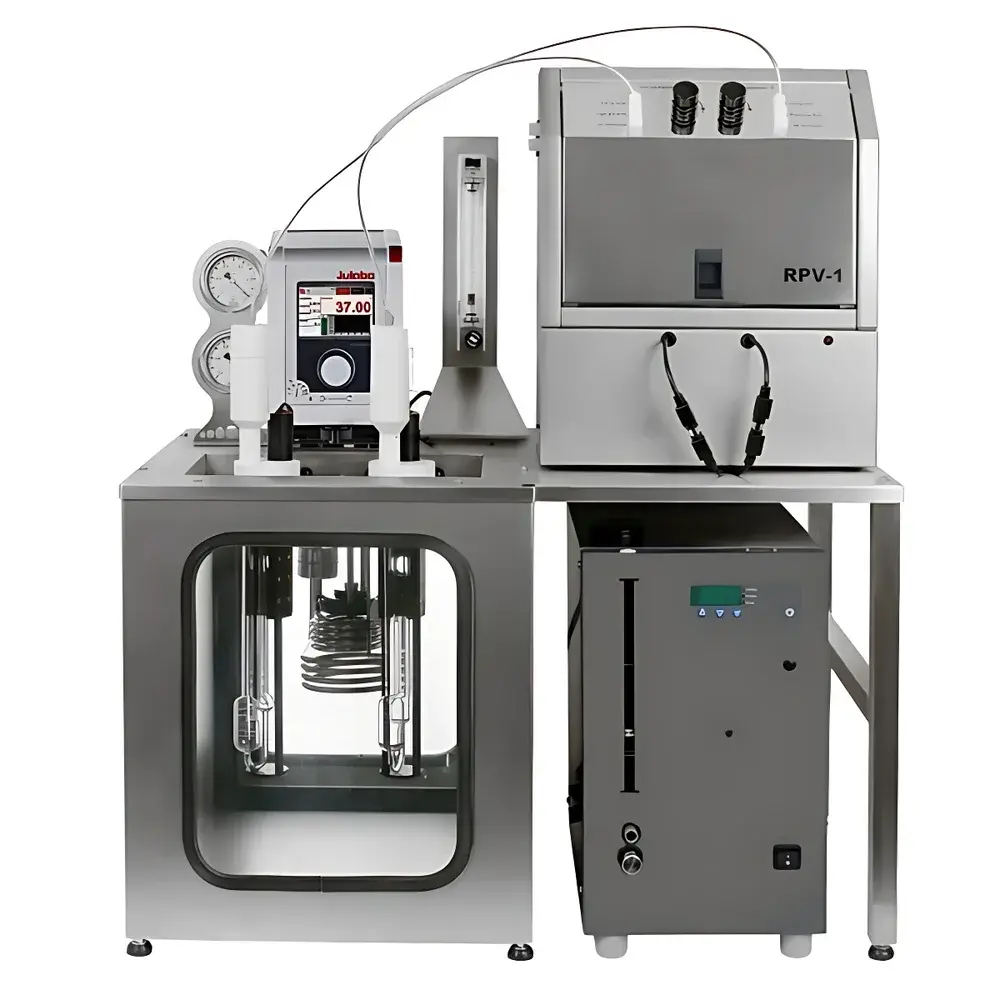
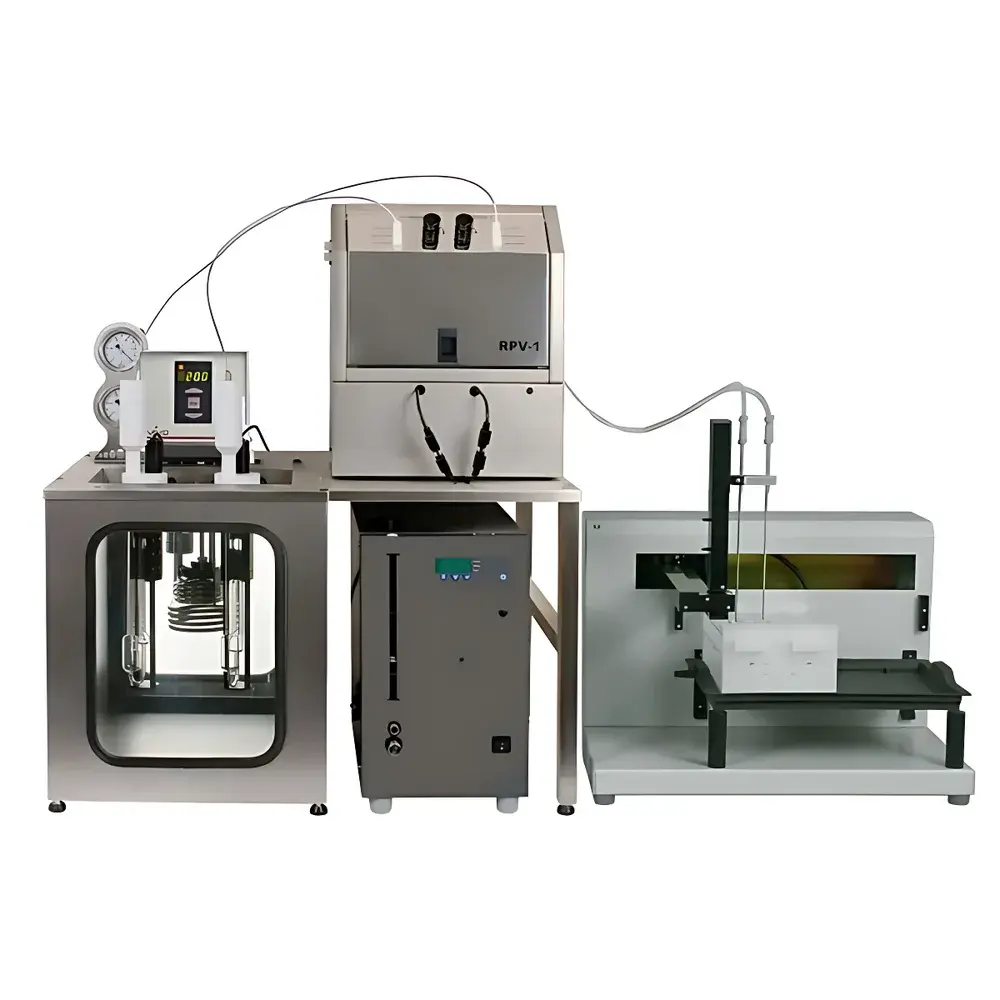
ChemTron RPV-1 Automated Kinematic Viscometry & Intrinsic Viscosity-Based Molecular Weight Determination System
| Brand | ChemTron |
|---|---|
| Origin | Germany |
| Model | RPV-1 |
| Instrument Type | Benchtop Fixed-Position System |
| Operating Environment | Ambient Temperature |
| Compliance | ASTM D445, D789, D1243, D4603 |
Overview
The ChemTron RPV-1 is a fully automated, benchtop kinematic viscometry platform engineered for high-precision intrinsic viscosity (IV) determination and subsequent molecular weight calculation of synthetic and natural polymers. It operates on the capillary flow principle—measuring the time required for a fixed volume of polymer solution to gravitationally traverse a calibrated glass capillary under controlled thermal conditions (per ASTM D445 and ISO 3104). By integrating gravimetric solution preparation, temperature-stabilized dissolution, programmable thermal ramping (heating–isothermal hold–cooling), and shear-controlled agitation, the RPV-1 eliminates operator-induced variability in sample history—a critical factor affecting IV reproducibility. The system computes intrinsic viscosity via Huggins, Kraemer, or Schulz-Blaschke extrapolation methods, then derives weight-average molecular weight (Mw) using established Mark–Houwink–Sakurada (MHS) equations with polymer-specific K and α coefficients. Designed for GLP-compliant laboratories, it delivers traceable, audit-ready data from mass weighing through final Mw reporting.
Key Features
- Fully automated workflow: solution preparation, dissolution, filtration (optional), sample loading, capillary timing, solvent rinse, drying, and data processing—all executed without manual intervention
- Gravimetric concentration control using analytical balances (0.01 mg or 0.1 mg resolution) compliant with ISO 17025 mass metrology requirements
- Programmable dissolution protocol: precise temperature ramping (±0.01 °C stability), defined shear rate during stirring, and inert atmosphere compatibility (N2 purge option)
- Dual-mode capillary timing: high-resolution chronometry (0.001 s resolution, <0.1% timing error) with automatic meniscus detection and bubble rejection logic
- PTFE-wetted fluid path: corrosion-resistant construction compatible with chlorinated solvents (e.g., chloroform, o-dichlorobenzene), phenol-based systems, and sulfuric acid solutions
- Integrated safety architecture: low-level bath detection, dry-run prevention, overtemperature cutoff, solvent depletion alerts, waste bottle full sensing, and SafeVacuum™ controlled vacuum rinsing
- Modular configuration: single- to quad-capillary measurement stations; scalable for throughput up to 40 samples per 8-hour shift
Sample Compatibility & Compliance
The RPV-1 supports routine analysis of thermoplastic and thermosetting polymers including polyamide (PA6, PA66), polyethylene terephthalate (PET), polyvinyl chloride (PVC), polypropylene (PP), polycarbonate (PC), poly(lactic acid) (PLA), polybutylene terephthalate (PBT), cellulose derivatives (acetate, nitrate), pulp suspensions, and ink formulations. All operational parameters adhere strictly to method-defined tolerances in ASTM D445 (kinematic viscosity), D789 (PA), D1243 (PVC), D4603 (PET), ISO 307 (PA), ISO 5351 (cellulose), ISO 1628-1 (general IV), and DIN 53726–53728 (polymer solution rheology). Measurement repeatability meets or exceeds industry benchmarks: ≤0.03% RSD for PA (ISO 307), ≤0.15% for PVC (ASTM D1243), and ≤0.26% for PET (ASTM D4603).
Software & Data Management
The RPV-1 Control Suite provides validated, 21 CFR Part 11–ready software with role-based access control, electronic signatures, full audit trail (including balance logs, temperature profiles, timing events, and rinse cycles), and raw data archiving in vendor-neutral formats (CSV, PDF, XML). Calibration records, method templates, and MHS parameter libraries are centrally managed. Results include kinematic viscosity (mm²/s), relative viscosity (ηrel), specific viscosity (ηsp), reduced viscosity ([η]red), inherent viscosity ([η]inh), intrinsic viscosity ([η]), limiting viscosity number (LVN), K-value, degree of polymerization (DP), and calculated Mw. Export modules support LIMS integration via ASTM E1384-compliant interfaces.
Applications
This system serves quality control labs in polymer manufacturing, R&D centers developing novel biopolymers, contract testing facilities accredited to ISO/IEC 17025, and academic institutions conducting structure–property relationship studies. Typical use cases include batch release testing of PET resin for bottle-grade applications, IV monitoring of nylon fiber intermediates, degradation assessment of recycled PLA, specification verification of cellulose acetate for film production, and regulatory submission support for medical-grade polymer devices under FDA Q5C guidelines.
FAQ
Does the RPV-1 support non-standard solvents or custom Mark–Houwink parameters?
Yes—users may define custom solvent systems, temperature-dependent density corrections, and polymer-specific K/α coefficients within the method editor.
Can the system be integrated into an existing laboratory automation framework?
It offers OPC UA and REST API interfaces for bidirectional communication with MES, LIMS, and robotic sample handlers.
Is validation documentation provided for IQ/OQ/PQ protocols?
Comprehensive validation kits—including test scripts, acceptance criteria, and blank templates—are supplied with installation qualification (IQ) and operational qualification (OQ) support from ChemTron’s EU-based service team.
What maintenance intervals are recommended for capillary calibration and vacuum pump service?
Capillaries undergo annual recalibration traceable to NIST SRM 2783; vacuum pump oil replacement is scheduled every 6,000 operating hours or biannually, whichever occurs first.
How does the system handle viscous or thermally unstable polymer solutions?
Pre-heated sample vials, adjustable flow-rate control during aspiration, and programmable post-measurement purge cycles minimize adsorption and thermal degradation artifacts.



