
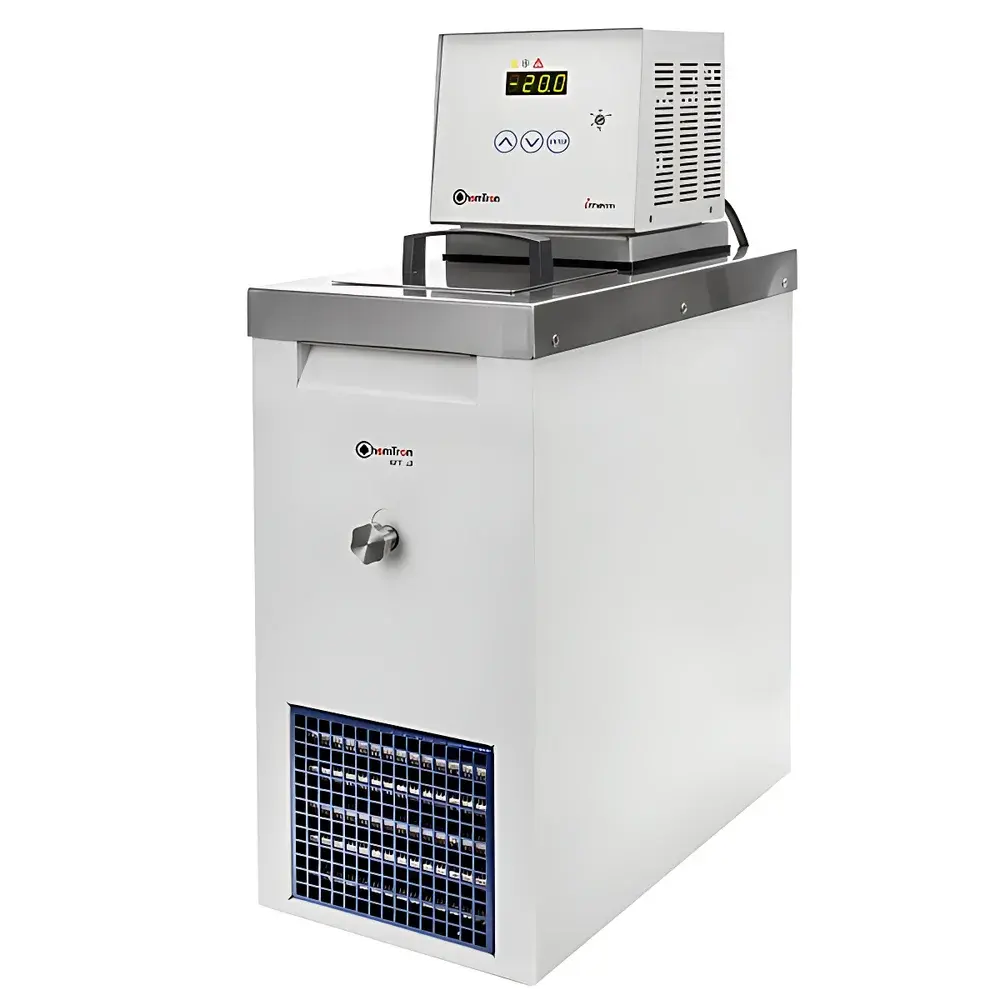
ChemTron RT3 Heating and Cooling Circulating Bath
| Brand | ChemTron |
|---|---|
| Origin | Germany |
| Model | RT3 |
| Instrument Type | Constant-Temperature Circulating Bath |
| Circulation Mode | Internal & External |
| Temperature Control | Dual-Mode (Heating & Refrigeration) |
| Bath Volume | 4–6 L |
| Temperature Range | −20 °C to +100 °C |
| Temperature Stability | ±0.05 °C |
| Heating Power | 1.5 kW |
| Pump Flow Rate | 10 L/min |
| Pump Pressure | 0.23 bar |
| Refrigerant | R134a (CFC-free) |
| Bath Opening / Depth | 12 × 11 / 15 cm |
| Dimensions (W × D × H) | 22 × 42 × 64 cm |
| Weight | 24 kg |
Overview
The ChemTron RT3 Heating and Cooling Circulating Bath is a precision-engineered laboratory thermal management system designed for stable, bidirectional temperature control across a broad operational range (−20 °C to +100 °C). Built upon a robust stainless-steel bath structure and integrated with Active Cooling Control technology, the RT3 delivers continuous refrigeration capability at any point within its full temperature span—eliminating warm-up delays before initiating cooling and ensuring rapid thermal response during dynamic setpoint transitions. Its dual-mode operation leverages PID-based digital temperature regulation to maintain exceptional stability of ±0.05 °C under steady-state conditions, making it suitable for applications requiring high repeatability in viscometry, spectrophotometry cell temperature control, reaction calorimetry support, and material testing fixtures. The unit complies with IEC 61010-1 safety standards for laboratory electrical equipment and incorporates redundant hardware-level safeguards—including overtemperature cutoff, low-level float switch interlock, and dry-run prevention logic—to ensure uninterrupted compliance with GLP and ISO/IEC 17025 environmental monitoring requirements.
Key Features
- Active Cooling Control architecture enables instantaneous refrigeration activation at any temperature within the operating range, eliminating conventional “cool-down lag”
- Dual-mode thermal regulation with 1.5 kW resistive heating and R134a-based vapor-compression refrigeration for balanced performance across sub-zero and high-temperature regimes
- High-flow circulation system delivering up to 10 L/min at 0.23 bar pressure, supporting both internal bath homogenization and external jacketed vessel or coil cooling/heating
- Three-button intuitive interface with dedicated keys for setpoint adjustment, mode selection (heating/refrigeration/standby), and quick access to status diagnostics
- Integrated low-level detection via stainless-steel float sensor: triggers audible/visual alarm and automatic power cutoff to prevent heater element exposure
- Front-mounted drain valve and large-volume bath chamber (4–6 L usable capacity) simplify fluid exchange and reduce maintenance downtime
- Optimized thermal shielding and expanded rear ventilation zone ensure long-term reliability under continuous 24/7 operation
- Corrosion-resistant stainless-steel heating coil minimizes scale deposition and extends service life in aqueous and glycol-based heat transfer fluids
Sample Compatibility & Compliance
The RT3 is compatible with standard water, ethanol/water mixtures, silicone oils, and propylene glycol solutions—provided viscosity remains below 50 cSt at operating temperature. Its open-bath geometry (12 × 11 cm aperture, 15 cm depth) accommodates immersion probes, jacketed reactors up to 2 L volume, and standard cuvette holders. All electrical components meet CE marking requirements per Directive 2014/30/EU (EMC) and 2014/35/EU (LVD). The device supports audit-ready documentation workflows: temperature log export via USB port includes timestamped setpoint, actual bath temperature, pump status, and alarm event flags—fully traceable for FDA 21 CFR Part 11–aligned environments when paired with validated third-party data acquisition software.
Software & Data Management
While the RT3 operates autonomously via its embedded controller, optional USB connectivity allows periodic export of thermal logs (CSV format) containing second-resolution timestamps, target/actual temperatures, pump duty cycle, and compressor on/off events. These logs are compatible with common laboratory informatics platforms including LabWare LIMS, Thermo Fisher SampleManager, and custom Python- or MATLAB-based analysis pipelines. No proprietary software installation is required; exported files retain ISO 8601-compliant time formatting and adhere to ASTM E29–22 rounding conventions for reported stability values. Firmware updates are delivered via signed .bin files and verified through CRC-32 checksum validation prior to execution.
Applications
- Temperature stabilization of UV-Vis and FTIR spectrophotometer sample compartments
- Thermal conditioning of rheometer measuring systems (e.g., parallel-plate or concentric cylinder geometries)
- Controlled-rate heating/cooling cycles in polymer crystallinity studies (DSC auxiliary temperature control)
- Calibration reference baths for platinum resistance thermometers (PRTs) and thermocouples per ISO/IEC 17025 Clause 6.4.5
- External temperature control of jacketed glass reactors in synthetic chemistry workflows
- Environmental stress screening of electronic components using programmable thermal profiles
FAQ
What types of heat transfer fluids are recommended for use with the RT3?
Deionized water, 30–50% aqueous propylene glycol, or low-viscosity silicone oils (≤20 cSt at 25 °C) are validated for extended operation. Avoid ethylene glycol due to oxidation-related corrosion risk.
Does the RT3 support external temperature feedback control?
No—the RT3 regulates based solely on internal PT100 sensor readings. For process-coupled control, an external PID controller with analog output (0–10 V or 4–20 mA) must be interfaced via optional I/O module (sold separately).
Is the unit suitable for overnight unattended operation?
Yes—when filled with appropriate fluid and placed in a well-ventilated, non-humid environment, the RT3’s dual thermal protection (overtemperature + low-level cutoff) satisfies institutional safety policies for unmonitored use.
Can the circulation pump flow rate be adjusted?
The pump operates at fixed speed; however, flow distribution between internal and external loops is manually regulated via dual isolation valves located on the rear panel.
What is the expected service interval for refrigerant recharge?
Under normal operating conditions and proper fluid maintenance, the sealed R134a circuit requires no scheduled refrigerant replenishment over a 10-year service life, per manufacturer accelerated aging tests conducted per ISO 5149-2.



