
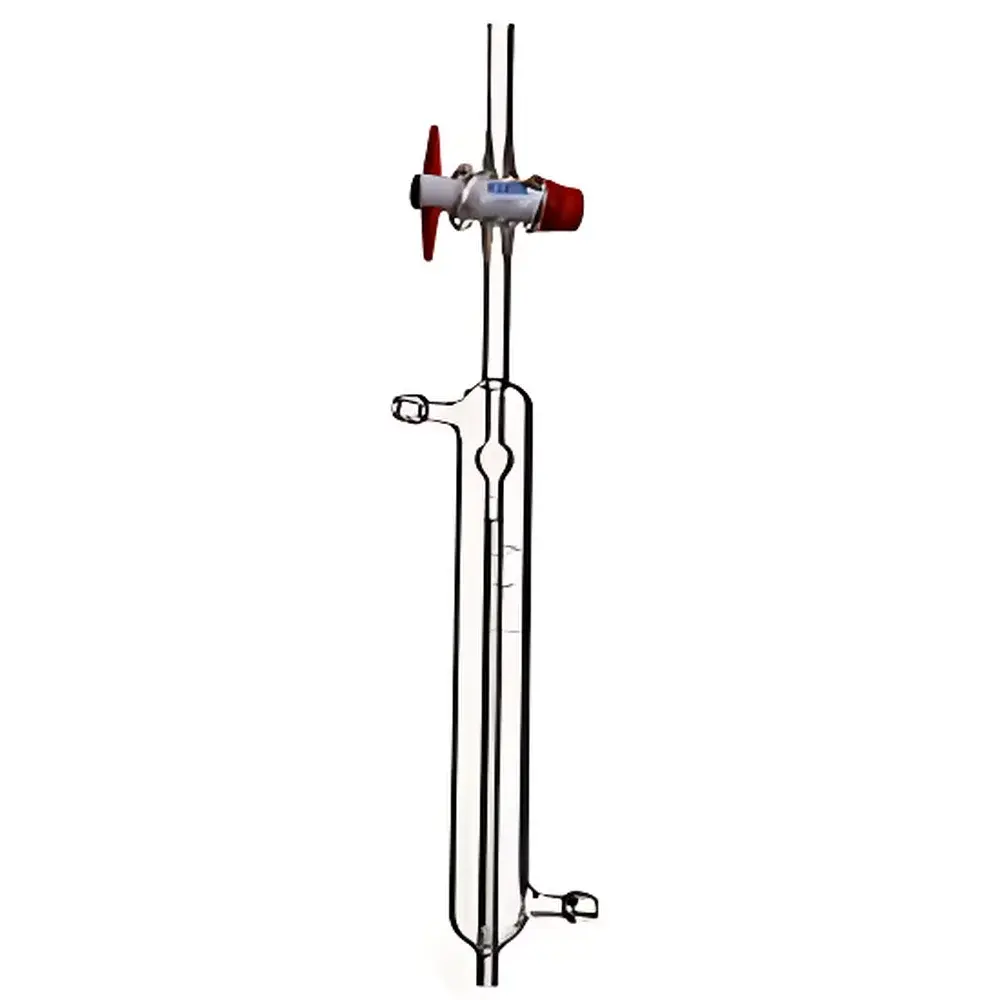
ChemTron SCAN Viscometer
| Brand | ChemTron |
|---|---|
| Origin | Germany |
| Model | SCAN Viscometer |
| Instrument Type | Portable Capillary Viscometer |
| Compliance | ISO 5351 (Pulp Viscosity) |
| Operating Environment | Ambient Temperature |
| Application | Manual Viscosity Measurement of Cellulosic Pulps |
Overview
The ChemTron SCAN Viscometer is a precision-engineered portable capillary viscometer designed specifically for the determination of kinematic viscosity in cellulose pulp suspensions according to ISO 5351. Unlike rotational or vibrational viscometers, the SCAN Viscometer operates on the principle of gravity-driven laminar flow through a calibrated glass capillary tube—enabling direct measurement of efflux time under controlled conditions. This method delivers high reproducibility for dilute aqueous pulp solutions where shear rate independence and Newtonian behavior are assumed within the defined concentration and temperature range. The instrument is optimized for routine QC laboratories in pulp and paper manufacturing facilities, research institutions conducting fiber characterization, and certification labs performing standardized pulp viscosity testing per international regulatory frameworks.
Key Features
- Compact, hand-held design with integrated timing mechanism and ergonomic grip—engineered for field deployment and benchtop use without external power supply.
- Two standardized configurations: Type C (Part No. 21003) for cupriethylenediamine (CED) solution measurements; Type T (Part No. 21004) for cupriethylenediamine hydroxide (CEDH) systems—both fully compliant with ISO 5351 Annex A and B specifications.
- Calibrated borosilicate glass capillary tubing with certified dimensions (inner diameter tolerance ±0.005 mm), traceable to national metrology institutes.
- Integrated digital stopwatch with 0.01 s resolution and automatic start/stop triggers activated by meniscus passage detection at upper and lower timing marks.
- Temperature-stabilized sample holder compatible with standard water baths (25.0 ± 0.1 °C), ensuring adherence to ISO 5351 thermal conditioning requirements.
- No moving parts or electronic sensors—minimizing calibration drift and maintenance overhead while maximizing long-term measurement stability.
Sample Compatibility & Compliance
The SCAN Viscometer is validated exclusively for low-concentration (0.2–1.0 % w/v), filtered, and deaerated pulp solutions dissolved in CED or CEDH solvents. It is not suitable for non-Newtonian polymer melts, high-viscosity oils, or particulate-laden suspensions outside ISO 5351 scope. All measurements must be performed under strict ambient temperature control (25.0 °C ± 0.1 °C) and atmospheric pressure conditions as defined in ISO 5351:2022. The device supports full traceability to ISO/IEC 17025-accredited calibration protocols when used with certified reference standards (e.g., NIST SRM 2789). Its mechanical simplicity ensures compatibility with GLP-compliant documentation workflows, including manual logbook entries and audit-ready test reports.
Software & Data Management
As a manually operated, analog-digital hybrid instrument, the SCAN Viscometer does not incorporate embedded firmware or proprietary software. Efflux time data is recorded directly into laboratory notebooks or exported to LIMS via standardized CSV templates. Users may integrate results into validated spreadsheet-based calculation modules that apply the ISO 5351 kinematic viscosity formula: ν = K × t, where K is the capillary constant (mm²/s²) and t is measured efflux time (s). For regulated environments requiring electronic records, the instrument supports 21 CFR Part 11 compliance when paired with validated third-party data capture platforms featuring electronic signatures, audit trails, and user access controls.
Applications
- Routine quality control of dissolving pulp viscosity during production line monitoring.
- Research-grade comparative analysis of cellulose chain degradation following bleaching, aging, or enzymatic treatment.
- Verification of pulp specification conformance prior to shipment or contractual delivery (e.g., ISO 5351 pass/fail thresholds).
- Method transfer studies between centralized QC labs and satellite production sites due to its portability and minimal infrastructure requirements.
- Training and educational use in polymer science and paper engineering curricula to demonstrate fundamental capillary flow principles.
FAQ
What solvent systems are supported by the SCAN Viscometer?
Type C (Part No. 21003) is calibrated for cupriethylenediamine (CED) solvent; Type T (Part No. 21004) is configured for cupriethylenediamine hydroxide (CEDH)—both specified in ISO 5351 Annexes.
Is temperature control built into the instrument?
No—the SCAN Viscometer requires external thermostatic bath immersion (25.0 °C ± 0.1 °C); the sample holder is designed for precise fit within standard 150 mm diameter water baths.
Can this instrument measure dynamic viscosity?
No—it measures kinematic viscosity (mm²/s) directly; dynamic viscosity (mPa·s) must be derived using the known density of the CED/CEDH solution at 25 °C.
Does it require annual recalibration?
Yes—capillary constant verification against certified reference fluids is recommended annually or after physical impact, per ISO/IEC 17025 Clause 6.5.2.
Is it suitable for regulatory submissions to FDA or EMA?
When operated within ISO 5351 protocol, documented with full traceability, and integrated into a validated data management system, it meets evidentiary requirements for pulp-related pharmaceutical excipient characterization (e.g., microcrystalline cellulose).
Related Products



