
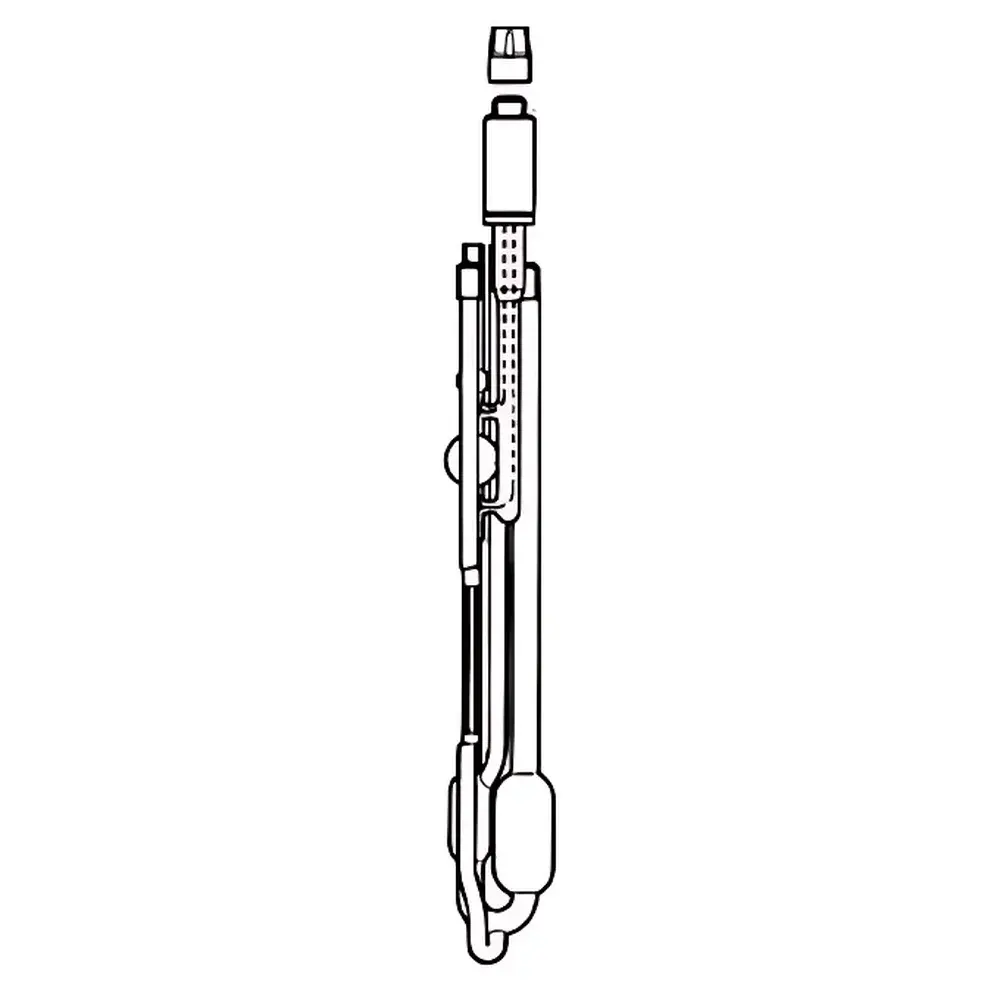
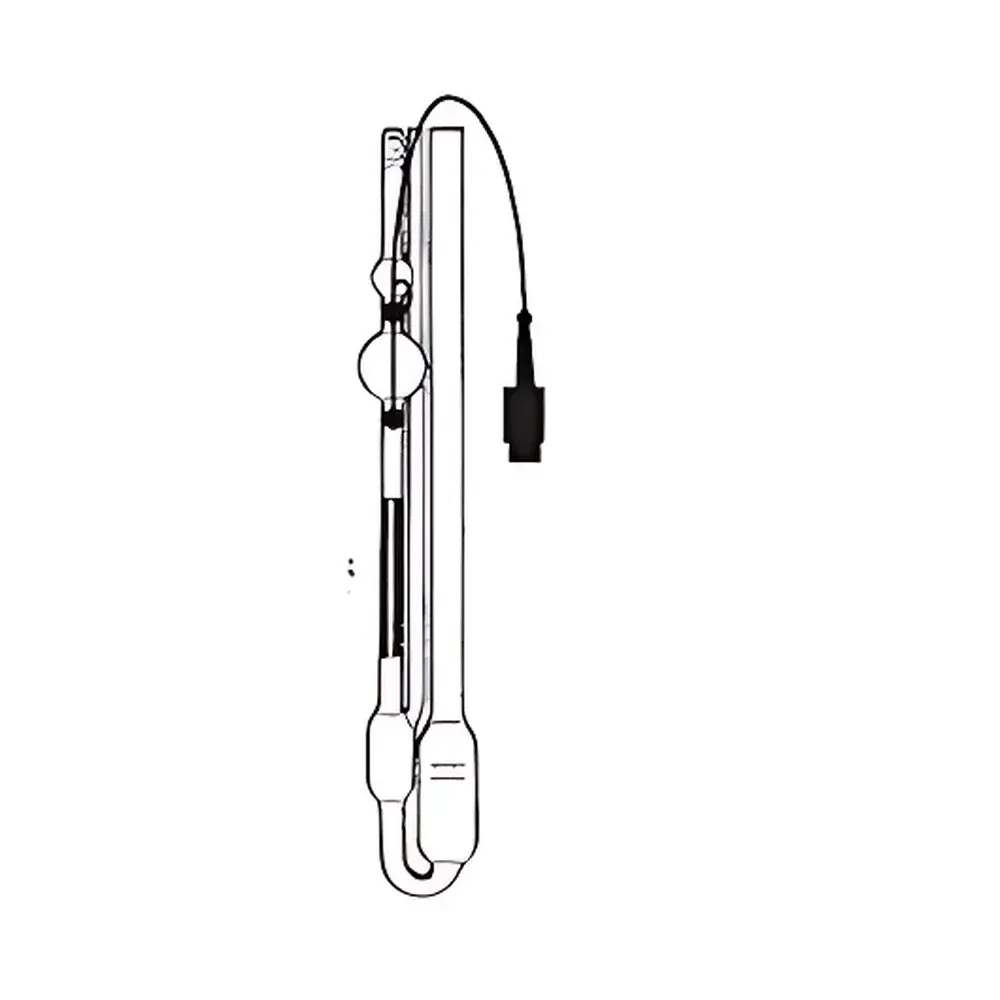
ChemTron TC Ubbelodde Viscometers (Models 56203 / 56703)
| Key | Brand: ChemTron |
|---|---|
| Origin | Germany |
| Instrument Type | Capillary Viscometer (Ubbelohde-type) |
| Portability | Benchtop / Modular Integration |
| Operating Temperature Range | –40 °C to +150 °C (model-dependent) |
| Kinematic Viscosity Range | 0.5–30,000 mm²/s (cSt) |
| Compliance | DIN 51562-1, ISO 3105 (BS-IP-SL), ASTM D445 |
| Calibration | Factory-calibrated with certified K-values |
| Capillary Dimensions | Bore diameters from 0.47 mm to 5.35 mm |
| Total Length | ~355 mm |
| Detector Option | Integrated thermal conductivity detector (for opaque & wall-adhering samples) |
| Compatibility | AVS 24 / AVS 26 / AVS 270 automated filling & cleaning systems |
| Material | Borosilicate glass (DIN/ISO-compliant), precision-ground glass threads |
Overview
The ChemTron TC Ubbelodde Viscometers (Models 56203 and 56703) are precision-engineered capillary viscometers based on the classical Ubbelohde design—optimized for kinematic viscosity determination of transparent and non-transparent liquids under controlled temperature conditions. These instruments operate on the principle of Poiseuille flow: a fixed volume of liquid is drawn by gravity through a calibrated capillary tube, and the efflux time is measured. Kinematic viscosity (ν, in mm²/s or cSt) is calculated using the instrument’s certified calibration constant (K-value) and the measured time: ν = K × t. Unlike suspended-level viscometers, the Ubbelohde configuration features a reservoir that isolates the measurement section from hydrostatic pressure fluctuations, ensuring high reproducibility across repeated runs—even for low-viscosity solvents or high-shear-sensitive polymer solutions.
Key Features
- Full compliance with DIN 51562-1 and ISO 3105 (equivalent to BS-IP-SL and ASTM D445), enabling direct traceability to national metrology institutes.
- Integrated thermal conductivity (TC) detector option—specifically engineered for opaque, turbid, or wall-adhering samples (e.g., pigment dispersions, crude oils, filled elastomers) where optical detection fails.
- Modular capillary selection: 18 standardized bore diameters (0.47–5.35 mm), each assigned a unique K-value and validated viscosity range (0.5–30,000 mm²/s), allowing precise matching to sample rheology and test temperature.
- Borosilicate glass construction per DIN ISO 3585, with precision-ground glass threads ensuring leak-tight, repeatable assembly and long-term dimensional stability.
- Benchtop-ready geometry (~355 mm total length) compatible with standard thermostatic baths (±0.01 °C stability recommended) and fully integrable into automated workflows via ChemTron’s AVS series (AVS 24, AVS 26, AVS 270).
- Factory-certified calibration with documented K-values traceable to PTB (Physikalisch-Technische Bundesanstalt, Germany); certificates include uncertainty budgets per ISO/IEC 17025.
Sample Compatibility & Compliance
These viscometers accommodate a broad spectrum of industrial and research-grade fluids—including hydrocarbons, synthetic lubricants, pharmaceutical solvents, polymer melts (in dilute solution), biofuels, and functional nanofluids. The TC detector variant eliminates reliance on optical clarity, extending usability to suspensions, emulsions, and thermally unstable formulations prone to wall deposition. All models meet GLP and GMP documentation requirements when used within validated analytical procedures. Data generated supports regulatory submissions under FDA 21 CFR Part 11 (when paired with compliant AVS automation and audit-trail-enabled software), as well as ISO/IEC 17025-accredited testing laboratories.
Software & Data Management
When integrated with AVS 24/26/270 systems, the TC Ubbelodde viscometers interface with ChemTron’s ViscoWare™ software suite—providing full control over temperature ramping, timed efflux acquisition, automatic K-value application, outlier rejection (Dixon Q-test), and multi-point viscosity averaging. Raw timing data is timestamped and stored with full metadata (bath temperature, ambient RH, operator ID, calibration certificate ID). Audit trails comply with ALCOA+ principles (Attributable, Legible, Contemporaneous, Original, Accurate), supporting 21 CFR Part 11 electronic record integrity. Export formats include CSV, PDF reports (with digital signature), and XML for LIMS integration.
Applications
- Quality control of base oils and finished lubricants per ASTM D445 and ISO 3105.
- Molecular weight estimation of polymers (e.g., PET, PA6, PS) via intrinsic viscosity (IV) measurements in dilute solution (requiring multiple concentrations and Huggins/Kraemer extrapolation).
- Stability assessment of colloidal dispersions and nanoparticle suspensions under thermal stress.
- Batch release testing of injectables and excipients in pharmaceutical manufacturing (USP , Ph. Eur. 2.2.34).
- Research on shear-thinning behavior of non-Newtonian fluids at low shear rates (capillary-based, low-shear regime).
- Calibration verification of rotational viscometers and rheometers using reference oils with certified kinematic viscosity.
FAQ
What distinguishes the TC (thermal conductivity) detector version from standard Ubbelohde viscometers?
Unlike photometric detectors requiring optical transparency, the TC detector measures changes in thermal resistance across the capillary outlet—enabling reliable efflux timing for opaque, colored, or particulate-laden samples without modification to fluid chemistry or dilution.
Can these viscometers be used above 100 °C?
Yes—selected models (e.g., 56230, 56730 and higher) are rated for continuous operation up to 150 °C when paired with silicone oil baths and appropriate bath circulators meeting IEC 61000-4-3 immunity standards.
Is K-value recalibration required after routine cleaning?
No—K-values remain valid provided no mechanical damage occurs to the capillary bore. However, periodic verification using NIST-traceable reference oils (e.g., Cannon-Fenske standards) is recommended per ISO/IEC 17025 every 6–12 months or after 200 runs.
How does the glass thread design improve operational safety?
The precision-ground conical glass threads eliminate the need for PTFE tape or adhesives, prevent cross-threading, ensure consistent immersion depth, and reduce risk of sudden fracture during thermal cycling—critical for high-temperature or cryogenic applications.
Are replacement capillaries available with NIST-traceable calibration certificates?
Yes—ChemTron supplies individually serialized capillaries with full calibration reports including expanded uncertainty (k=2), traceability to PTB, and compliance with ISO 6783-1 for capillary viscometer certification.



