
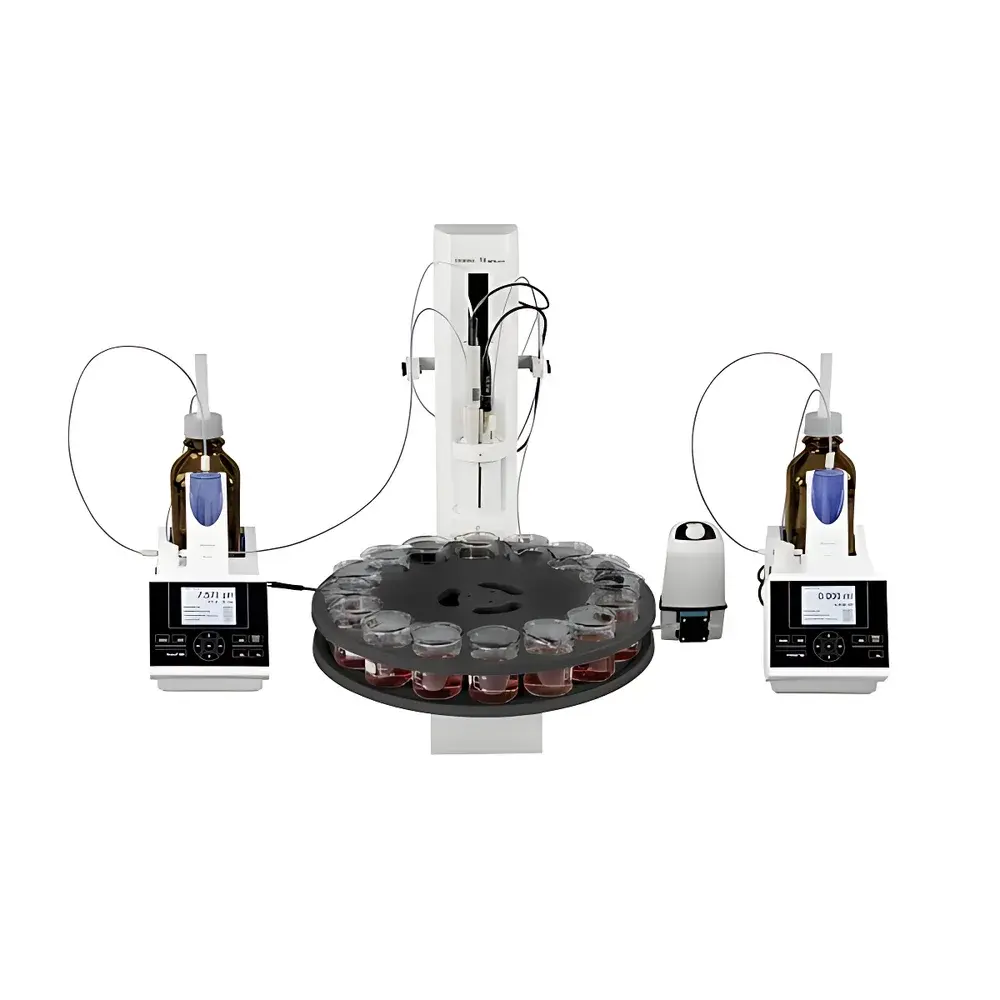
ChemTron TW alpha plus Automatic Continuous Potentiometric Titrator
| Brand | ChemTron |
|---|---|
| Origin | Germany |
| Model | TW alpha plus |
| Instrument Type | Universal Potentiometric Titrator |
| Sample Capacity | 12/16/24-position carousel (24-position compatible with COD reaction vials) |
| Cleaning System | Automated single- or dual-solvent rinse between titrations |
| Stirring Options | Bottom-mounted magnetic stirring or top-mounted mechanical stirring |
| Optional Peristaltic Pump | MP25 membrane liquid pump for complex titration protocols |
| Control Interface | Fully operable via integrated titrator console or external PC-based software |
| Compliance | Designed for GLP/GMP-aligned workflows |
| Connectivity | Compatible with analytical balances, thermostatted titration vessels, Karl Fischer dry ovens, homogenizers, printers, and PCs |
Overview
The ChemTron TW alpha plus Automatic Continuous Potentiometric Titrator is a modular, high-reliability electrochemical platform engineered for unattended, multi-sample potentiometric titration in regulated and research-intensive laboratory environments. Based on the fundamental principle of potentiometric endpoint detection—measuring the potential difference across a working electrode (e.g., pH, redox, or ion-selective) versus a stable reference electrode—the system delivers traceable, reproducible equivalence point determination under programmable kinetic and stoichiometric conditions. Its architecture integrates precise reagent delivery, adaptive endpoint recognition algorithms, and thermally stabilized reaction vessels to minimize drift and inter-sample carryover. Designed and assembled in Germany, the TW alpha plus conforms to IEC 61010-1 safety standards and meets essential performance criteria outlined in ISO 8655-6 (piston burettes) and ASTM E202–22 (standard test methods for water in organic liquids by coulometric Karl Fischer titration, where applicable via optional dry oven integration).
Key Features
- Modular sample handling: Interchangeable 12-, 16-, or 24-position carousels; the 24-position configuration accommodates standardized COD reaction vials for environmental wastewater analysis.
- Automated post-titration cleaning: Configurable single- or dual-solvent rinse cycles between samples; up to three independent rinse stations support sequential solvent exchange (e.g., water → ethanol → acetone), while a dedicated KCl soaking station maintains pH electrode hydration and junction stability.
- Dual stirring modalities: User-selectable bottom-mounted magnetic stirring (for low-viscosity aqueous systems) or top-mounted mechanical stirring (for heterogeneous, viscous, or suspended-phase samples).
- Expandable fluid handling: Optional MP25 membrane peristaltic pump enables precise metering of auxiliary reagents, masking agents, or pH-adjusting solutions during multi-step titrations (e.g., complexometric EDTA titrations with pH buffering).
- Hardware-software interoperability: Native control via ChemTron’s embedded titrator interface or remote orchestration through PC-based ChemSoft Titration Suite, supporting method import/export, real-time data overlay, and customizable report templates.
Sample Compatibility & Compliance
The TW alpha plus supports a broad range of sample matrices—including aqueous solutions, emulsions, suspensions, digested biological tissues, and acid-dissolved mineral extracts—provided they fall within standard electrochemical compatibility limits (pH 0–14, conductivity < 2 S/m, particulate size < 50 µm). It complies with Good Laboratory Practice (GLP) and Good Manufacturing Practice (GMP) documentation requirements when operated with audit-trail-enabled software configurations. The system is validated for use in accordance with USP , EP 2.2.20, and ISO/IEC 17025:2017 clauses related to measurement traceability and uncertainty estimation in volumetric analysis. Optional accessories—including thermostatted titration cups (±0.1 °C stability), analytical balance interfaces (Sartorius, Mettler Toledo), and Karl Fischer dry ovens—extend its applicability to moisture determination per ASTM E203 and ISO 760.
Software & Data Management
ChemSoft Titration Suite provides full lifecycle method management: from parameter definition (titrant concentration, equivalence point algorithm selection—1st/2nd derivative, fixed increment, or Gran plot) to raw signal visualization (E vs. V curves), automatic baseline correction, and uncertainty propagation reporting. All user actions—including method edits, start/stop commands, and calibration events—are time-stamped and logged with operator ID in an immutable audit trail compliant with FDA 21 CFR Part 11 Subpart B. Data export formats include CSV, PDF (with digital signature option), and XML for LIMS integration. Electronic signatures, role-based access control (RBAC), and encrypted local database storage ensure regulatory readiness without third-party middleware dependencies.
Applications
- Environmental testing: COD, alkalinity, chloride, and cyanide determinations per APHA Standard Methods 5220, 2320, 4500-Cl⁻, and 4500-CN⁻.
- Pharmaceutical QC: Assay of active pharmaceutical ingredients (APIs) via acid–base, redox, or precipitation titrations; excipient quantification (e.g., citric acid in oral solutions).
- Food & beverage: Total acidity (TA), free SO₂, salt content, and lactic acid in dairy and fermented products.
- Chemical manufacturing: Purity assessment of inorganic salts, catalyst precursors, and surfactants using selective ion electrodes or redox indicators.
- Research laboratories: Method development for non-aqueous titrations (e.g., perchloric acid in glacial acetic acid), potentiometric titration coupled with UV-Vis monitoring, or sequential multi-analyte protocols.
FAQ
What electrode types are supported?
The TW alpha plus accepts standard BNC- or DIN-compatible pH, redox, silver/silver chloride, and ion-selective electrodes (e.g., fluoride, nitrate, calcium) with automatic electrode identification via encoded connectors.
Can it perform back-titrations or multi-step titrations?
Yes—via programmable sequence logic in ChemSoft, including conditional branching (e.g., “if endpoint not detected within X mL, add Y reagent and continue”), making it suitable for iodometric, argentometric, and complexometric procedures.
Is validation documentation available?
ChemTron supplies IQ/OQ protocol templates, factory calibration certificates (traceable to NIST standards), and a comprehensive User Requirement Specification (URS) alignment guide for GxP environments.
How is carryover minimized during high-throughput runs?
The dual-solvent rinse cycle—combined with optimized rinse volume, dwell time, and air purge—achieves < 0.005% residual carryover (validated using 0.1 M KCl spiked with 10 ppm Co²⁺).
Does it support remote monitoring or integration with lab automation systems?
Via Ethernet or RS-232, the instrument supports Modbus TCP and ASCII command protocols for integration into central lab management systems (LMS) or robotic sample handlers compliant with ANSI/SLAS standards.
Related Products





