
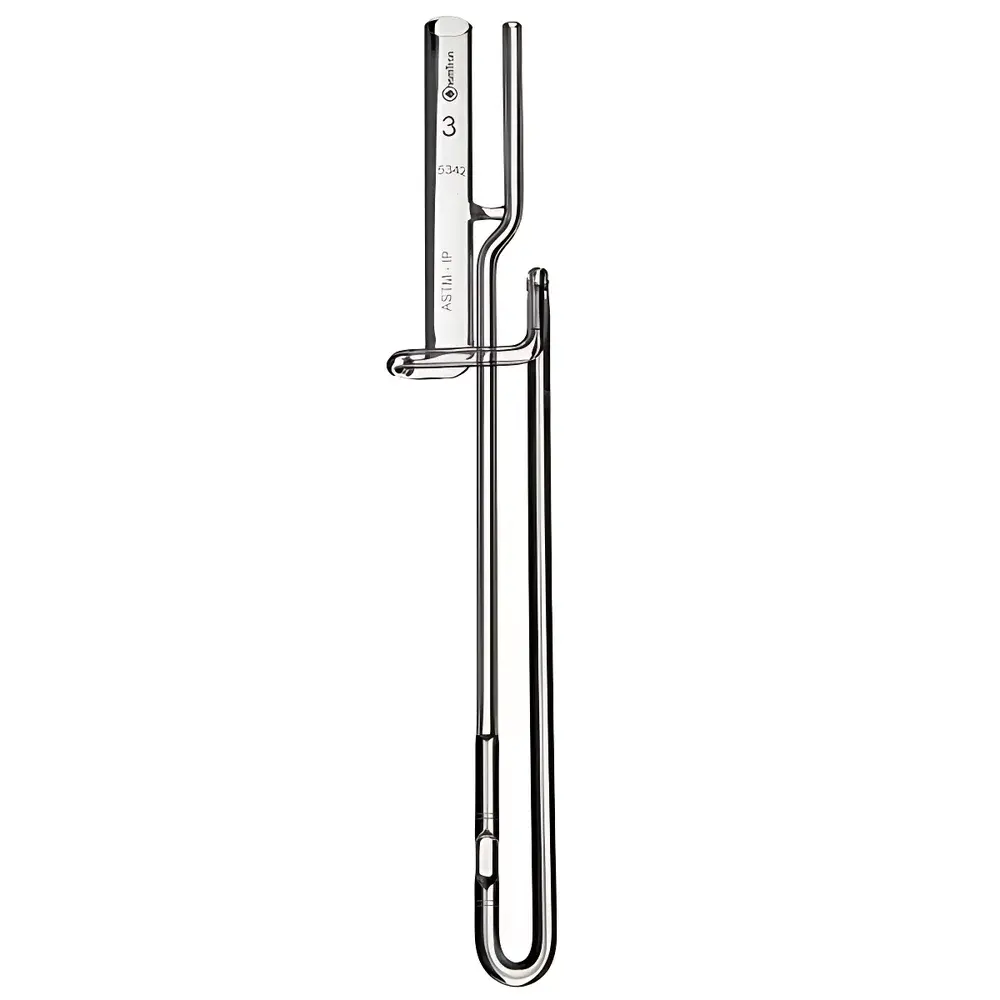
ChemTron Ubbelohde-Type Capillary Viscometer (Model 1663)
| Brand | ChemTron |
|---|---|
| Origin | Germany |
| Model | 1663 |
| Instrument Type | Portable Capillary Viscometer |
| Viscosity Range | 0.6 – 100,000 mm²/s |
| Calibration Compliance | ISO/IEC 17025 |
| Fill Volume | 3 mL |
| Total Length | 295 mm |
| Capillary Constant (K-value) Range | 0.003 – 100.0 mm²/s² |
| Available K-value Codes | 1663/01 to 1663/10 |
Overview
The ChemTron Ubbelohde-Type Capillary Viscometer (Model 1663) is a precision-engineered glass capillary viscometer designed for kinematic viscosity measurement of transparent and Newtonian liquids in accordance with ASTM D445, ISO 3104, IP 71, and DIN 51562 standards. Based on the principle of Poiseuille flow, it measures the time required for a fixed volume of liquid to gravitationally flow through a calibrated capillary under controlled temperature conditions—typically within a thermostatted bath (±0.01 °C stability recommended). Unlike Ostwald or suspended-level viscometers, the Ubbelohde design features a separate reservoir arm that isolates the timing section from hydrostatic pressure variations, ensuring high reproducibility and eliminating dependence on sample volume beyond the minimum fill requirement. This architecture delivers intrinsic accuracy for routine QC testing and research-grade fluid characterization across petrochemicals, lubricants, polymers, solvents, and pharmaceutical excipients.
Key Features
- Manufactured in Germany from borosilicate 3.3 glass (DIN ISO 3585), ensuring thermal stability, chemical resistance, and long-term dimensional integrity
- ISO/IEC 17025-accredited calibration traceable to national metrology institutes; each unit supplied with individual K-value certificate and unique serial identifier
- Ten standardized K-value variants (1663/01–1663/10) covering a continuous kinematic viscosity range from 0.6 to 100,000 mm²/s — enabling method-specific selection without interpolation error
- Optimized geometry: 3 mL nominal fill volume, total length 295 mm, with precisely ground timing bulbs and capillary bore diameters ranging from ~0.2 mm to 1.2 mm depending on K-value
- Integrated universal stand (1663/01 accessory) provides vertical alignment, secure clamping, and compatibility with standard bath openings (≥60 mm diameter)
- No electronics or power required — fully manual operation supports GLP-compliant manual data recording and audit-ready procedural documentation
Sample Compatibility & Compliance
The Model 1663 is validated for use with low- to medium-viscosity Newtonian fluids including mineral oils, synthetic lubricants, diesel fuels, biodiesel blends, glycerol/water mixtures, and organic solvents. It is not suitable for non-Newtonian, opaque, or particulate-laden samples. All units comply with ISO 3104:2016 requirements for capillary viscometer geometry, dimensional tolerances, and calibration methodology. The certified K-values are determined using reference oils with certified kinematic viscosity (e.g., NIST SRM 2786 series) at 20 °C and 40 °C. Full calibration documentation satisfies regulatory expectations for instruments used in ISO 9001, ISO 14001, and API RP 1162 environments. For laboratories operating under FDA 21 CFR Part 11 or EU Annex 11, manual timing records generated with this viscometer may be incorporated into validated electronic lab notebooks (ELN) with appropriate metadata annotation and reviewer sign-off.
Software & Data Management
As a purely mechanical, analog measurement device, the Model 1663 does not incorporate embedded firmware or digital interfaces. However, its standardized output — efflux time (t, in seconds) — integrates seamlessly into laboratory data management workflows. Users typically record t manually or via stopwatch interfaced with LIMS or ELN systems. Kinematic viscosity (ν) is calculated as ν = K × t, where K is the certified capillary constant (mm²/s²). ChemTron provides a downloadable Excel-based calculation template supporting automatic uncertainty propagation per GUM (JCGM 100:2008) and generation of ASTM D445-compliant test reports. Optional third-party software (e.g., RheoLab Suite, ViscoSoft Pro) can import timed data from Bluetooth stopwatches for automated batch reporting and statistical process control (SPC) charting.
Applications
- Quality control of base oils and finished lubricants per ASTM D445 and ISO 3104
- Viscosity grading of bitumen binders and asphalt emulsions (ASTM D2170)
- Stability assessment of polymer solutions during solvent evaporation studies
- Batch release testing of pharmaceutical-grade propylene glycol, ethylene glycol, and PEG solutions
- Educational demonstration of Newtonian fluid behavior and Hagen–Poiseuille law validation
- Reference method verification for rotational viscometers and automated microviscometers
FAQ
What temperature control is required for accurate measurements?
Standard practice requires immersion in a thermostatically controlled bath with stability ≤ ±0.01 °C at the specified test temperature (commonly 20 °C, 40 °C, or 100 °C). Bath uniformity across the capillary bulb region must be verified per ISO 17025.
Can this viscometer be used for non-Newtonian fluids?
No. The Ubbelohde principle assumes laminar, steady-state flow of Newtonian fluids. Shear-thinning or thixotropic behavior invalidates the Poiseuille-derived viscosity calculation.
How often should recalibration be performed?
Per ISO/IEC 17025, recalibration is recommended annually or after mechanical shock, cleaning with aggressive solvents, or observed drift exceeding ±0.5% of certified K-value.
Is cleaning procedure standardized?
Yes. Recommended protocol: rinse sequentially with toluene, acetone, and filtered air; avoid ultrasonic cleaning unless validated for borosilicate 3.3 glass. Never use chromic acid or HF-containing solutions.
Does ChemTron provide installation qualification (IQ) or operational qualification (OQ) documentation?
Upon request, ChemTron supplies a customizable IQ/OQ template aligned with ASTM E2500 and EU GMP Annex 15, including verification steps for vertical alignment, bath immersion depth, and timing repeatability (n ≥ 5 replicates, RSD ≤ 0.2%).



