
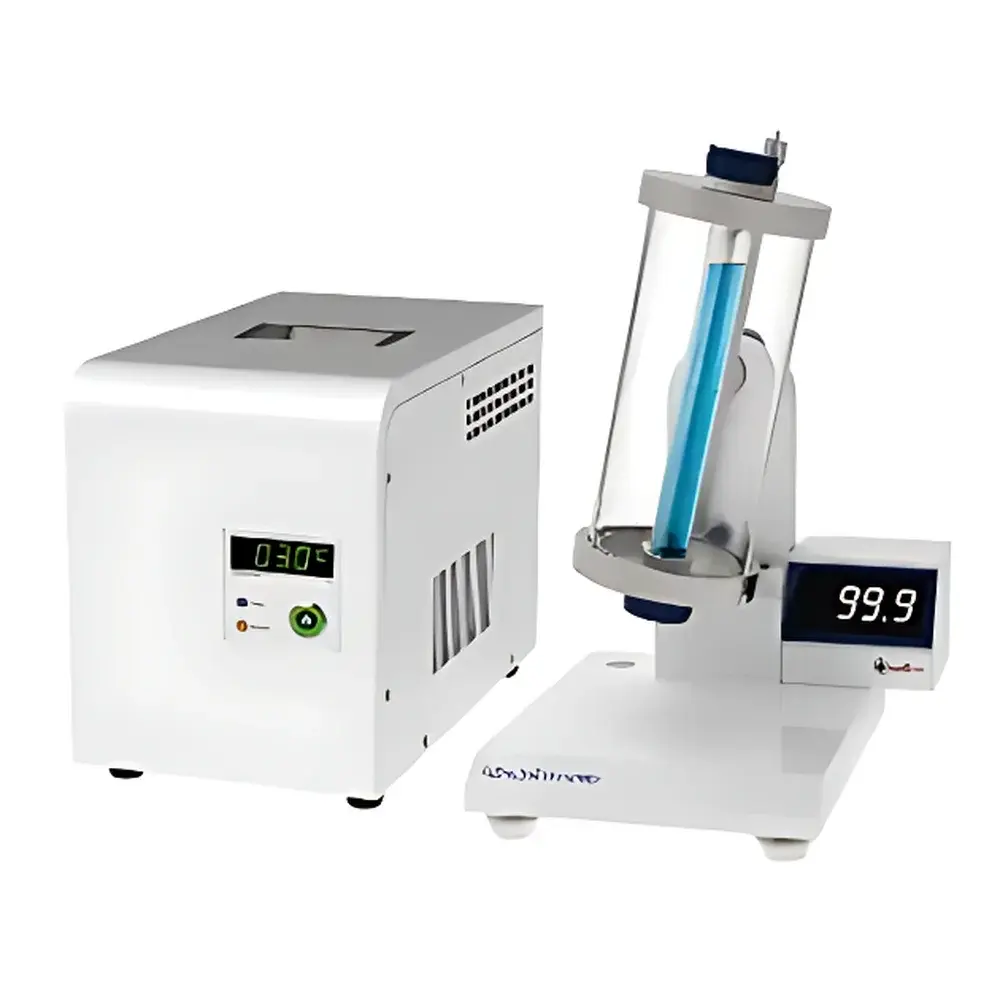
ChemTron V92101 Hoeppler Falling-Ball Viscometer
| Brand | ChemTron |
|---|---|
| Origin | Germany |
| Model | V92101 |
| Instrument Type | Portable Falling-Ball Viscometer |
| Viscosity Range | 0.6–75,000 mPa·s |
| Temperature Range | −20 to +120 °C |
| Temperature Resolution | 0.1 °C |
| Measuring Tube Internal Diameter | 15.95 mm |
| Compliance | DIN 53015, ISO 12058 |
| Display | LED with digital temperature readout |
| Thermal Control | External jacketed bath (10 mm OD inlet/outlet ports) |
| Standard Accessories | Calibrated ball set (V92101–V92106), tweezers, cleaning brush, factory calibration certificate |
Overview
The ChemTron V92101 Hoeppler Falling-Ball Viscometer is a precision laboratory instrument engineered for the dynamic viscosity measurement of transparent Newtonian liquids using the classical Hoeppler principle. This method relies on gravitational sedimentation of a calibrated sphere through a vertically oriented, thermostatically controlled glass capillary tube filled with sample fluid. Upon 180° rapid inversion of the measuring assembly—mounted on a low-friction central bearing—the sphere begins its descent under gravity along a defined path between two precisely engraved timing marks. The transit time is recorded digitally and converted into kinematic or dynamic viscosity (mPa·s) via a validated calibration function traceable to NIST-traceable reference oils. Designed for high reproducibility and minimal operator dependency, the V92101 delivers consistent results across routine QC workflows in regulated and non-regulated environments alike. Its modular architecture supports integration with external high-precision circulating baths (e.g., JULABO units) to ensure thermal stability within ±0.05 °C—critical for temperature-sensitive formulations.
Key Features
- Compliant with internationally recognized standards: DIN 53015 and ISO 12058 for falling-ball viscometry
- LED digital display with real-time temperature readout (0.1 °C resolution) and integrated leveling adjustment mechanism
- Dual timing mark configuration enables rapid, repeatable measurements without repositioning or manual alignment
- High-stability stainless steel base with vibration-damping feet ensures mechanical rigidity during measurement cycles
- Optically clear borosilicate glass measuring tube (ID 15.95 mm) housed in a double-walled, jacketed thermal sleeve for uniform heat transfer
- Factory-calibrated ball set (V92101–V92106) supplied with individual NIST-traceable calibration certificates; each ball optimized for specific viscosity sub-ranges
- Quick-release 180° flip mechanism allows immediate duplicate or triplicate runs—reducing total analysis time per sample
Sample Compatibility & Compliance
The V92101 is validated for use with optically transparent, Newtonian fluids exhibiting no significant yield stress or thixotropic behavior. It is routinely deployed in laboratories adhering to GLP, GMP, and ISO/IEC 17025 quality frameworks. While not inherently compliant with FDA 21 CFR Part 11, its data output (time, temperature, calculated viscosity) can be captured in audit-trail-enabled LIMS or ELN systems when paired with compatible digital logging interfaces. The instrument meets essential safety and electromagnetic compatibility requirements per CE directives (2014/30/EU, 2014/35/EU). Sample compatibility spans mineral oils, hydrocarbon solvents, food-grade syrups (honey, corn syrup), pharmaceutical excipients (glycerol, propylene glycol), polymer solutions, and coating resins—provided clarity and absence of particulates are confirmed prior to analysis.
Software & Data Management
The V92101 operates as a standalone analog-digital hybrid system with no embedded firmware or proprietary software. All calculations are performed externally using the supplied calibration equation and measured transit time. Users may integrate time/temperature inputs into custom spreadsheets or validated laboratory informatics platforms. For automated data capture, optional RS-232 or USB-to-serial adapters enable connection to PC-based acquisition tools supporting CSV export and timestamped logging. Calibration certificates include full uncertainty budgets (k=2) aligned with ISO/IEC 17025 Clause 6.4, facilitating metrological traceability audits. Routine recalibration is recommended annually or after 500 measurement cycles, whichever occurs first.
Applications
- Petroleum & lubricants: Base oils, transformer fluids, hydraulic oils, diesel fuels
- Food & beverage: Honey, maple syrup, molasses, fruit concentrates, dairy-based emulsions
- Pharmaceuticals & cosmetics: Glycerin, PEG solutions, topical gels, solvent-based extracts
- Chemicals & polymers: Monomer solutions, resin dilutions, crosslinker formulations
- Paints & coatings: Solvent-borne varnishes, ink vehicles, pigment dispersions
- Pulp & paper: Starch slurries, sizing agents, retention aid solutions
- Cleaning & surfactants: Alkaline cleaners, detergent concentrates, wetting agent blends
FAQ
What viscosity range does the V92101 cover, and how is it extended?
The standard configuration covers 0.6–75,000 mPa·s using six interchangeable calibrated spheres (V92101–V92106), each assigned to a defined subrange based on density and diameter. No user recalibration is required.
Is temperature control built-in or external?
Temperature regulation is external: the instrument features a jacketed measuring tube with 10 mm OD ports for connection to a certified circulating bath (e.g., JULABO F25 or similar). Internal heating/cooling elements are not present.
Can the V92101 measure non-Newtonian fluids?
No. The Hoeppler method assumes constant shear rate and linear stress–strain response. Non-Newtonian samples (e.g., xanthan gum solutions, ketchup) will yield inaccurate and non-reproducible values.
How often must the glass measuring tube be cleaned?
The tube must be thoroughly rinsed with appropriate solvents (e.g., acetone, isopropanol) and dried with lint-free tissue after every sample to prevent residue buildup and refractive index interference.
Does the instrument require periodic verification against reference standards?
Yes. Annual verification using certified viscosity reference oils (e.g., Cannon–Fenske or Paratherm standards) is recommended to confirm system accuracy and detect drift in timing electronics or thermal coupling efficiency.
Related Products



