
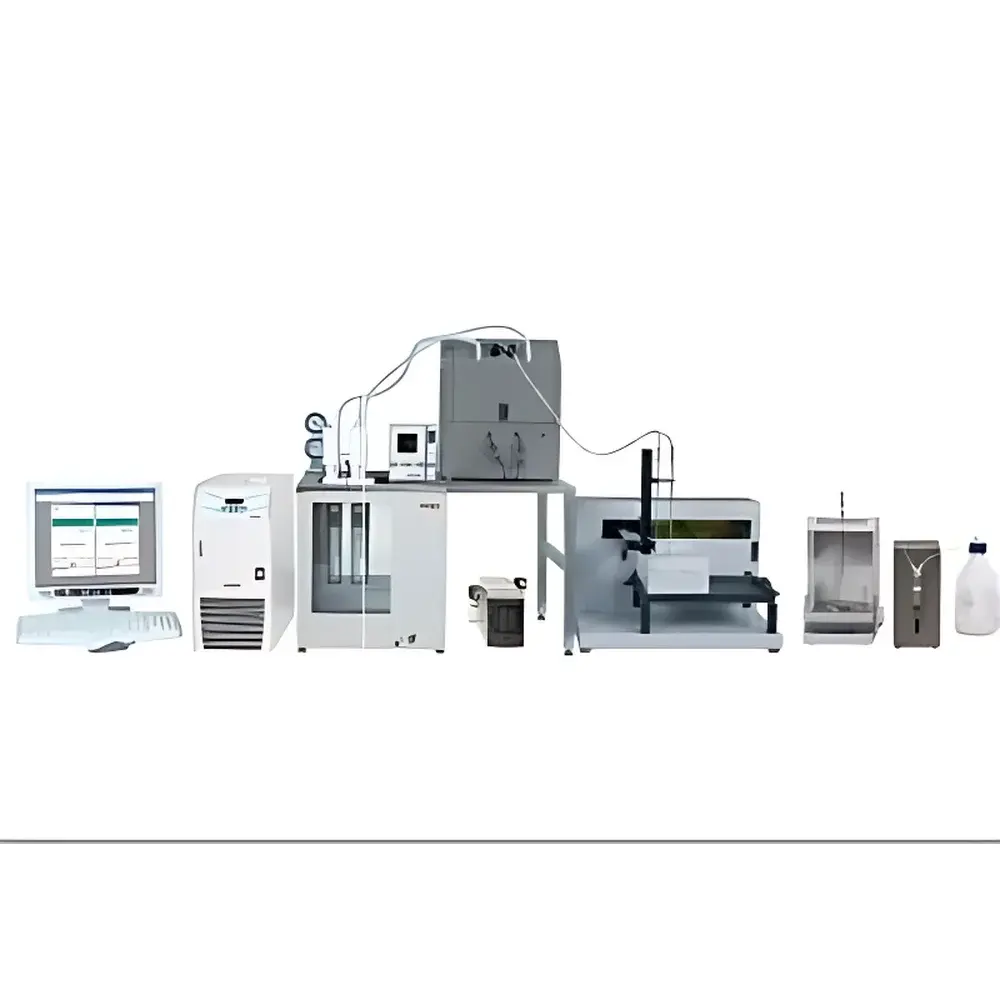
ChemTron VICSO 380 Fully Automated Polymer Kinematic Viscosity and Molecular Weight Determination System
| Brand | ChemTron |
|---|---|
| Origin | Germany |
| Model | VICSO 380 |
| Instrument Type | Rotational Viscometer-Based Capillary Viscometry System |
| Viscosity Range | 5–100 mPa·s |
| Temperature Stability | ±0.01 °C |
| Efflux Time Resolution | 0.001 s |
| Mass Accuracy | 0.01 mg or 0.1 mg |
| Compliance | ASTM D445, D789, D1243, D4603 |
Overview
The ChemTron VICSO 380 is a fully automated, modular capillary viscometry platform engineered for high-precision kinematic viscosity measurement and intrinsic viscosity-derived molecular weight determination of synthetic and natural polymers. Unlike conventional rotational viscometers, the VICSO 380 implements standardized gravity-driven capillary flow—aligned with ASTM D445, ISO 3104, and ISO 307—ensuring traceable, inter-laboratory comparable results. Its core architecture integrates gravimetric solution preparation, thermally controlled dissolution, temperature-stabilized capillary efflux timing (±0.01 °C), and vacuum-assisted solvent recovery—all under unified software orchestration. Designed specifically for polymer QC/QA and R&D laboratories, the system eliminates operator-induced variability in sample preparation, thermal history control, and efflux timing—critical factors affecting Mark–Houwink parameter accuracy and molecular weight reproducibility.
Key Features
- Fully automated workflow: solution preparation (mass/mass method), polymer dissolution (programmable heating/cooling/stirring profile), sample aspiration, capillary efflux measurement, tube cleaning, drying, and data reporting
- High-accuracy gravimetric dispensing: integrated analytical balance (0.01 mg or 0.1 mg resolution) and precision liquid dispenser ensure ≤0.1% concentration uncertainty per ISO 1628-1 and ASTM D4603
- Thermally isolated viscometer bath: Peltier-cooled stainless-steel bath with internal cooling ring maintains ±0.01 °C stability across −40 °C to +150 °C operating range; no external chilled water required
- Chemical-resistant fluidic path: all solvent-contact components fabricated from PTFE, borosilicate glass, and chemically inert elastomers—fully compatible with chlorinated solvents (e.g., chloroform, o-dichlorobenzene), phenol-based systems, and formic acid
- Four-position parallel testing: independent capillary modules enable concurrent analysis of up to four samples—achieving throughput of 8–10 samples/hour per station
- Integrated safety architecture: low-level bath detection, dry-run prevention, solvent depletion alerts, waste reservoir full sensing, overtemperature shutdown, and SAFE VACUUM™ controlled vacuum cleaning cycle
Sample Compatibility & Compliance
The VICSO 380 supports a broad spectrum of thermoplastic and thermosetting polymers—including polyamide (PA/Nylon), polyethylene terephthalate (PET), polyvinyl chloride (PVC), polyolefins (PE, PP), polycarbonate (PC), polylactic acid (PLA), polybutylene terephthalate (PBT), cellulose derivatives, esterified fibers, pulp suspensions, and ink formulations. All measurements comply with internationally recognized standards: ASTM D445 (kinematic viscosity), D789 (inherent viscosity of nylon), D1243 (PVC K-value), D4603 (PET intrinsic viscosity), ISO 307 (polyamides), ISO 5351 (cellulose), ISO 1628-1 (general polymer solutions), DIN 53726–53728 (viscosity number, K-value, and molecular weight estimation), and DIN 7744 (capillary calibration). System validation includes documented standard deviation performance: <0.03% for PA (ISO 307), <0.10% for PA (ASTM D789), <0.15% for PVC (ASTM D1243), and <0.26% for PET (ASTM D4603).
Software & Data Management
The VICSO Control Suite provides full system orchestration via intuitive GUI, supporting GLP-compliant audit trails, user role management, electronic signatures, and 21 CFR Part 11–ready data integrity features. Raw efflux times, mass values, temperature logs, and calculated parameters—including kinematic viscosity (mm²/s), relative viscosity (ηrel), specific viscosity (ηsp), inherent viscosity ([η]inh), intrinsic viscosity ([η]), limiting viscosity number (LVN), K-value, DP (degree of polymerization), and molecular weight (via Mark–Houwink equation)—are automatically computed and exported in CSV, PDF, or XML format. The software supports direct LIMS integration via ASTM E1394 or HL7-compatible APIs. Custom calculation modules (e.g., multi-point dilution series fitting, Huggins/Kraemer extrapolation, branching index derivation) are available upon request.
Applications
The VICSO 380 serves as a primary tool in polymer manufacturing quality control, formulation development, and regulatory submission support. Typical use cases include batch release testing of PET resin for bottle-grade applications (ASTM D4603), specification verification of nylon 6,6 fiber intermediates (ISO 307), K-value assessment of suspension-grade PVC (ASTM D1243), intrinsic viscosity monitoring during polyacrylonitrile (PAN) fiber spinning dope preparation, and molecular weight trending in biodegradable PLA production. Its automated dissolution protocol—featuring programmable ramp/soak/cool cycles under defined shear—is particularly valuable for process optimization studies where thermal degradation or premature crystallization must be avoided.
FAQ
Does the VICSO 380 measure dynamic or kinematic viscosity?
It measures kinematic viscosity (mm²/s) via calibrated capillary efflux time, then derives dynamic viscosity using solvent density input.
Can the system handle high-boiling or thermally sensitive solvents?
Yes—the bath operates from −40 °C to +150 °C with active cooling, and dissolution modules feature jacketed heating/stirring with programmable thermal profiles to prevent degradation.
Is calibration traceable to national standards?
Capillary viscometers are calibrated using NIST-traceable certified reference oils (ASTM D445 Annex A1); system temperature sensors are certified to ISO/IEC 17025-accredited labs.
How is solvent consumption minimized during cleaning?
The SAFE VACUUM™ system uses pulsed solvent delivery and pressure-controlled aspiration, reducing cleaning solvent volume by >60% versus continuous rinse methods.
What level of IT infrastructure is required for LIMS integration?
Standard Ethernet connection and Windows-based host PC; API documentation and validation protocols provided for IQ/OQ execution.



