
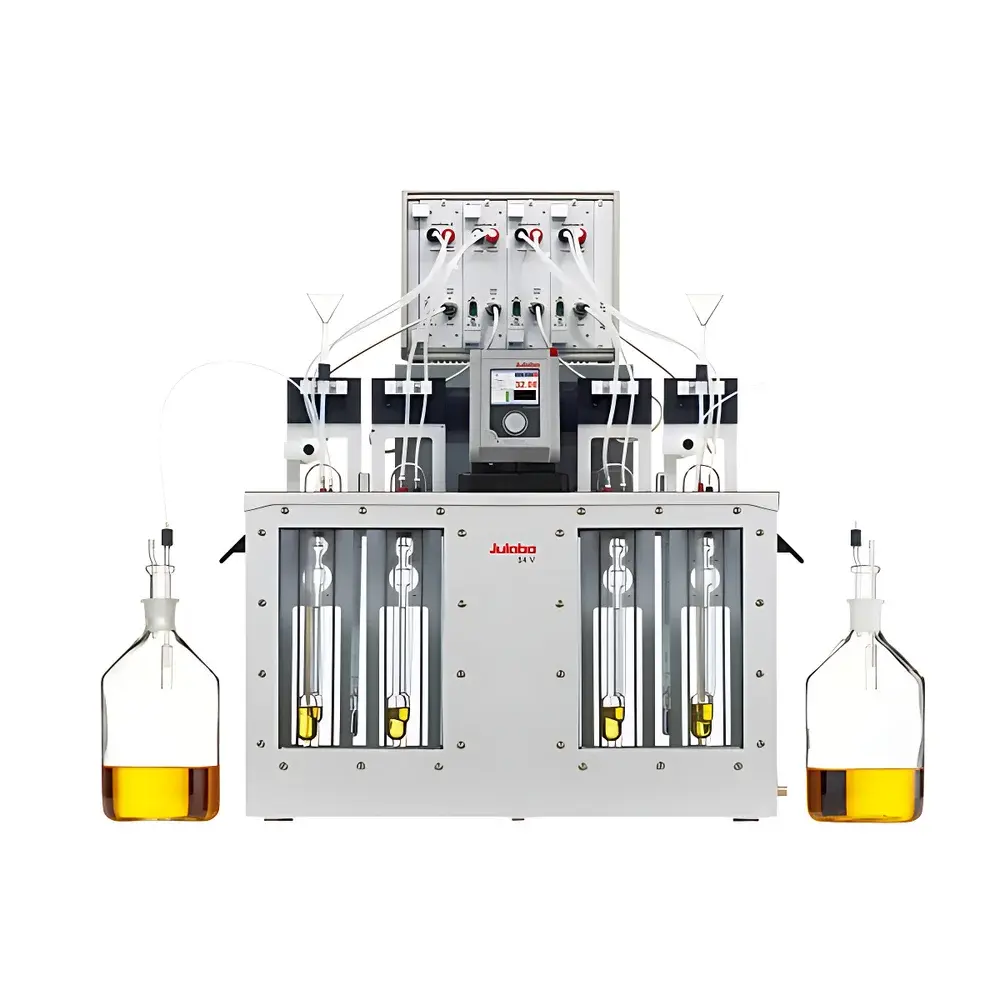
ChemTron VISCO 370 Automated Kinematic Viscosity Measurement System
| Brand | ChemTron |
|---|---|
| Origin | Germany |
| Model | VISCO 370 |
| Measurement Principle | Capillary Viscometry (Ostwald/Ubbelohde/Cannon-Fenske) |
| Temperature Range | –40 °C to +150 °C |
| Temperature Stability | ±0.01 °C (DT-series bath) |
| Timing Resolution | 0.01 s |
| Timing Accuracy | ±0.01% (±1 digit) |
| Kinematic Viscosity Range | 0.35–1800 mm²/s (cSt) under pressure mode |
| Capillary Compatibility | Ubbelohde, Cannon-Fenske, micro-Ostwald, micro-Ubbelohde, dilution-type, and thermal conductivity viscometers |
| Calibration | ISO/ASTM-traceable capillaries with certified constants to four decimal places |
| Module Scalability | Up to 8 independent measurement units |
| Cleaning Options | Single- or dual-solvent automated rinsing with programmable solvent volume, rinse duration, and drying time |
| Software | WinVisco 4 (multi-language: EN/DE/FR/ES/CN), supports ASTM D445, ISO 3104, ISO 1628, USP <911>, and GLP-compliant audit trail |
| Data Output | PDF & CSV reports with timestamped filenames, full traceability, and user-level access control (3-tier permissions) |
| Compliance | Fully compliant with ASTM D445, ISO 3104, ISO 1628-1, DIN 51562, and FDA 21 CFR Part 11 (when configured with electronic signature and audit trail enabled) |
Overview
The ChemTron VISCO 370 Automated Kinematic Viscosity Measurement System is an engineered solution for high-precision, fully automated capillary viscometry in petroleum, polymer, lubricant, and chemical quality control laboratories. Based on the fundamental principle of kinematic viscosity determination—measuring the time required for a fixed volume of liquid to flow under gravity (or controlled pressure/vacuum) through a calibrated glass capillary—the VISCO 370 delivers reproducible, standards-compliant results across wide viscosity ranges. Its dual-mode fluid handling architecture supports both pressure-driven and vacuum-driven aspiration, enabling robust adaptation to low- and high-viscosity samples without hardware reconfiguration. Designed for regulatory environments, the system operates within temperature-controlled baths with stability of ±0.01 °C (DT-series), ensuring adherence to ASTM D445 and ISO 3104 requirements for thermal equilibration and timing accuracy. All capillaries are individually certified per ISO/IEC 17025 and supplied with traceable calibration certificates specifying constants to four decimal places.
Key Features
- Modular architecture supporting scalable configurations from 1 to 8 independent measurement units—each configurable for distinct capillary types and operational modes (pressure/vacuum).
- Dual-mode fluid handling: seamless switching between pressure-assisted (0.35–1800 mm²/s) and vacuum-assisted (0.35–5000 mm²/s) aspiration, eliminating manual intervention during method execution.
- High-resolution timing system with 0.01 s resolution and ±0.01% accuracy (±1 digit), synchronized with photometric or optional thermal-conductivity-based meniscus detection.
- Automated cleaning module with programmable single- or dual-solvent protocols—including solvent volume, rinse duration, and inert-gas drying cycles—to minimize analyst exposure and cross-contamination.
- Temperature-controlled transparent bath options: DT-series (±0.01 °C stability) and CT-series (±0.03 °C), available in 2-, 4-, 6-, or 8-position formats, including cryogenic (–40 °C) and high-temperature (+150 °C) variants.
- Three-tier user permission management, electronic signatures, and full audit trail functionality compliant with FDA 21 CFR Part 11 when enabled via WinVisco 4 configuration.
Sample Compatibility & Compliance
The VISCO 370 accommodates standard and specialized capillaries per ISO 3104, ASTM D445, DIN 51562, and USP , including Ubbelohde, Cannon-Fenske, micro-Ostwald, dilution-type, and thermal-conductivity viscometers. It supports all common petroleum fractions (e.g., base oils, distillates, residuals), synthetic lubricants, polymer solutions (e.g., PET, PA, PC in phenol/o-chlorophenol), and biofuels. Each capillary is supplied with an ISO/ASTM-traceable calibration certificate, and the system validates capillary integrity prior to each run using optical meniscus detection. Regulatory compliance extends to GLP and GMP laboratory workflows: data immutability, method version control, user-specific activity logging, and report generation with embedded metadata (operator ID, timestamp, environmental conditions, calibration status) satisfy internal QA and external auditor requirements.
Software & Data Management
WinVisco 4 is a Windows-based platform supporting multilingual operation (English, German, French, Spanish, Chinese) and offering full remote instrument control, real-time visualization of flow events, and integrated calculation engines. It performs automatic outlier rejection using statistical deviation thresholds (e.g., Grubbs’ test), triggers repeat measurements upon failure, and applies standardized formulas for intrinsic viscosity (via Huggins/Kraemer extrapolation), polymer molecular weight estimation (Mark–Houwink–Sakurada), Saybolt Universal Viscosity (SUV), and ASTM D2161 K-factor derivation. Raw timing data, temperature logs, and calibration parameters are stored in encrypted SQLite databases. Export options include timestamped PDF analytical reports and CSV files compatible with LIMS integration. Audit trail records all critical actions—including method edits, user logins, result approvals, and calibration updates—with tamper-proof timestamps.
Applications
- Petroleum refining: kinematic viscosity of crude fractions, fuel oils, lubricating base stocks, and bitumen dilutions per ASTM D445 and ISO 3104.
- Polymers & plastics: intrinsic viscosity of polyolefins, polyesters, and nylons for molecular weight assessment per ISO 1628-1 and ASTM D1243.
- Pharmaceutical excipients: viscosity characterization of cellulose derivatives and synthetic polymers used in controlled-release formulations (USP ).
- Biofuels & renewables: cold-flow properties of biodiesel blends and hydrotreated vegetable oils under low-temperature bath conditions.
- Research & development: screening of novel lubricant additives, nanofluid rheology, and temperature-dependent viscosity profiling across –40 °C to +150 °C.
FAQ
Does the VISCO 370 support ASTM D445-compliant testing?
Yes—the system meets all instrumental and procedural requirements of ASTM D445, including temperature stability (±0.01 °C), timing resolution (0.01 s), capillary calibration traceability, and meniscus detection methodology.
Can I use my existing ISO-certified capillaries with the VISCO 370?
Yes—any capillary conforming to ISO 3104 dimensional tolerances and supplied with a valid calibration certificate can be registered and deployed in the system.
Is the software validated for 21 CFR Part 11 compliance?
WinVisco 4 supports full 21 CFR Part 11 compliance—including electronic signatures, audit trail, and role-based access control—when installed on validated IT infrastructure and configured per ChemTron’s IQ/OQ documentation package.
What cleaning solvents are compatible with the automated rinse module?
Standard solvents include toluene, xylene, chloroform, THF, and acetone; compatibility with aggressive solvents (e.g., concentrated sulfuric acid, HF) requires optional PTFE/PFA fluid path upgrades.
How does the system handle viscosity measurements below 0.35 mm²/s?
For ultra-low-viscosity fluids (e.g., light hydrocarbons, solvents), ChemTron recommends pairing the VISCO 370 with micro-capillary configurations and optimized vacuum-mode protocols, validated per ASTM D7042 for dynamic viscosity correlation.





