
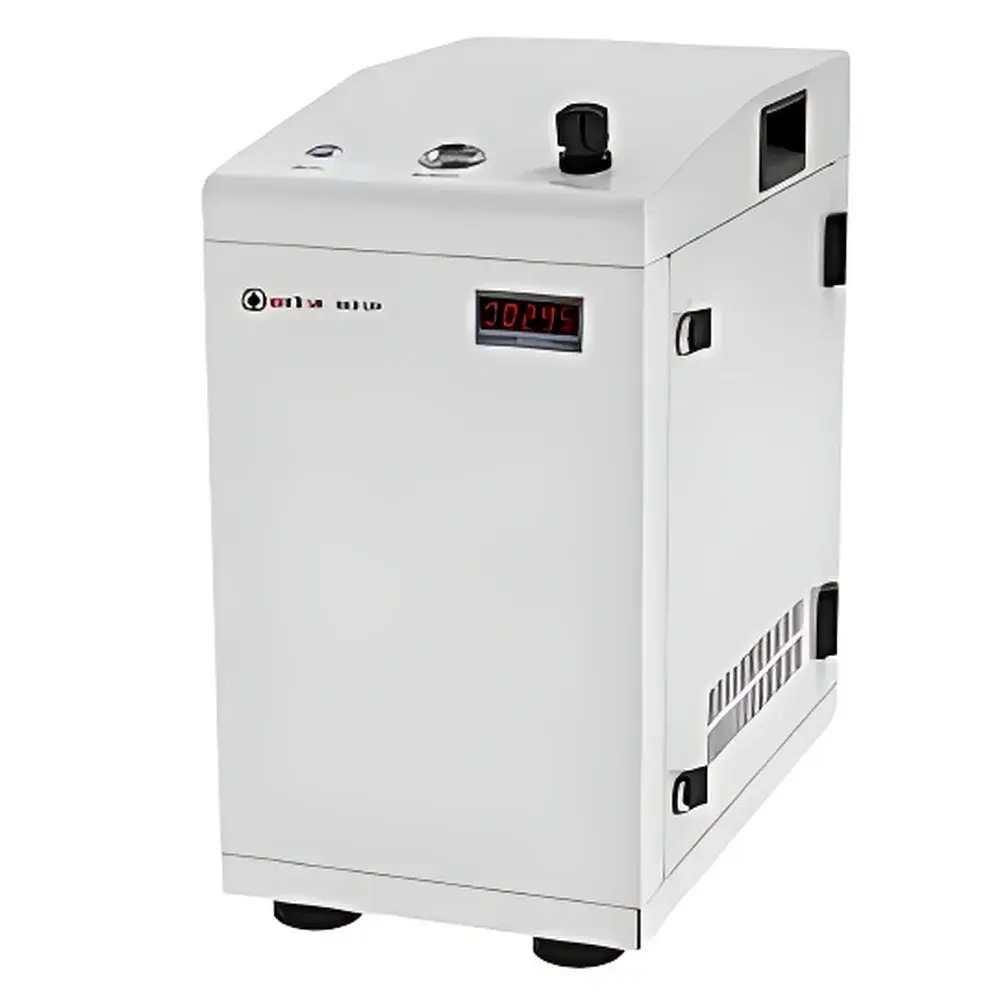
ChemTron WIND CAD Dedicated Nitrogen Generator for Charged Aerosol Detectors
| Brand | ChemTron |
|---|---|
| Origin | Germany |
| Model | WIND CAD |
| Output Flow | 20 L/min @ 5.5 bar |
| Output Pressure | 5.5 bar |
| Nitrogen Dew Point | < −40 °C |
| Ambient Temperature Range | 10–35 °C |
| Ambient Humidity | 0–80 % RH (non-condensing) |
| Power Supply | 220–240 V / 50 Hz |
| Noise Level | 58 dB(A) |
| Dimensions (W×L×H) | 300 × 550 × 560 mm |
| Weight | 40 kg |
| Internal Stainless Steel Buffer Tank | 5 L |
| Filtration | Integrated Type I Triple-Stage Coalescing Filter (particle retention ≤ 0.01 µm) |
| Cooling | Air-cooled heat exchanger with condensate separation |
| Control | Digital pressure switch with adjustable cut-in/cut-out setpoints |
| Safety Features | Compressor thermal overload protection, anti-vibration mounting, automatic depressurization at shutdown, ambient-safe operating temperatures |
Overview
The ChemTron WIND CAD is a purpose-engineered nitrogen generator designed exclusively for use with Charged Aerosol Detectors (CAD) in high-performance liquid chromatography (HPLC) and ultra-high-performance liquid chromatography (UHPLC) systems. Unlike generic nitrogen sources, the WIND CAD employs vacuum-driven hollow-fiber membrane separation technology—optimized for consistent delivery of dry, oil-free nitrogen at precisely regulated flow rates (up to 20 L/min) and stable pressure (5.5 bar). Its integrated air compressor, multi-stage pre-filtration, and thermally stabilized membrane module ensure long-term stability of nitrogen purity (>99.5% typical at 10 L/min), critical for baseline stability and detector response linearity in CAD applications. The system operates without high-pressure cylinders or cryogenic hazards, eliminating regulatory handling requirements while maintaining full compliance with laboratory safety protocols for continuous unattended operation.
Key Features
- Vacuum-assisted hollow-fiber membrane separation—engineered for non-degrading nitrogen selectivity over time, with no molecular sieve degradation or regeneration cycles required
- Integrated oil-free scroll-type air compressor (1450 rpm, 800 W) with thermal overload protection, anti-vibration base mount, and automatic depressurization at shutdown to reduce mechanical stress
- Triple-stage coalescing filtration (Type I) upstream of the membrane module—removes particulates ≤0.01 µm, aerosols, and water vapor prior to separation
- Integrated air-cooled heat exchanger—rapidly cools compressed air to induce condensate formation, protecting downstream membranes from thermal shock and extending service life
- Digital electronic pressure switch—field-adjustable start/stop pressure setpoints enable optimization of compressor duty cycle, reducing energy consumption and wear
- 5 L stainless steel buffer tank—resistant to corrosion from ambient humidity and residual chlorine, preventing microbial growth and ensuring gas integrity
- Front-access quick-release side panels with maintenance reference labels—facilitating routine filter replacement and system inspection without tools
- Low-noise enclosure (58 dB[A]) and passive thermal management—designed for placement within analytical laboratories without environmental impact
- Zero plasticizer or phthalate content in all wetted and structural components—compliant with ISO 10993 biocompatibility guidelines for lab-grade gas supply
Sample Compatibility & Compliance
The WIND CAD delivers nitrogen meeting ASTM D6352-22 specifications for instrumental gas purity in chromatographic detection. Its consistent dew point (<−40 °C) and particle-free output ensure compatibility with sensitive CAD nebulizers and evaporative light-scattering detectors (ELSD). The unit conforms to IEC 61000-6-3 (EMC emissions) and IEC 61000-6-2 (immunity), and its electrical design complies with EN 61010-1 for laboratory equipment safety. While not certified under FDA 21 CFR Part 11, the system supports audit-ready operation when integrated into validated HPLC workflows—its digital pressure logging, automatic runtime tracking, and maintenance history (via filter replacement intervals) align with GLP/GMP documentation expectations.
Software & Data Management
The WIND CAD operates as a standalone hardware platform with no embedded firmware or network interface. All operational parameters—including cumulative runtime, compressor cycling frequency, and pressure deviation history—are accessible via front-panel LED indicators and mechanical timers. For integration into laboratory information management systems (LIMS), analog 4–20 mA pressure output and dry-contact alarm relays (for low-pressure or high-temperature events) are available as optional accessories. No proprietary software is required; system status can be monitored through standard PLC or SCADA inputs. Maintenance logs and calibration records are maintained manually per ISO/IEC 17025 Clause 8.5.
Applications
- Charged Aerosol Detection (CAD) in pharmaceutical QC/QA labs requiring stable, oil-free nitrogen for universal compound detection independent of chromophore presence
- Evaporative Light Scattering Detection (ELSD) where low dew point and particulate-free gas prevent nozzle clogging and signal drift
- Mobile phase sparging and solvent degassing in preparative and analytical HPLC systems
- Gas supply for nitrogen-purged sample vial storage and autosampler environments
- Support gas for mass spectrometry source drying in hybrid LC-MS configurations (when paired with additional purification stages)
FAQ
What is the typical nitrogen purity delivered by the WIND CAD at rated flow?
At 10 L/min, the system delivers ≥99.5% nitrogen (balance O₂ and trace Ar); purity increases marginally at lower flows due to extended membrane residence time.
Does the WIND CAD require external cooling water or exhaust ventilation?
No—it is fully air-cooled and designed for ambient laboratory installation without dedicated HVAC support.
Can the output pressure be adjusted below 5.5 bar?
Yes—the digital pressure switch allows field adjustment of both cut-in and cut-out thresholds, enabling customized pressure bands between 3.0–6.0 bar.
How often must the triple-stage filter be replaced?
Under typical lab conditions (ISO Class 8 environment), replacement is recommended every 6–12 months or after 2000 hours of operation—whichever occurs first.
Is the 5 L buffer tank ASME-certified?
No—the tank is constructed from ASTM A240 316L stainless steel and rated for 10 bar MAWP, but it is not stamped to ASME Section VIII Division 1 due to its non-pressure-vessel classification under PED 2014/68/EU.



