
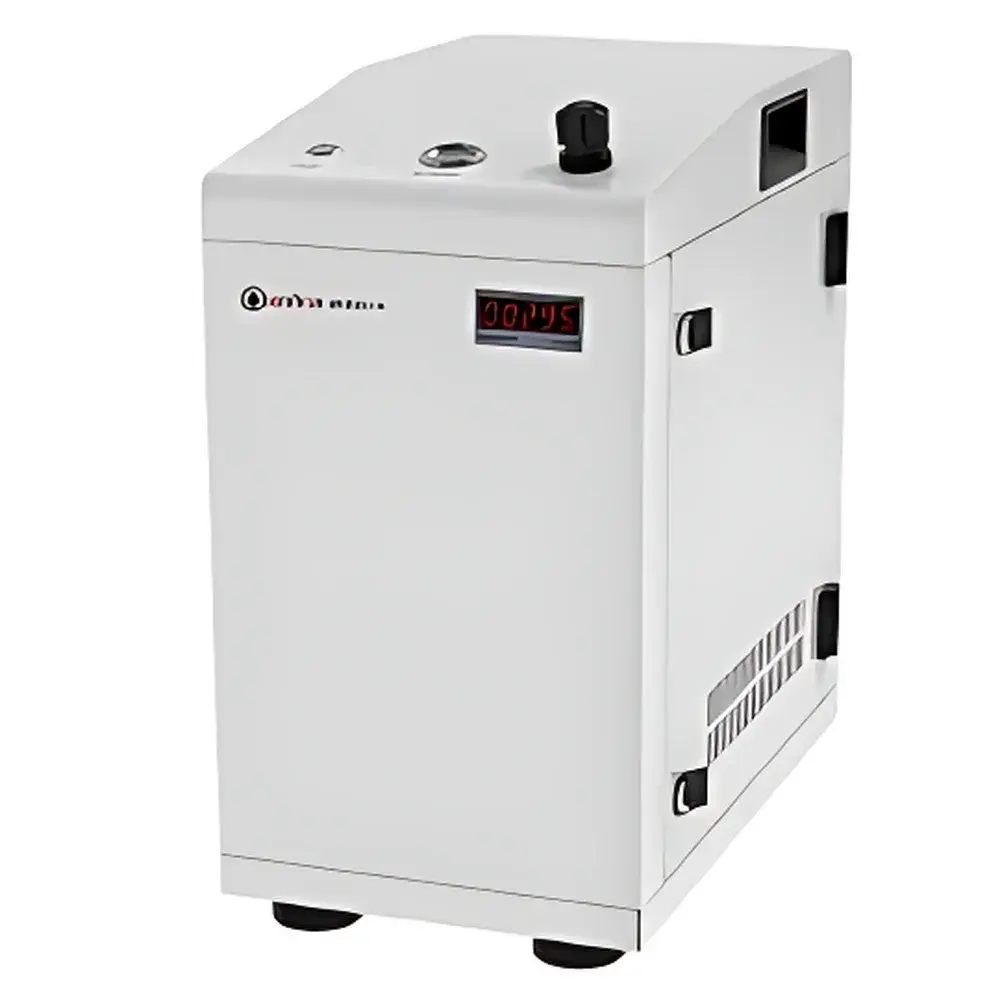
ChemTron WIND EVA M Dedicated Nitrogen Generator for Nitrogen Evaporation Systems
| Brand | ChemTron |
|---|---|
| Origin | Germany |
| Manufacturer Type | Authorized Distributor |
| Origin Category | Imported |
| Model | WIND EVA M |
| Output Flow | 45 L/min @ 5.5 bar |
| Output Pressure | 5.5 bar |
| Nitrogen Purity | 95–99% |
| Dew Point | < −40 °C |
| Ambient Temperature Range | 10–35 °C |
| Ambient Humidity | 0–80% RH (non-condensing) |
| Power Supply | 220–240 V / 50 Hz |
| Motor Speed | 1450 rpm |
| Power Consumption | 1600 W |
| Noise Level | 62 dB(A) |
| Dimensions (W×L×H) | 400 × 600 × 720 mm |
| Weight | 70 kg |
| Integrated Air Receiver | 5 L stainless steel tank |
| Filtration | Triple-stage coalescing filter (0.01 µm particulate removal) |
| Cooling | Integrated air-cooled heat exchanger and cyclonic moisture separator |
| Membrane Technology | Thermostatically stabilized hollow-fiber membrane with pre-conditioned feed air |
Overview
The ChemTron WIND EVA M is a dedicated, plug-and-play nitrogen generator engineered specifically to supply high-reliability, on-demand nitrogen gas to laboratory evaporation systems—including nitrogen blow-down concentrators, purge-and-trap units, and solid-phase extraction (SPE) workstations. It employs vacuum-driven hollow-fiber membrane separation technology—distinct from pressure-swing adsorption (PSA)—to produce nitrogen from compressed ambient air without requiring high-pressure storage cylinders or cryogenic infrastructure. The system integrates a maintenance-optimized oil-free scroll compressor, multi-stage air purification, precision thermal management, and a stainless-steel 5 L receiver tank. Designed for continuous operation in regulated laboratory environments, the WIND EVA M delivers stable flow and purity across variable demand profiles while maintaining full compliance with ISO 8573-1:2010 Class 2:2:2 (compressed air quality) and supporting GLP/GMP-aligned operational traceability.
Key Features
- Integrated oil-free scroll compressor with anti-vibration mounting and thermal overload protection—enabling safe, long-term duty cycles
- Triple-stage pre-filtration system: particulate (0.01 µm), coalescing (oil/water aerosol), and activated carbon polishing—ensuring feed air meets membrane inlet specifications
- Thermostatically controlled hollow-fiber membrane module with active temperature stabilization—guaranteeing consistent separation efficiency and preventing flux drift over time
- Cyclonic moisture separator and integrated air-cooled heat exchanger—removing >95% of condensed water upstream of the membrane, extending membrane service life and improving gas dryness
- Stainless-steel 5 L receiver tank—corrosion-resistant, chlorine-free, and microbially inert; eliminates rust-derived particulates and supports smooth pressure regulation
- Digital electronic pressure switch with adjustable cut-in/cut-out setpoints—enabling user-defined pressure band control to optimize energy consumption and compressor cycling frequency
- Automatic timed drainage and runtime logging—supporting preventive maintenance scheduling and audit-ready usage records
- Front-access quick-release side panels with integrated maintenance instructions—reducing service downtime and technician training requirements
- Lockable castor wheels—facilitating repositioning within shared lab spaces while ensuring mechanical stability during operation
Sample Compatibility & Compliance
The WIND EVA M is validated for use with all major nitrogen-dependent sample preparation platforms requiring ≤5.5 bar working pressure and flow rates up to 45 L/min. Its output meets ASTM D6349–22 requirements for nitrogen used in analytical sample concentration and complies with ISO 8573-1:2010 Class 2:2:2 for particle, water, and oil content in instrument-grade compressed air. The absence of plasticizers, phthalates, or halogenated elastomers in all wetted components ensures compatibility with sensitive applications such as residual solvent analysis (USP ) and trace-level environmental testing. All electrical components conform to IEC 61000-6-3 (EMC) and IEC 61000-6-2 (immunity) standards. The unit is CE-marked and RoHS-compliant.
Software & Data Management
While the WIND EVA M operates as a standalone hardware system without embedded firmware or network connectivity, it includes analog and digital instrumentation enabling integration into facility monitoring networks via optional 4–20 mA or 0–10 V signal outputs (available as field-upgrade kits). Runtime data—including total operating hours, compressor cycle count, and pressure event logs—is stored locally in non-volatile memory and accessible via front-panel display. For laboratories operating under FDA 21 CFR Part 11 or EU Annex 11 requirements, the device supports manual logbook documentation aligned with ALCOA+ principles when paired with standard lab notebook practices or LIMS-integrated workflow protocols.
Applications
- Nitrogen blow-down concentration of biological, environmental, and pharmaceutical samples prior to GC, HPLC, or LC-MS analysis
- Inert gas overlay and purge functions in automated SPE manifolds and vacuum manifold systems
- Carrier and purge gas supply for headspace samplers and thermal desorption units
- Blank gas generation for background correction in elemental analysis (ICP-MS, AAS)
- Lab-scale inerting of reaction vessels during air-sensitive synthesis and formulation development
FAQ
What is the relationship between flow rate and nitrogen purity?
Nitrogen purity is inversely related to flow demand: at lower flow rates (e.g., ≤35 L/min), the system achieves ≥99% N₂; at maximum rated flow (45 L/min), purity stabilizes within 95–99%, per ISO 8573-1 verified measurement.
Does the WIND EVA M require external cooling water or exhaust venting?
No. The unit is fully air-cooled and self-contained, with acoustic insulation and thermal management designed for standard laboratory HVAC environments (10–35 °C, non-condensing humidity).
Can the output pressure be adjusted beyond 5.5 bar?
No. The system is factory-calibrated and safety-limited to 5.5 bar maximum output pressure. Pressure adjustment is restricted to the compressor’s start/stop band within this envelope.
Is routine membrane replacement required?
Under normal operating conditions and with proper upstream filtration, the hollow-fiber membrane has a service life exceeding 15,000 hours. No scheduled replacement is mandated; performance is monitored via dew point and purity verification during annual calibration.
How is compliance with ISO 8573-1 verified?
Third-party certified test reports—performed annually using calibrated dew point meters (Vaisala DM70), particle counters (TSI 3321), and hydrocarbon analyzers (Shimadzu GC-2014)—are supplied with each unit and available upon request.



