
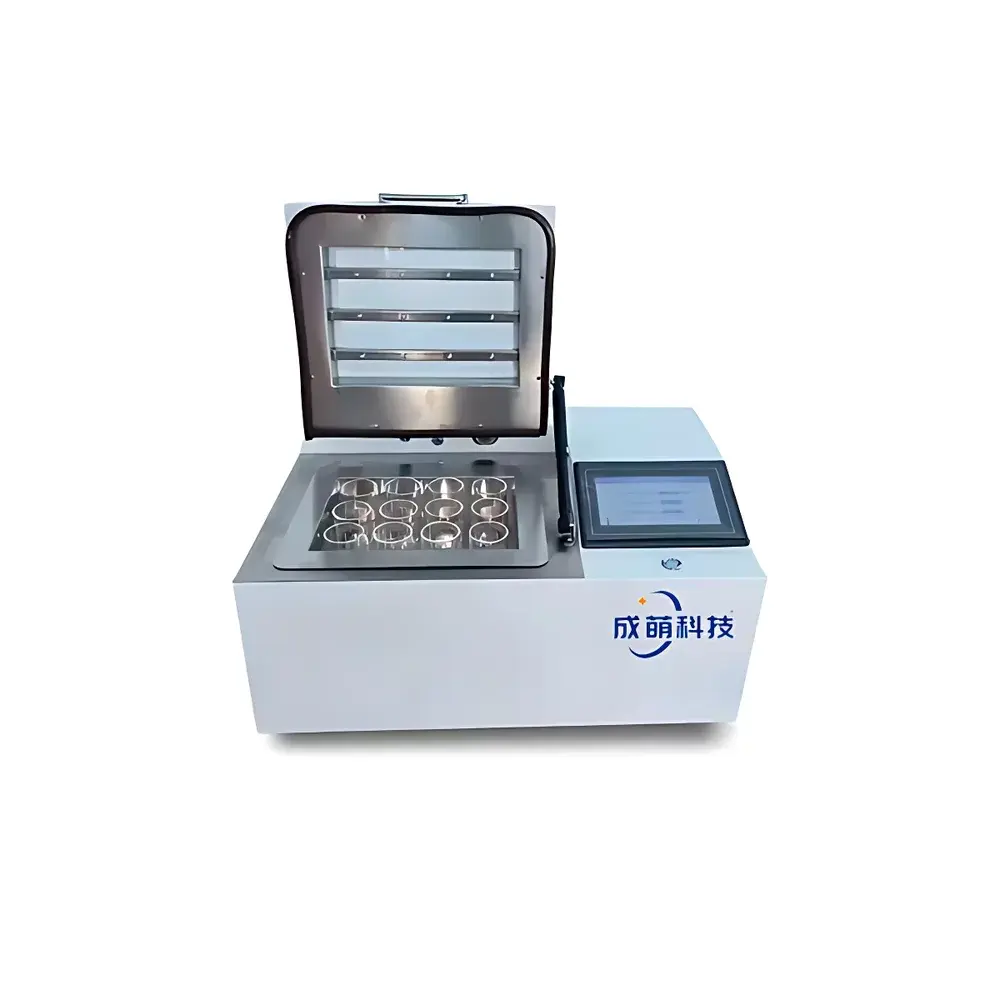
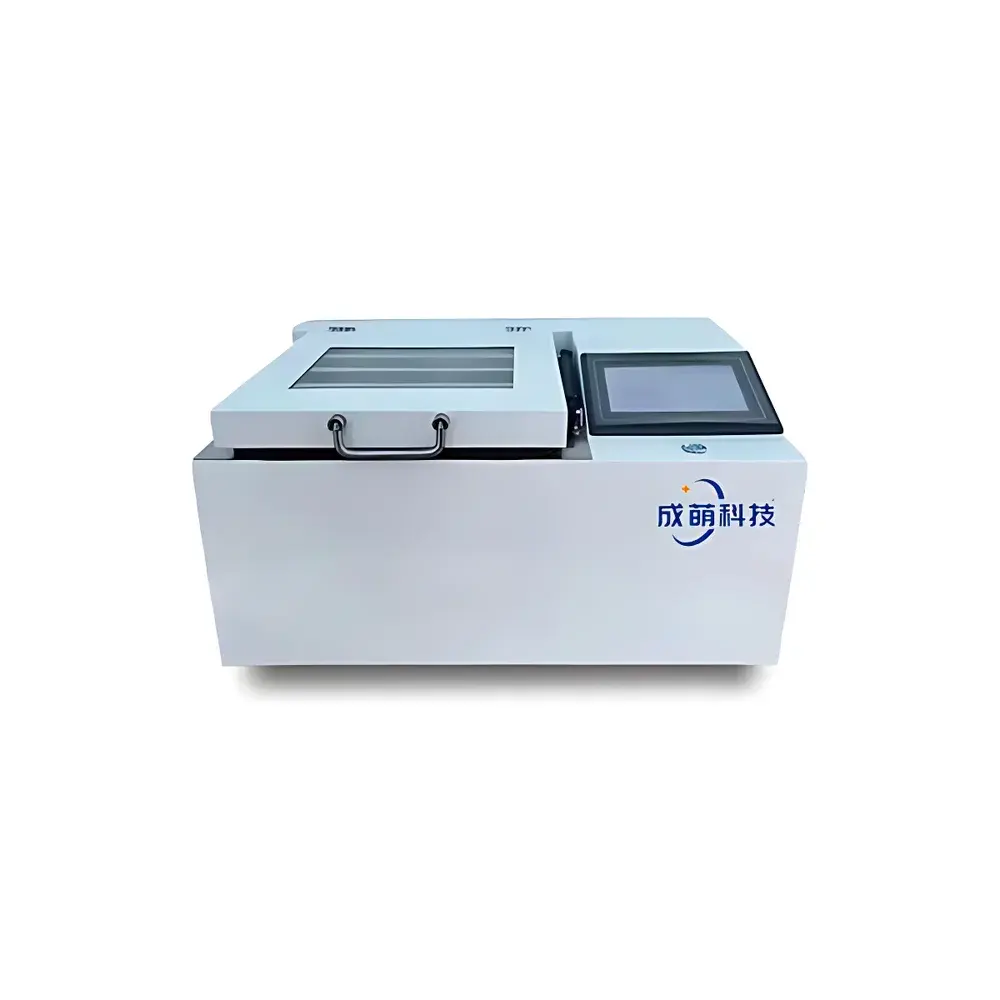
Chengmeng CMDS-12D Automated Nitrogen Evaporator
| Brand | Chengmeng Technology |
|---|---|
| Origin | Beijing, China |
| Manufacturer Type | Authorized Distributor |
| Product Category | Domestic |
| Model | CMDS-12D |
| Instrument Type | Automated Quantitative Concentrator |
| Temperature Range | Ambient to 99 °C |
| Temperature Control Accuracy | ±0.5 °C |
| Sample Vessel Capacity | 50 mL or 150 mL |
| Heating Method | Dry-block (water bath optional) |
| Endpoint Detection | Optical sensor per channel |
| Adjustable Endpoint Volume | 1.0 mL, 0.5 mL, or near-dry (~0.1 mL) |
| Nitrogen Pressure Range | 0–0.1 MPa (adjustable in 0.01 MPa increments) |
| Inlet Gas Requirement | 0.2–0.8 MPa |
| Gas Consumption | ~500 mL/min per channel at 0.1 MPa |
| Endpoint Sensitivity | 10-level optical threshold adjustment |
| Power Supply | 220 V / 60 Hz |
| Dimensions | 650 × 450 × 308 mm |
| Weight | 21 kg |
Overview
The Chengmeng CMDS-12D Automated Nitrogen Evaporator is an engineered solution for quantitative solvent removal in analytical sample preparation workflows. It operates on the principle of inert gas-assisted evaporation—using precisely regulated nitrogen flow across the surface of liquid samples immersed in a thermally controlled dry-block heater—to accelerate volatilization while minimizing analyte degradation, oxidation, or thermal decomposition. Designed for laboratories performing trace-level analysis (e.g., pesticide residue testing, environmental contaminant screening, pharmaceutical impurity profiling), the system supports reproducible concentration down to user-defined residual volumes without manual intervention. Its integrated exhaust management—featuring a built-in centrifugal blower and directional venting—enables safe operation outside fume hoods, reducing infrastructure dependency while maintaining operator safety and ambient lab air quality compliance.
Key Features
- 12-channel independent endpoint control: Each position is equipped with a dedicated optical sensor that continuously monitors liquid meniscus height or turbidity shift, enabling precise termination of nitrogen flow upon reaching preset volumes (1.0 mL, 0.5 mL, or near-dry).
- Stable pneumatic regulation: An onboard pressure regulator maintains consistent nitrogen delivery across all active channels—even during dynamic load changes—eliminating flow fluctuations caused by intermittent channel activation or deactivation.
- Dual heating modality: Standard dry-block heating ensures rapid thermal response and uniform temperature distribution; optional water bath configuration is available for applications requiring gentler, more homogeneous heat transfer.
- Contamination-minimized fluid path: All wetted components—including gas manifolds, nozzles, and sample support fixtures—are fabricated from chemically inert, low-leaching materials (e.g., PTFE-coated stainless steel, borosilicate glass-compatible interfaces) validated for compatibility with acetonitrile, methanol, dichloromethane, and other common extraction solvents.
- Adaptive optical sensitivity: Ten-step calibration of sensor gain allows reliable endpoint detection across diverse sample matrices—including colored extracts, turbid suspensions, or low-transmittance solutions—without hardware modification.
- Integrated safety architecture: Real-time monitoring of lid position, bath level (for water bath variant), inlet pressure, and thermal stability triggers audible/visual alerts and automatic shutdown if thresholds are breached.
Sample Compatibility & Compliance
The CMDS-12D accommodates standard 50 mL and 150 mL conical-bottom vials, including those conforming to ASTM D7066 (pesticide residue analysis) and USP chromatographic method validation requirements. Its dry-block design eliminates cross-contamination risks associated with shared water baths and supports rapid cleaning between batches. While not certified to IEC 61000-6-3 (EMC) or UL 61010-1 out-of-the-box, the instrument meets essential safety provisions for Class II laboratory equipment under GB 4793.1–2007 (Chinese equivalent of IEC 61010-1). When deployed in GLP- or GMP-regulated environments, users may configure audit trails via external LIMS integration (see Software section) to satisfy FDA 21 CFR Part 11 data integrity expectations for electronic records.
Software & Data Management
The CMDS-12D operates via an embedded microcontroller interface with local parameter storage (up to 99 user-defined methods). Though it lacks native Ethernet/Wi-Fi connectivity, its RS-232 serial port enables bidirectional communication with laboratory information management systems (LIMS) or electronic lab notebooks (ELN) for method export, run log retrieval, and event timestamping. All critical operational events—including start/stop times, endpoint triggers, pressure deviations, and alarm activations—are time-stamped and stored in non-volatile memory for ≥30 days. For full 21 CFR Part 11 compliance, third-party middleware (e.g., LabArchives, Thermo Fisher SampleManager) can be deployed to enforce electronic signatures, role-based access control, and immutable audit logs.
Applications
- Environmental testing: Concentration of aqueous extracts prior to GC-MS analysis of PAHs, PCBs, and organochlorine pesticides per EPA Method 525.3 and ISO 18856.
- Clinical toxicology: Pre-concentration of urine or plasma supernatants for LC-MS/MS quantification of opioids, benzodiazepines, and stimulants following protein precipitation.
- Food safety: Final volume adjustment of QuEChERS extracts before injection into HPLC systems for mycotoxin or veterinary drug residue screening.
- Forensic chemistry: Parallel processing of seized substance extracts under chain-of-custody protocols where volumetric consistency directly impacts reporting limits.
- Academic research: High-throughput sample cleanup in natural product isolation workflows involving sequential solvent partitioning and fraction evaporation.
FAQ
Can the CMDS-12D be used with corrosive solvents such as hydrochloric acid or trifluoroacetic acid?
No. The system is validated only for organic solvents (e.g., hexane, ethyl acetate, acetonitrile) and aqueous buffers. Exposure to strong acids or halogenated agents may degrade sensor optics and compromise pressure regulation integrity.
Is calibration of the optical endpoint sensors required by the user?
No routine recalibration is needed. Sensor baseline drift is compensated automatically during idle cycles. However, periodic verification using standardized dye solutions (e.g., 0.1% methylene blue in water) is recommended every 6 months for trace-level applications.
Does the instrument support programmable ramping of nitrogen flow rate during a single run?
No. Flow rate is set globally per method and held constant. Variable-rate control is not implemented due to pneumatic architecture constraints.
What maintenance intervals are specified for the internal blower and heating block?
The centrifugal blower requires filter replacement every 12 months under continuous use. The dry-block heater undergoes thermal calibration verification annually using NIST-traceable RTD probes.
Can multiple CMDS-12D units be synchronized for coordinated batch processing?
Not natively. Inter-unit synchronization requires external PLC-level coordination via discrete I/O signals (start/stop/ready) routed through industrial relay modules.



