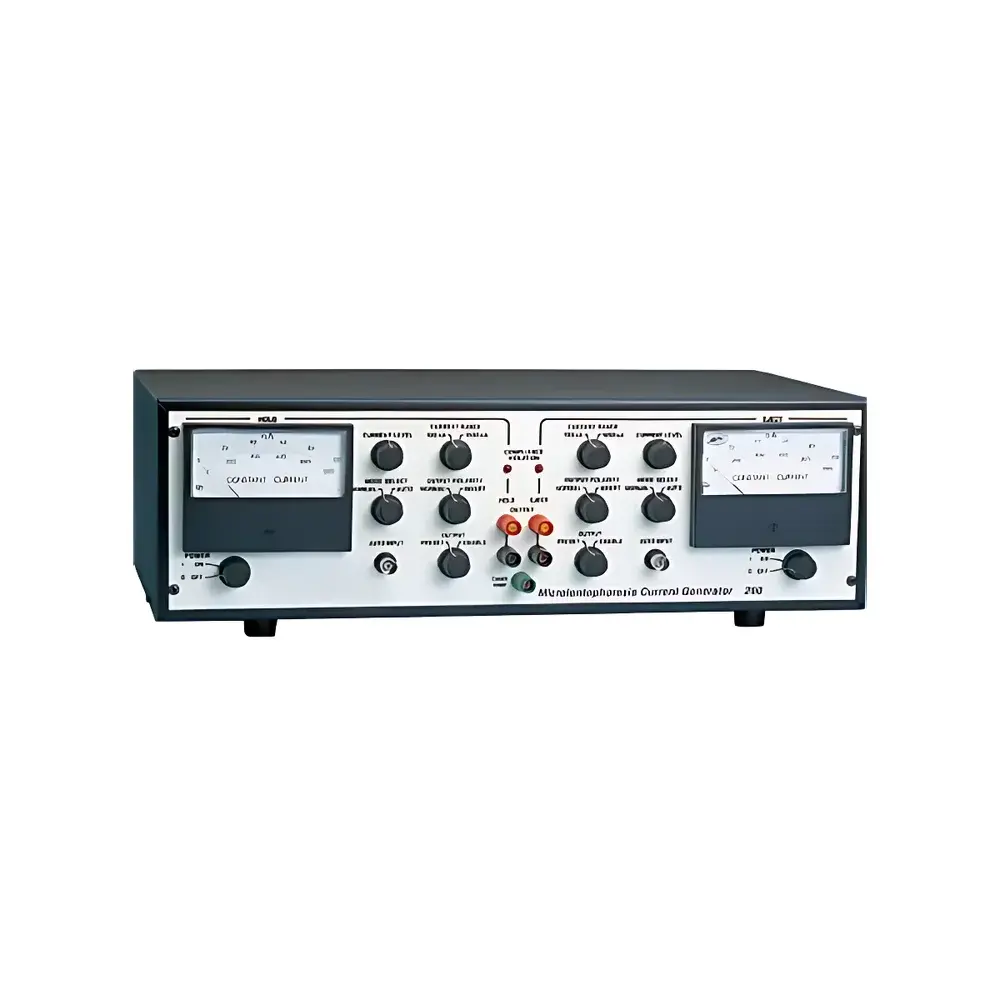
Chengmeng SYS-260 Dual-Channel Nanoscale Electrophoretic Current Generator
| Brand | Chengmeng |
|---|---|
| Origin | USA |
| Manufacturer Type | Authorized Distributor |
| Product Category | Imported Instrument |
| Model | SYS-260 Dual-Channel Nanoscale Electrophoretic Current Generator |
| Current Range | 0.1–1000 nA (selectable ranges: 100 nA / 1000 nA full-scale) |
| Output Channels | 2 independent, battery-powered electrophoretic current sources |
| Polarity Control | Manual toggle (±) |
| Operation Mode | Front-panel selectable manual or timed auto-injection |
| Compliance | Designed for intracellular and extracellular microinjection in electrophysiology and neuropharmacology workflows |
Overview
The Chengmeng SYS-260 Dual-Channel Nanoscale Electrophoretic Current Generator is a precision-engineered instrument designed for controlled, low-current electrophoretic delivery of charged molecules—including fluorescent dyes, neurotransmitters, peptides, and pharmacological agents—into biological specimens with subcellular spatial resolution. Unlike conventional pressure-based or iontophoretic systems relying on high-voltage pulses, the SYS-260 employs two independent, battery-isolated, ultra-low-noise current sources operating in the 0.1–1000 nA range. Its core operational principle is based on constant-current electrophoresis: migration velocity of charged solutes through glass micropipettes (tip diameters <1 µm) is directly proportional to applied current under fixed ionic strength and temperature conditions. This enables reproducible, diffusion-limited ejection kinetics essential for quantitative neurophysiological mapping, single-cell pharmacology, and live-cell imaging studies where temporal fidelity and minimal perturbation are critical.
Key Features
- Dual-channel architecture with fully isolated current paths—enabling simultaneous “hold” (retention) and “eject” (injection) functions without cross-talk or ground-loop interference.
- Battery-powered design ensures galvanic isolation from mains supply, eliminating 50/60 Hz noise and enabling stable operation inside Faraday cages or near sensitive patch-clamp rigs.
- Front-panel selectable output ranges: 100 nA and 1000 nA full-scale, each with 16-bit digital resolution for fine-grained current adjustment.
- Manual polarity switch (±) allows reversible ion transport—critical for injecting cationic (e.g., acetylcholine, dopamine-HCl) or anionic (e.g., GABA, fluorescein) species using the same pipette.
- Two operational modes: Manual mode for real-time experimenter control; Timed Auto mode with user-defined injection duration (10 ms–30 s), supporting repeatable stimulus protocols in behavioral or electrophysiological paradigms.
- Compact, rack-mountable chassis (210 × 120 × 65 mm) with low thermal drift (<0.05% per °C) and long-term current stability (<0.2% over 8 h).
Sample Compatibility & Compliance
The SYS-260 is validated for use with standard borosilicate or quartz capillary pipettes pulled to tip diameters between 0.1–0.8 µm—ideal for intranuclear, cytoplasmic, or extracellular microinjection in primary neuronal cultures, brain slices, and in vivo stereotaxic preparations. It supports common electrophysiology buffers (e.g., ACSF, Ringer’s, HEPES-based intracellular solutions) and exhibits no measurable electrochemical decomposition at ≤1 µA across typical saline media. While not certified to IEC 61010-1 as a medical device, its electrical safety design complies with UL 61010-1 requirements for laboratory equipment. The system meets GLP-aligned documentation standards for traceable parameter logging when integrated with third-party data acquisition platforms (e.g., National Instruments DAQmx or Spike2).
Software & Data Management
The SYS-260 operates as a stand-alone analog instrument with no embedded firmware or USB interface—ensuring deterministic latency and immunity to software-induced jitter. All settings are retained via non-volatile front-panel configuration memory. For automated experiment orchestration, TTL-compatible trigger inputs (5 V CMOS) accept external start/stop signals from electrophysiology amplifiers, behavior tracking systems, or programmable logic controllers. Injection timing and current amplitude can be logged synchronously with electrophysiological recordings via auxiliary analog output channels (±1 V scaling). Audit trails—comprising timestamped operator entries, range selections, and polarity states—are maintained manually per GLP practice; digital integration with LabArchives or Benchling requires external ADC coupling.
Applications
- Targeted intranuclear delivery of CRISPR-Cas9 ribonucleoprotein complexes into adherent mammalian cells without membrane disruption.
- Subsecond, dose-controlled ejection of glutamate or GABA into defined dendritic spines during two-photon glutamate uncaging experiments.
- Chronic intracerebral microinjection of radiolabeled tracers (e.g., 3H-dopamine) into rodent basal ganglia nuclei for autoradiographic quantification.
- Calibration of ion-selective microelectrodes via known-flux iontophoretic standards (per ASTM E2914-13 guidelines).
- Combined patch-clamp and iontophoresis in acute brain slices to assess postsynaptic receptor kinetics with millisecond temporal precision.
FAQ
Is the SYS-260 compatible with commercially available micromanipulators?
Yes—the device outputs standard BNC-triggered analog control signals and accepts standard micromanipulator footswitch inputs; it has been validated with Sutter MP-285, Scientifica PatchStar, and Luigs & Neumann SM-10 systems.
Can both channels operate at different current magnitudes simultaneously?
Yes—each channel is independently calibrated and adjustable; one may be set to −50 nA (hold) while the other delivers +320 nA (eject), with no inter-channel coupling.
Does the SYS-260 require calibration before first use?
No—factory calibration is NIST-traceable and remains valid for 24 months under normal lab conditions; optional annual verification kits (part #CAL-SYS260-VK) are available.
What battery type does the SYS-260 use, and what is its operational lifetime?
It uses two user-replaceable CR123A lithium batteries, providing ≥120 hours of continuous operation at 100 nA output; battery status is indicated by dual LED indicators on the front panel.
Is there electromagnetic compatibility (EMC) documentation available for use in MRI-adjacent labs?
Yes—full EMC test reports (EN 61326-1:2013 Class A) and magnetic field immunity data (≤10 µT @ 1 kHz) are provided upon request for institutional safety review boards.
Related Products