
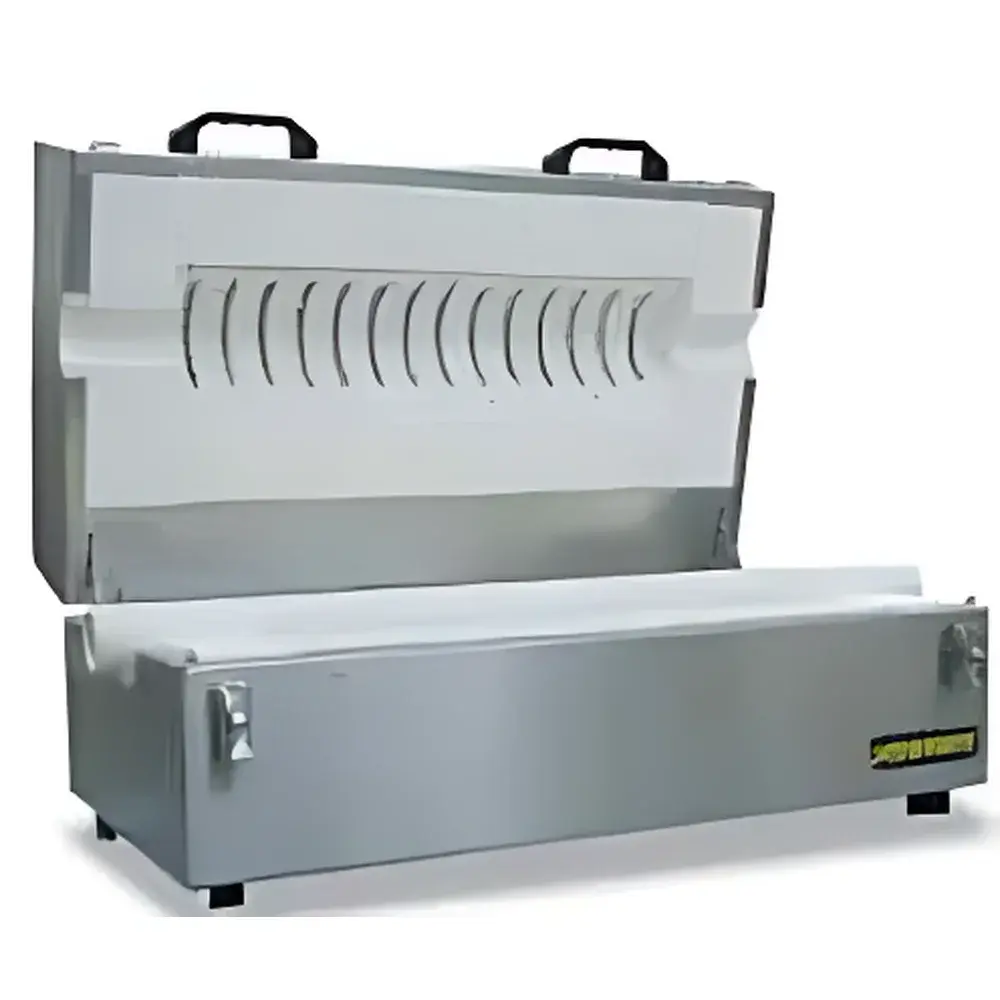
CHINYEE L-Series Muffle Furnace
| Brand | CHINYEE |
|---|---|
| Origin | Germany |
| Manufacturer Type | Authorized Distributor |
| Origin Category | Imported |
| Model | L-Series |
| Pricing | Available Upon Request |
| Temperature Range | 30–3000 °C |
| Construction | Dual-layer stainless steel housing |
| Insulation | Vacuum-formed ceramic fiber modules (standard) |
| Heating Element | Embedded resistance wire in ceramic heating plates |
| Controller | Standard B170 digital PID (ramp/soak programming) |
| Air Management | Adjustable front air inlet, rear exhaust port (fan-cooled or catalytic exhaust options available) |
| Safety | Low external surface temperature, silent solid-state relays |
| Compliance | Designed to meet general laboratory safety standards per EN 61000-6-3 (EMC) and EN 61000-6-4 |
Overview
The CHINYEE L-Series Muffle Furnace is a high-performance, laboratory-grade thermal processing system engineered for precise, repeatable, and contamination-free heat treatment across research, quality control, and industrial R&D environments. Operating on the principle of radiant heating within an insulated, sealed chamber—where the sample is thermally isolated from direct contact with heating elements—the furnace ensures uniform thermal distribution and minimal atmospheric interference. Its operational range spans from ambient-assisted preheating at 30 °C up to extreme high-temperature applications at 3000 °C, accommodating diverse material characterization protocols including ashing, calcination, sintering, annealing, and loss-on-ignition (LOI) analysis. The dual-layer stainless steel enclosure, combined with vacuum-formed ceramic fiber insulation, delivers exceptional thermal efficiency and surface temperature containment—typically maintaining exterior shell temperatures below 55 °C at maximum operating setpoints—thereby reducing energy consumption and enhancing operator safety.
Key Features
- Dual-layer structural design with electropolished 304 stainless steel outer and inner shells, ensuring mechanical rigidity and long-term corrosion resistance in humid or chemically aggressive lab environments.
- Vacuum-formed ceramic fiber insulation modules (standard), offering low thermal mass, rapid heat-up/cool-down cycles, and superior thermal retention; firebrick lining is optionally available for L3–L9 configurations requiring enhanced thermal inertia or prolonged high-temperature stability.
- Ceramic heating plates with embedded Kanthal A1 or similar high-alloy resistance wire—field-replaceable without disassembly of the furnace chamber, minimizing downtime and maintenance cost.
- Front-mounted adjustable air inlet and rear exhaust port enable controlled atmosphere management; optional accessories include fan-assisted exhaust ducts and catalytic converters for organic fume abatement during ashing procedures.
- Standard B170 digital PID controller supports single-segment ramp-and-soak operation with programmable rate limits (°C/min), target temperature, and dwell duration; optional P320 controller extends functionality with nine independent programs, each comprising four ramp stages and four soak stages—ideal for multi-step thermal protocols required in ASTM E1131, ISO 1171, or USP <281> methods.
- Silent solid-state relays eliminate mechanical switching noise and provide high-cycle durability (>1 million operations), critical for unattended overnight runs under GLP-compliant data integrity requirements.
Sample Compatibility & Compliance
The L-Series accommodates crucibles, boats, and trays made from alumina, silicon carbide, platinum, or quartz—compatible with both oxidizing and inert atmospheres when used with optional gas purge kits. Chamber dimensions vary by model (L3 to L9), supporting sample volumes from 1.2 L to 36 L. All units are constructed and tested in accordance with IEC 61010-1 for electrical safety in laboratory equipment and conform to electromagnetic compatibility standards EN 61000-6-3 (residential/emission) and EN 61000-6-4 (industrial/emission). While not certified as Class I Division 1 hazardous location equipment, the furnace may be integrated into validated thermal validation systems compliant with FDA 21 CFR Part 11 when paired with audit-trail-capable data loggers and electronic signature-enabled software platforms.
Software & Data Management
The B170 and P320 controllers support RS485 Modbus RTU communication for integration into centralized lab information management systems (LIMS) or SCADA networks. Optional PC-based configuration utilities allow offline program editing, firmware updates, and event logging export (CSV/TXT). When deployed in regulated environments, the system supports ALCOA+ data integrity principles—ensuring attributable, legible, contemporaneous, original, accurate, complete, consistent, enduring, and available records—particularly when interfaced with time-stamped, user-authenticated data acquisition modules meeting GAMP 5 guidance.
Applications
- Quantitative ash content determination in food, pharmaceuticals, and environmental samples per AOAC 942.05 and EPA Method 2540E.
- Thermal decomposition studies in materials science, including catalyst activation, battery cathode synthesis, and ceramic precursor pyrolysis.
- Residue analysis in polymer and composite testing per ISO 3451-1 and ASTM D5630.
- Calibration and verification of thermocouples and reference materials using fixed-point cells (e.g., Ag, Cu, Al freezing points).
- Pre-treatment of analytical substrates prior to XRF, SEM-EDS, or XRD analysis to remove organic binders or moisture without elemental volatilization.
FAQ
What is the maximum recommended continuous operating temperature for the L-Series?
Continuous operation at 3000 °C is rated only for specific high-purity graphite or molybdenum disilicide (MoSi₂) element configurations—standard ceramic-heated models are rated to 1700 °C. Exact upper limits depend on insulation type, chamber geometry, and atmosphere; consult the model-specific technical datasheet.
Can the furnace be used under inert or reducing atmospheres?
Yes—when equipped with optional gas inlet/outlet fittings and appropriate sealing hardware, the L-Series supports N₂, Ar, H₂/N₂ mixtures, and forming gases; however, hydrogen service requires additional safety interlocks and leak detection per EN 13445.
Is remote monitoring and control supported?
RS485 Modbus RTU enables integration with third-party SCADA or building management systems; dedicated CHINYEE LabLink software (optional) provides real-time graphing, alarm notification, and electronic batch record generation.
How often does calibration verification need to be performed?
Per ISO/IEC 17025 and internal quality procedures, temperature uniformity mapping should be conducted annually or after major component replacement; thermocouple calibration traceable to NIST or DAkkS standards is recommended every six months for critical applications.
Are spare parts such as heating plates and insulation modules stocked internationally?
CHINYEE maintains regional distribution hubs in Europe and North America; standard ceramic fiber modules and B170 controller PCBs are held in inventory with typical lead times under 5 business days.



