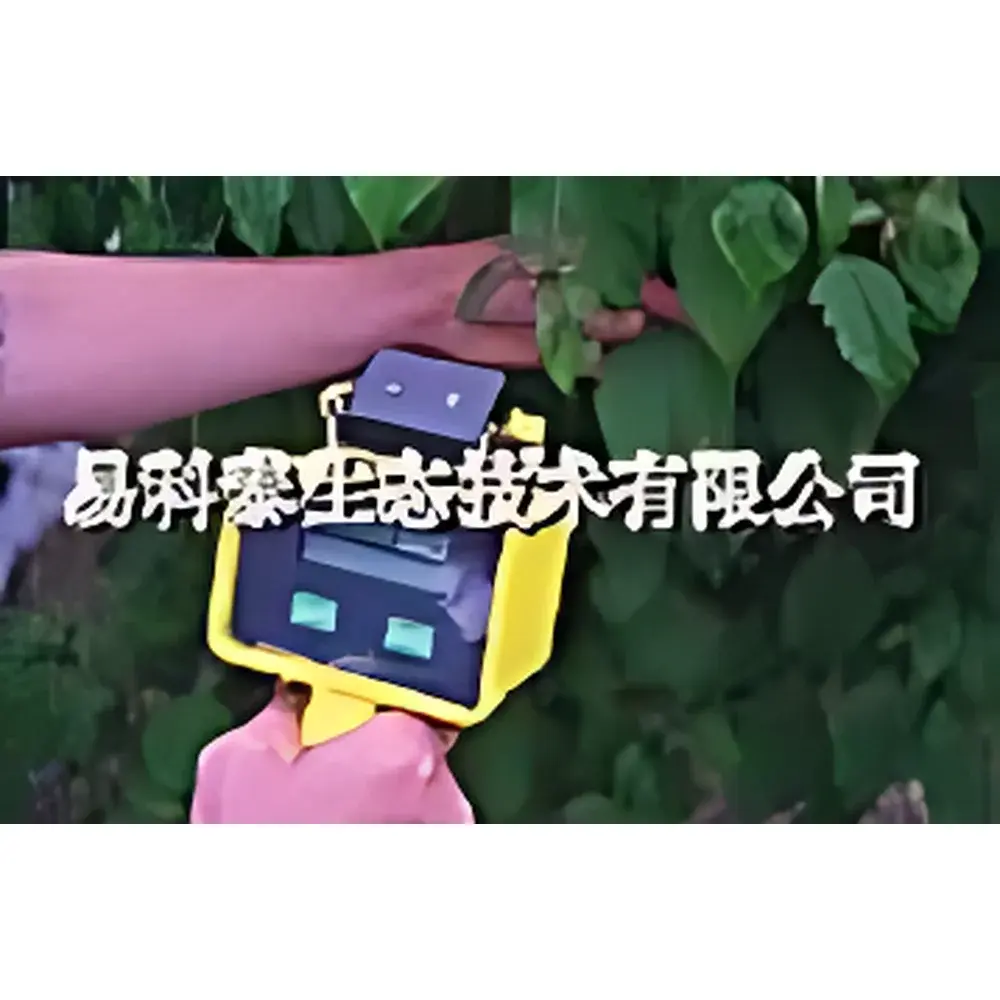
ChloroPen Non-Contact Chlorophyll Meter
| Origin | USA |
|---|---|
| Manufacturer Type | Authorized Distributor |
| Origin Category | Imported Instrument |
| Model | ChloroPen NC |
| Price | Upon Request |
| Measurement Principle | Dual-Wavelength Reflectance (700–840 nm) |
| Minimum Measurement Distance | 28.4 cm |
| Maximum Measurement Distance | 183 cm |
| Spot Diameter | 1.35 cm (at 30.5 cm), 3.0 cm (at 46 cm), 11.8 cm (at 122 cm) |
| Measurement Interval | >2 s per reading |
| Repeatability | ±5% of reading |
| Sample Types | Intact leaves, turfgrass canopies |
Overview
The ChloroPen Non-Contact Chlorophyll Meter is an engineered optical instrument designed for rapid, non-destructive assessment of relative chlorophyll content in intact plant tissues. Leveraging NASA-derived point-source reflectance technology, it operates on the well-established principle that chlorophyll-a exhibits strong absorption in the red region (~650–680 nm) and high reflectance in the near-infrared (NIR), while remaining relatively transparent in the far-red to NIR transition band (700–840 nm). By quantifying the ratio of reflectance at two strategically selected wavelengths within this range—specifically calibrated to maximize sensitivity to chlorophyll concentration—the device delivers a dimensionless, unitless index proportional to leaf chlorophyll density. This index correlates strongly with laboratory-determined chlorophyll concentrations (µg/cm² or mg/g FW) when validated against standard acetone extraction protocols (e.g., Arnon, 1949; Porra et al., 1989). Unlike contact-based SPAD meters, the ChloroPen eliminates mechanical pressure artifacts and surface contamination risks, making it ideal for repeated longitudinal monitoring of sensitive species, young seedlings, or field-grown turfgrass without physical disturbance.
Key Features
- True non-contact operation: No leaf clamping, no surface contact, no risk of bruising or photoinhibitory stress during measurement
- Variable-spot optics: Adjustable measurement area (1.35–11.8 cm diameter) via distance-dependent collimation—enabling both single-leaf precision and canopy-scale averaging
- Field-deployable ergonomics: Lightweight handheld design with integrated OLED display, onboard memory (≥500 readings), and real-time statistical summary (mean, SD, n)
- Robust environmental tolerance: IP54-rated enclosure suitable for outdoor use under ambient light conditions; automatic ambient light compensation algorithm minimizes solar interference
- Calibration traceability: Factory-calibrated using NIST-traceable spectral reflectance standards; optional user recalibration protocol available via companion software
- Battery-powered operation: Rechargeable Li-ion battery supports ≥8 hours of continuous field use; USB-C interface for data export and firmware updates
Sample Compatibility & Compliance
The ChloroPen NC is validated for use across a broad spectrum of vascular plant species, including but not limited to Zea mays, Triticum aestivum, Oryza sativa, Poa pratensis, Festuca arundinacea, and Arabidopsis thaliana. It accommodates heterogeneous leaf morphologies—broad, narrow, pubescent, waxy, or rolled—without requiring standardized orientation or positioning. While not intended for submerged aquatic macrophytes or bryophytes, its optical design accommodates natural leaf angle variation typical of field canopies. The instrument complies with IEC 61000-4-2 (ESD immunity) and IEC 60529 (IP54 ingress protection). Data acquisition workflows support GLP-compliant documentation when paired with the optional ChloroLog Software Suite, which maintains full audit trails, user authentication logs, and electronic signatures per FDA 21 CFR Part 11 requirements.
Software & Data Management
ChloroLog Desktop Software (v3.2+) provides comprehensive post-acquisition analysis, including batch normalization, spatial mapping (geotagged measurements), time-series trend visualization, and export to CSV, Excel, or MATLAB-compatible formats. The software implements ISO/IEC 17025-aligned uncertainty propagation models, incorporating repeatability (±5%), distance-induced spot-size variance, and ambient irradiance variability into confidence interval estimates for each reported index value. Raw spectral reflectance logs (700–840 nm at 2-nm resolution) are stored alongside metadata (GPS coordinates, timestamp, operator ID, instrument serial number), enabling retrospective reprocessing as calibration models evolve. All data files are SHA-256 hashed and digitally signed to ensure integrity and chain-of-custody compliance in regulatory submissions.
Applications
- Nitrogen status monitoring in precision agriculture: Enables site-specific N fertilizer optimization by identifying suboptimal chlorophyll zones prior to visible deficiency symptoms
- Turfgrass health assessment: Quantifies photosynthetic capacity across golf course fairways, sports fields, and municipal landscapes without disrupting play or maintenance schedules
- Ecophysiological research: Supports long-term phenotyping studies of drought, heat, or ozone stress responses through repeated non-invasive chlorophyll tracking
- Plant breeding programs: Accelerates selection for chlorophyll retention traits (e.g., stay-green genotypes) in segregating populations under field conditions
- Educational field labs: Provides students with immediate, quantitative access to photosynthetic physiology concepts without destructive sampling or wet chemistry
FAQ
Does the ChloroPen NC require leaf clipping or contact for accurate measurement?
No. It is designed exclusively for non-contact reflectance measurement at distances ranging from 28.4 cm to 183 cm.
Can it be used under direct sunlight?
Yes. Its dual-wavelength algorithm includes real-time ambient light subtraction, and the optical housing features anti-glare baffling optimized for outdoor daylight operation.
Is the chlorophyll index directly convertible to µg/cm²?
The index is unitless and species-specific. Linear regression equations linking index values to lab-quantified chlorophyll can be established for target species using local calibration curves.
How is measurement repeatability verified?
Repeatability (±5% of reading) was determined per ASTM E2586-21 guidelines using 30 replicate measurements on homogeneous leaf regions under controlled illumination.
Does the device store GPS coordinates?
Yes—when paired with a Bluetooth-enabled GNSS receiver, geotagging is automatically embedded in all exported data files.