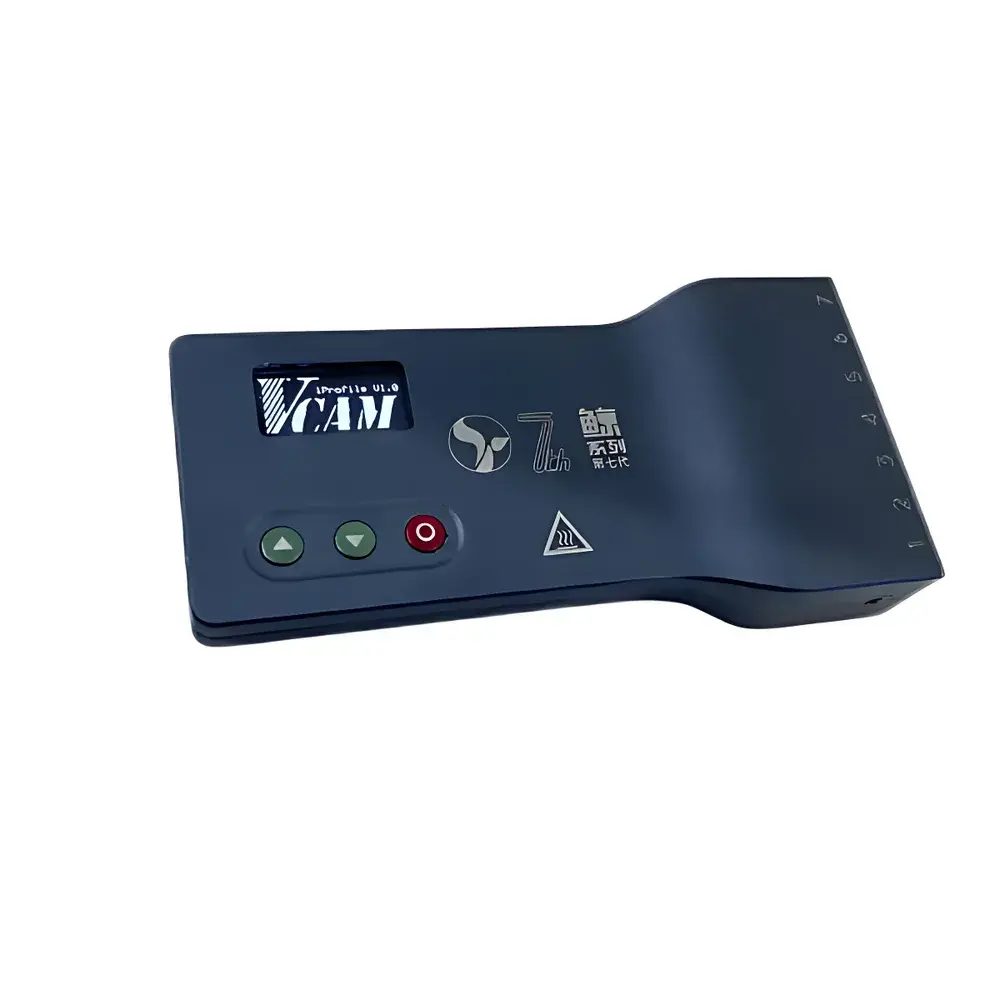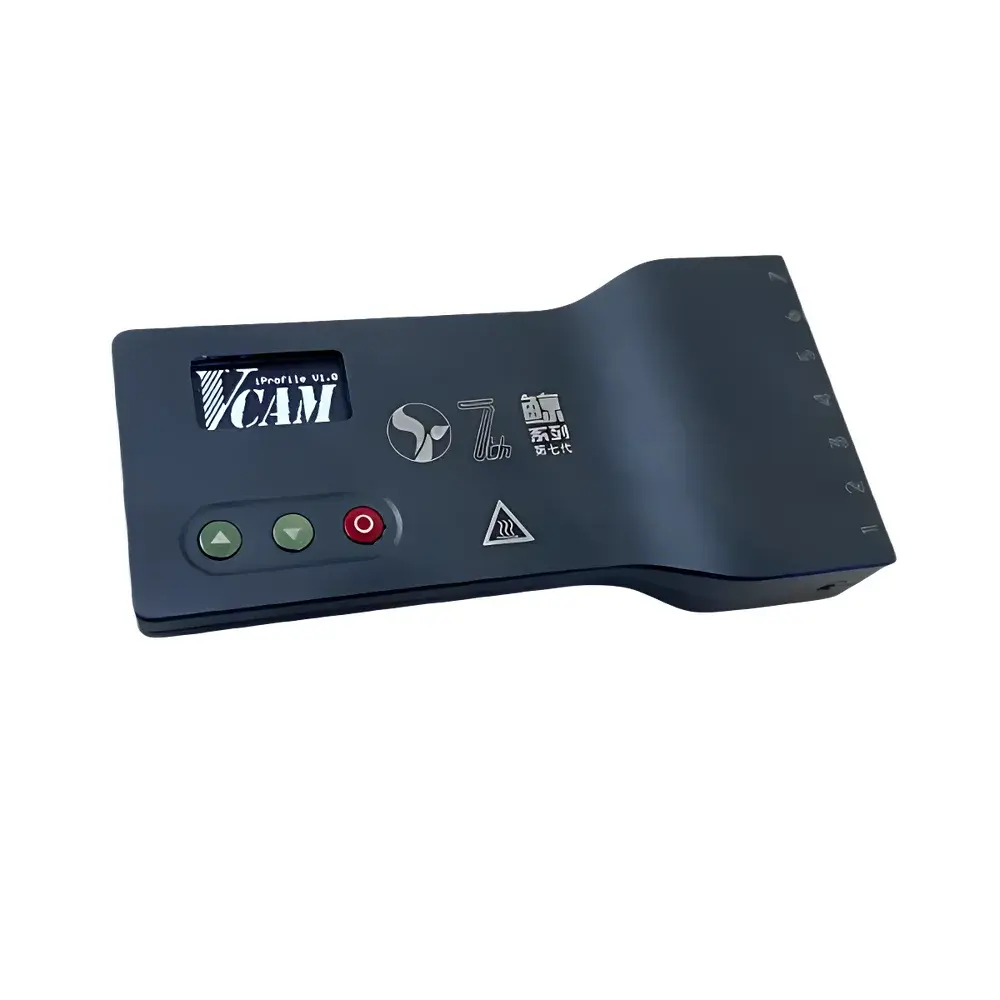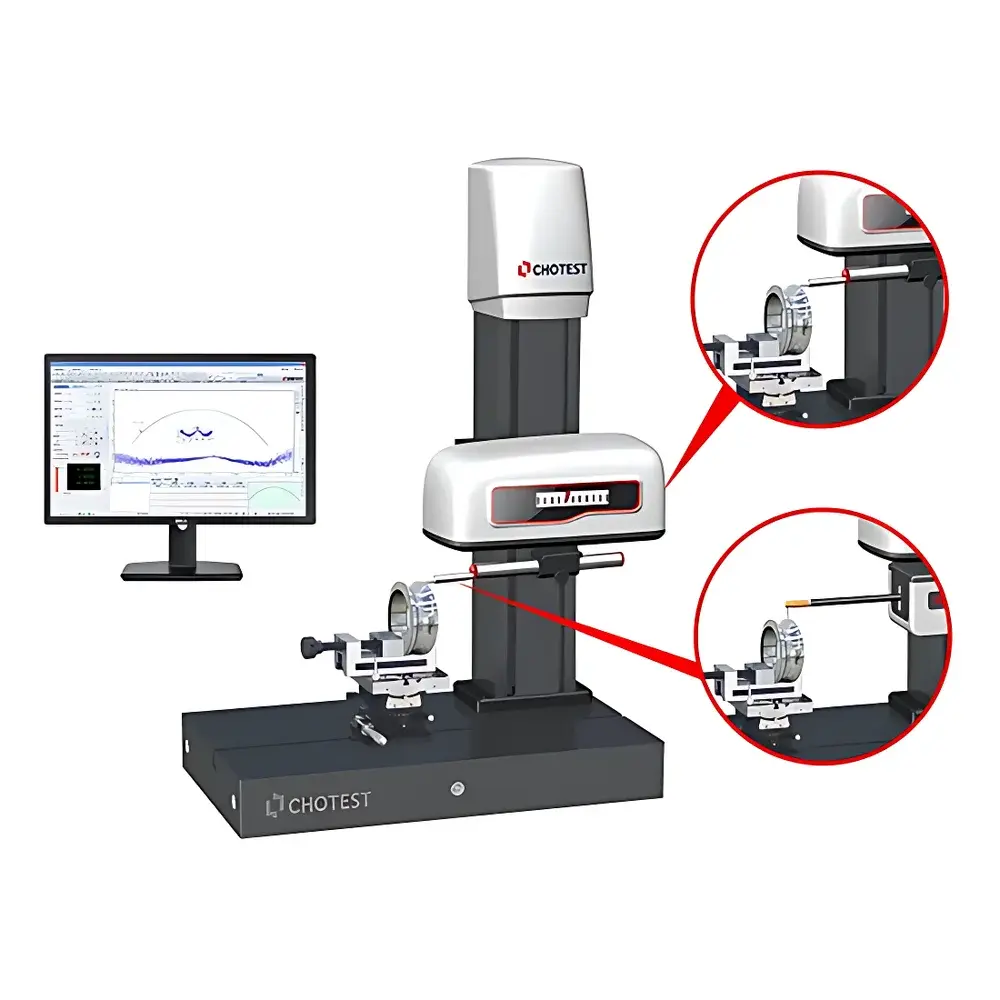
Chotest SJ5700E-PR Economic Profilometer & Surface Roughness Tester
| Brand | Chotest |
|---|---|
| Origin | Guangdong, China |
| Model | SJ5700E-PR |
| Compliance | GB/T 19600–2004, GB/T 3505–2009, GB/T 6062–2009, GB/T 10610–2009, JJF 1105–2018, ISO 5436, ISO 11562 |
| Measurement Principle | Contact stylus profilometry with high-precision grating displacement sensing and motorized linear scanning |
| Stylus Force Control | Voice-coil actuator with programmable force regulation (0.5–5 mN typical range) |
| Motion System | Non-contact linear motor + precision ground granite guideway |
| Position Resolution | ≤ 0.01 µm (X-axis), ≤ 0.1 nm (Z-axis) |
| Scan Length | Up to 100 mm (standard), extendable to 200 mm |
| Vertical Range | ±10 mm |
| Software Platform | Chotest Profilometer Analysis Suite (v5.x), compliant with FDA 21 CFR Part 11 audit trail requirements |
Overview
The Chotest SJ5700E-PR is an economic-grade combined profilometer and surface roughness tester engineered for high-reproducibility 2D topographic characterization of machined, molded, and ground components. It operates on the principle of contact stylus profilometry: a diamond-tipped probe (2 µm radius, 90° included angle) traverses the surface under precisely regulated voice-coil force, while a high-resolution optical encoder (sub-micron X-axis resolution) and capacitive or inductive Z-sensor (nanometer-level vertical resolution) capture coordinate data along the scan path. The system integrates a non-contact linear motor drive and precision ground granite guideway to ensure minimal mechanical hysteresis and thermal drift—critical for repeatable form measurement across production shifts. All raw profile data undergo real-time correction using proprietary algorithms that compensate for stylus tip geometry, dynamic tracking error, and thermal expansion effects, enabling traceable reconstruction of true surface geometry per ISO 11562:2021 and GB/T 6062–2009.
Key Features
- Modular dual-function architecture: Simultaneous contour and roughness evaluation on a single platform—eliminating need for separate instruments and reducing lab footprint.
- Programmable stylus force control (0.5–5 mN range) via closed-loop voice-coil actuator, ensuring consistent tip–surface interaction across soft polymers, hardened steels, and brittle ceramics.
- High-stability motion system: Linear motor-driven carriage mounted on thermally stable, hand-lapped granite guideways with <0.5 µm straightness over 100 mm travel.
- Integrated grating-based position feedback: 0.01 µm X-axis resolution enables accurate step-height, radius, and slope measurements per ISO 5436–1.
- Automated feature extraction: AI-assisted edge detection, automatic inflection point search, thread pitch identification, and multi-point arc fitting—all configurable via scriptable measurement routines.
- Comprehensive geometric metrology suite: Supports line, circle, arc, angle, distance, area, and intersection calculations; evaluates GD&T parameters including straightness, roundness, parallelism, perpendicularity, concentricity, and profile of a line/surface per ASME Y14.5 and ISO 1101.
- Multi-format reference comparison: Imports and aligns standard profiles from .CNC, .XML, and .DXF files; performs deviation mapping and tolerance band overlay with pass/fail flagging.
Sample Compatibility & Compliance
The SJ5700E-PR accommodates samples up to 300 mm × 200 mm × 150 mm (L×W×H) with optional fixtures for cylindrical, threaded, or irregular geometries—including gear teeth, bearing raceways, cam lobes, and injection-molded housings. Its modular probe holder accepts interchangeable styli (2 µm, 5 µm, and 12.5 µm radii) and skidless configurations for unfiltered roughness assessment. The instrument complies fully with national and international standards for surface texture metrology: GB/T 3505–2009 (equivalent to ISO 4287), GB/T 10610–2009 (ISO 4288), GB/T 6062–2009 (ISO 3274), and JJF 1105–2018 (calibration specification for profile measuring instruments). All measurement reports include full traceability metadata—operator ID, environmental conditions (optional sensor input), calibration certificate ID, and uncertainty budget per GUM (JCGM 100:2008).
Software & Data Management
The Chotest Profilometer Analysis Suite (v5.x) provides a validated, 21 CFR Part 11–compliant environment for measurement execution, analysis, and reporting. Core capabilities include: user-defined report templates (Word, PDF, Excel export); batch statistical processing (CPK, PPK, CA, PP, control charts per AIAG SPC manual); Q-DAS-compliant output (.qdf format); SPC dashboard with real-time process capability trending; and centralized database management with SQL-backed storage supporting query-by-part-number, operator, date range, or custom tags. Audit trails record all parameter changes, report modifications, and user logins with timestamps and digital signatures. Raw data exports support .TXT (point cloud), .PRF (profile binary), and .DXF (vectorized features) formats for third-party CAE integration.
Applications
This system serves as a primary metrology tool in quality control laboratories across precision manufacturing sectors. Typical use cases include: verification of gear tooth profile deviation and lead error in automotive transmissions; quantification of surface finish on bearing raceways per ISO 1302; evaluation of mold cavity replication fidelity in medical device injection molding; measurement of thread pitch, flank angle, and minor/major diameter on fasteners; analysis of non-spherical optical surfaces (e.g., LED lens arrays); and roughness assessment of cylinder bore honing patterns in engine blocks. It is routinely deployed for incoming inspection of powder metallurgy parts, dimensional validation of CNC-turned shafts, and GD&T verification of aerospace turbine blade root forms.
FAQ
What standards does the SJ5700E-PR support for roughness evaluation?
It supports R-, P-, and W-family parameters per ISO 4287/GB/T 3505, core roughness (Rcore) per ISO 13565-2, and motif analysis per ISO 25178-2.
Can the system perform automated batch measurement?
Yes—via programmable CNC-style measurement sequences with part recognition, auto-alignment, and scheduled reporting to network drives or MES systems.
Is the software validated for regulated industries?
Yes—the Profilometer Analysis Suite includes 21 CFR Part 11 compliance features: electronic signatures, role-based access control, immutable audit trails, and password-protected configuration locks.
What is the maximum allowable surface slope for reliable tracing?
The system maintains stable tip contact up to ±30° local slope under default force settings; higher slopes require customized stylus geometry or reduced scan speed.
Does it support uncertainty estimation per ISO/IEC 17025?
Yes—uncertainty budgets are generated automatically based on calibration certificates, environmental inputs, and repeatability studies conducted during IQ/OQ/PQ validation.