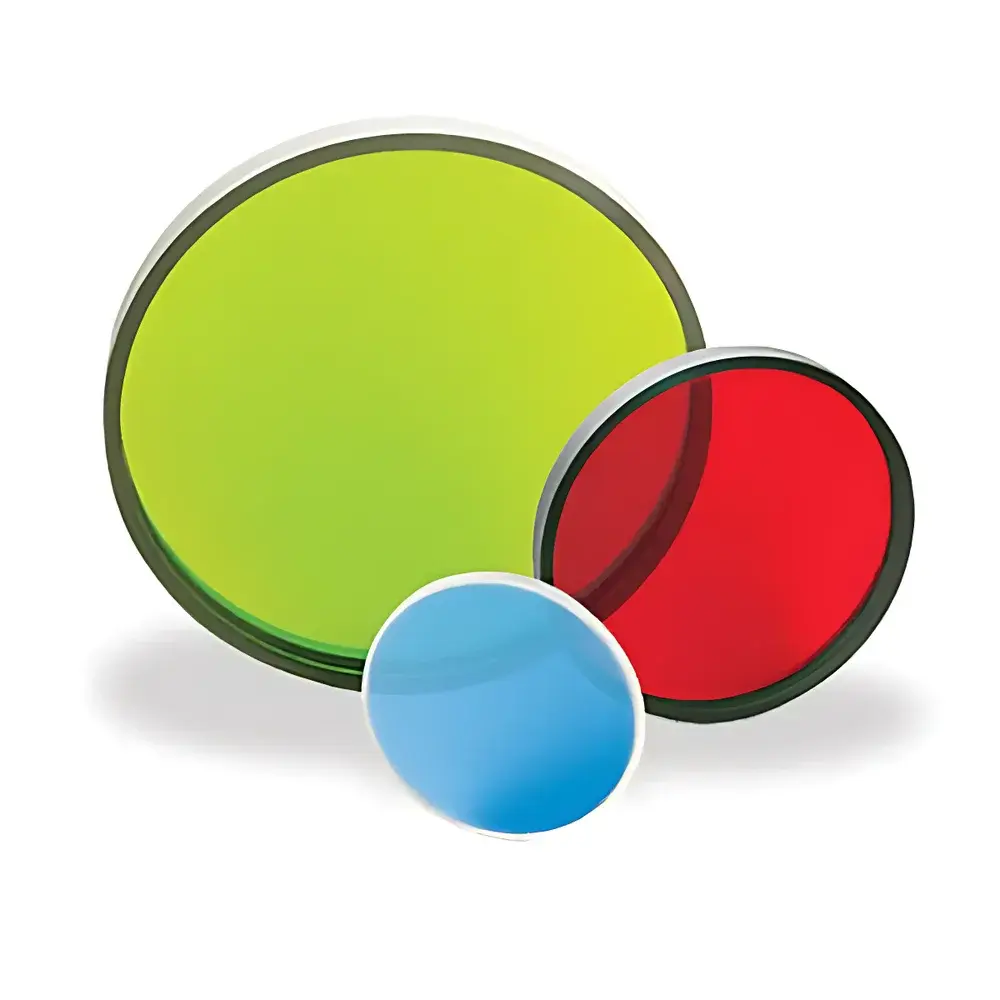
Chroma RET537LP Long-Pass Optical Interference Filter
| Brand | Chroma |
|---|---|
| Origin | USA (Manufactured in Vermont) |
| Model | RET537LP |
| Coating Technology | Ion-Assisted Magnetron Sputtering |
| Layers | 200–300 |
| Transmission Range | 537–3500 nm |
| Cut-on Wavelength (50% T) | 537 nm |
| Peak Transmission | >95% (typ. 550–1200 nm) |
| Blocking Depth | OD6–OD8 (200–520 nm) |
| Steepness (10–90% transition) | <15 nm |
| Substrate | Fused Silica or BK7 (single-substrate, cement-free architecture) |
| Environmental Stability | ISO 9001-certified production |
Overview
The Chroma RET537LP is a high-performance long-pass optical interference filter engineered for precision spectral separation in demanding scientific and industrial applications. Based on advanced thin-film physics, it operates via multilayer dielectric interference—utilizing constructive and destructive wave interference across 200–300 precisely controlled layers deposited via ion-assisted magnetron sputtering. This process yields an exceptionally steep cut-on transition at 537 nm (defined as the wavelength where transmission reaches 50%), enabling sharp discrimination between excitation and emission bands. Unlike absorptive filters, the RET537LP achieves spectral selectivity without thermal load accumulation, making it suitable for high-power laser illumination and continuous-wave imaging systems. Its single-substrate, cement-free design eliminates interfacial stress and ghost reflections, while fused silica or BK7 substrates ensure minimal wavefront distortion and low birefringence—critical for confocal microscopy, TIRF, and super-resolution modalities requiring diffraction-limited performance.
Key Features
- High peak transmission (>95% from 550 nm to 1200 nm), optimized for visible-to-NIR fluorescence detection
- Deep blocking (OD6–OD8) across UV–blue region (200–520 nm), effectively suppressing excitation bleed-through and autofluorescence
- Ultra-steep spectral transition (<15 nm between 10% and 90% transmission), minimizing spectral crosstalk in multiplexed assays
- Robust hard-coated architecture resistant to thermal cycling (−40°C to +85°C), high humidity (85% RH), and mechanical abrasion—validated per MIL-C-48497A
- No epoxy or adhesive layers: monolithic substrate construction ensures long-term spectral stability and eliminates outgassing risks in vacuum or cleanroom environments
- Front-surface primary coating with rear-surface AR coating reduces ghost images and maximizes system throughput
Sample Compatibility & Compliance
The RET537LP is compatible with standard 25 mm, 32 mm, and 50 mm diameter mounts (C-mount, SM1, or custom kinematic fixtures) and integrates seamlessly into OEM optical paths—including inverted microscopes, flow cytometers, and compact spectrometers. It meets ISO 10110-7 surface quality standards (scratch-dig 10–5) and complies with RoHS 2015/863/EU and REACH SVHC regulations. For regulated life science instrumentation, the filter supports GLP/GMP traceability through lot-specific spectral certification reports (including full T(λ) and OD(λ) curves), and its manufacturing process adheres to ISO 9001:2015 quality management protocols. While not inherently FDA 21 CFR Part 11-compliant (as a passive optical component), it is routinely qualified in Class I and II medical device optical trains used in FDA-cleared qPCR instruments and digital pathology scanners.
Software & Data Management
As a passive optical element, the RET537LP requires no embedded firmware or driver software. However, Chroma provides downloadable spectral data files in ASCII (.txt) and CSV formats, fully compatible with common optical simulation platforms (Zemax OpticStudio, FRED, LightTools) and spectral analysis tools (MATLAB, Python SciPy, OriginLab). Each shipped unit includes a certificate of conformance with measured transmission and blocking spectra, recorded on NIST-traceable spectrophotometers (PerkinElmer Lambda 1050+ with 150 mm integrating sphere). For OEM integration, Chroma offers custom spectral reporting packages—including batch-level statistical summaries (mean ± SD of CWL, bandwidth, and OD@405 nm) aligned with ICH Q5E comparability guidelines.
Applications
- Fluorescence microscopy: Ideal as an emission filter in FITC/TRITC dual-band systems and as a dichroic complement in widefield and spinning-disk confocal setups
- Flow cytometry: Enables simultaneous detection of PE-Cy5 and APC conjugates by isolating >540 nm emissions while rejecting 488 nm and 532 nm excitation scatter
- Genomic analysis: Used in Illumina-based sequencing platforms and digital PCR chips to separate probe emission from background Raman and LED leakage
- Remote sensing & LIDAR: Stable performance under thermal shock makes it suitable for airborne NIR atmospheric monitoring (e.g., CH4, CO2 band isolation)
- Astronomy: Deployed in narrowband H-α and [O III] imaging systems where out-of-band rejection prevents skyglow contamination
- Industrial machine vision: Enhances contrast in SWIR inspection of silicon wafers and polymer sorting by transmitting >900 nm while blocking ambient visible light
FAQ
What is the tolerance on cut-on wavelength (CWL)?
Standard tolerance is ±2 nm at 23°C; tighter tolerances (±0.5 nm) are available under custom specification with additional metrology validation.
Can this filter be used with pulsed lasers?
Yes—its damage threshold exceeds 500 mJ/cm² at 1064 nm, 10 ns pulse width, 10 Hz (tested per ISO 21254-1); consult Chroma’s LIDT report for specific wavelength/pulse parameter guidance.
Is angle-of-incidence (AOI) sensitivity characterized?
Yes—transmission shift is <0.3 nm per degree AOI up to 10°; chromatic shift increases beyond 15° and must be modeled in oblique-path optical designs.
Do you offer mounting options or custom sizes?
Standard unmounted filters are supplied; threaded mounts (SM1, RMS), kinematic cages (Thorlabs-compatible), and OEM-specific housings are available upon request with mechanical drawings.
How does humidity affect long-term spectral performance?
No measurable drift observed after 1000-hour exposure to 85°C/85% RH per Telcordia GR-1221-CORE; no spectral hysteresis detected during thermal cycling between −40°C and +85°C.