
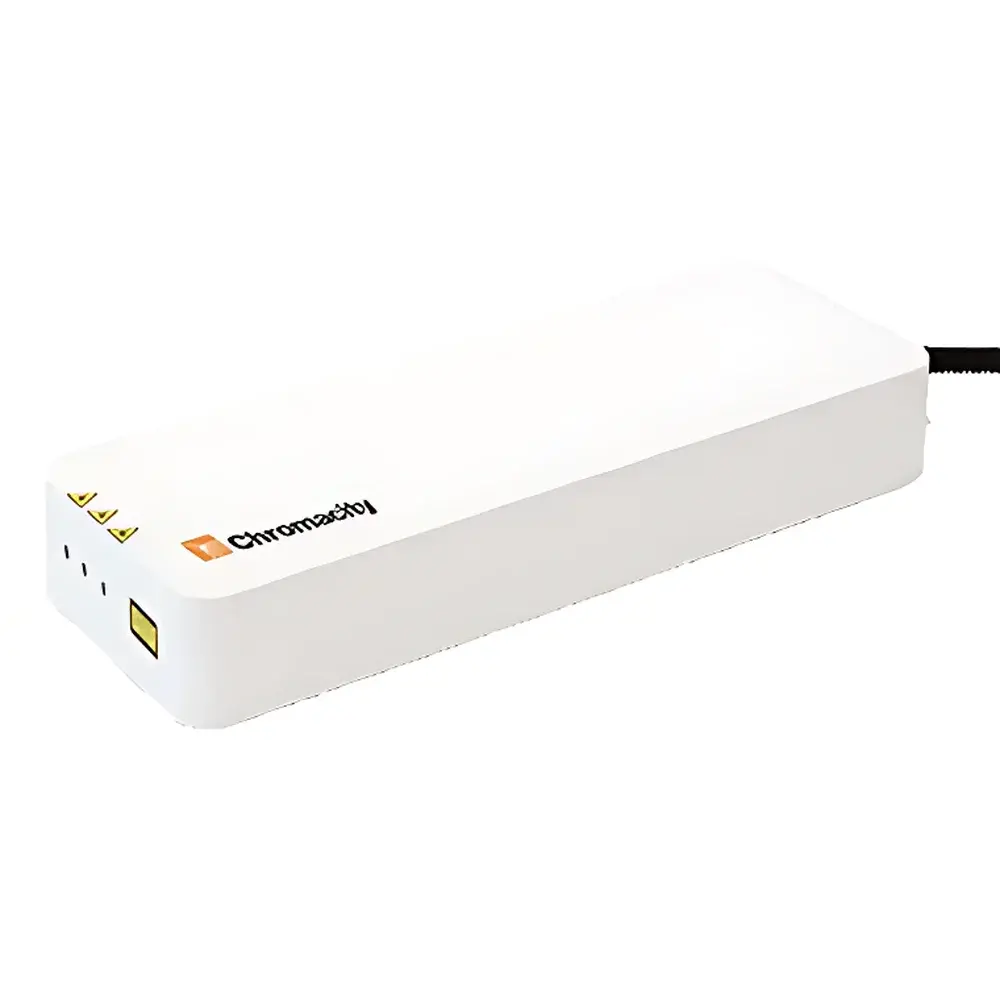
Chromacity Spark–OPO Near-Infrared to Mid-Infrared Picosecond Optical Parametric Oscillator
| Brand | Chromacity |
|---|---|
| Origin | United Kingdom |
| Manufacturer Type | Authorized Distributor |
| Product Origin | Imported |
| Model | Spark–OPO |
| Core Component | Solid-State Laser System |
| Pump Wavelength | 1040 nm |
| Repetition Rate | 100 MHz |
| Signal Wavelength Range | 1.48–1.9 µm |
| Signal Output Power | 100 mW @ 1.5 µm |
| Idler Wavelength Range | 2.1–3.6 µm |
| Idler Output Power | 20 mW @ 3.3 µm |
| Beam Quality (M²) | <1.1 |
| Polarization | Linear |
| Beam Divergence | <2 mrad |
| Output Configuration | Free-Space, Three Independent Ports |
| Cooling Method | Air-Cooled |
| Control Interface | Ethernet |
| Laser Head Dimensions | 765 × 240 × 82 mm |
| Controller Dimensions | 483 × 285 × 86 mm |
| Laser Head Weight | 18 kg |
| Controller Weight | 2 kg |
| Power Supply | 110–240 V AC, 50–60 Hz |
Overview
The Chromacity Spark–OPO is a fully integrated, turnkey picosecond optical parametric oscillator engineered for high-stability, wavelength-agile coherent light generation across the near-infrared (NIR) and mid-infrared (MIR) spectral regions. Based on synchronous pumping of a singly resonant OPO cavity by a mode-locked Yb-fiber laser operating at 1040 nm and 100 MHz repetition rate, the system delivers simultaneously tunable signal (1.48–1.9 µm) and idler (2.1–3.6 µm) outputs with excellent temporal coherence and pulse-to-pulse amplitude stability. Its design adheres to fundamental principles of nonlinear frequency conversion in β-barium borate (BBO) or periodically poled lithium niobate (PPLN) crystals—optimized for picosecond pulse durations to minimize thermal loading while maximizing conversion efficiency. This architecture enables precise control over spectral bandwidth, pulse duration (<10 ps), and spatial mode quality (M² < 1.1), making it suitable for applications demanding high peak power, low timing jitter, and phase-matching flexibility.
Key Features
- Simultaneous dual-output configuration: independently accessible signal and idler beams via three free-space ports, each with linear polarization and beam divergence <2 mrad
- Patented synchronous pump architecture ensuring high conversion efficiency and long-term power stability (>98% RMS stability over 8 hours)
- Air-cooled operation eliminates need for chiller infrastructure, reducing footprint and operational complexity
- Full remote control via standard Ethernet interface compliant with TCP/IP protocols; supports integration into LabVIEW, Python, and MATLAB environments
- Rugged mechanical design with vibration-isolated optical mounts and thermally compensated cavity alignment for field-deployable reliability
- Compliance with IEC 60825-1:2014 Class 4 laser safety standards; interlock-ready for integration into certified laboratory enclosures
Sample Compatibility & Compliance
The Spark–OPO is compatible with standard optical tables, motorized translation stages, and commercial spectroscopic platforms (e.g., FTIR spectrometers, time-resolved fluorescence setups, THz-TDS systems). Its output wavelengths align with strong fundamental vibrational absorption bands of numerous gases (e.g., CO, CH₄, NH₃, NO₂) and biological tissue chromophores, supporting quantitative gas sensing and label-free histopathology studies. The system meets electromagnetic compatibility requirements per EN 61326-1 and conforms to RoHS 2011/65/EU directives. For regulated environments, its deterministic trigger output and audit-trail-capable software logging support GLP/GMP-aligned experimental documentation workflows.
Software & Data Management
Chromacity’s OPOControl software provides intuitive GUI-based wavelength tuning, real-time power monitoring, and automated calibration routines. All parameter settings—including cavity temperature setpoints, mirror alignment offsets, and pump power thresholds—are stored with timestamped metadata. Export formats include CSV, HDF5, and XML, enabling traceable data exchange with LIMS or ELN platforms. The Ethernet API supports SCPI-like command syntax for scripting repetitive scan sequences (e.g., hyperspectral acquisition across 200 cm⁻¹ wavenumber windows), and includes built-in safeguards against out-of-range tuning or thermal runaway conditions.
Applications
- Time-resolved pump–probe spectroscopy of carrier dynamics in 2D materials and perovskite semiconductors
- Coherent anti-Stokes Raman scattering (CARS) and stimulated Raman scattering (SRS) microscopy in lipid-rich tissues
- High-resolution FTIR microspectroscopy for pharmaceutical polymorph identification
- Terahertz generation via optical rectification in ZnTe or GaP crystals
- Multi-photon excitation deep-tissue imaging using 1.7–1.9 µm signal light for reduced scattering and enhanced penetration depth
- In situ gas-phase detection in combustion diagnostics and environmental monitoring
- Nonlinear optical isolation experiments requiring phase-matched difference-frequency generation
FAQ
What is the typical pulse duration of the Spark–OPO output?
The system delivers transform-limited pulses with duration <10 ps (FWHM), consistent with the 1040 nm pump source and optimized group-delay dispersion compensation.
Can the Spark–OPO be synchronized to external triggers?
Yes — it provides a TTL-compatible sync output referenced to the 100 MHz repetition rate, and accepts external clock inputs for master–slave configurations.
Is vacuum or purged operation required for MIR output stability?
No — the idler beam path is sealed and humidity-controlled within the laser head; atmospheric water vapor absorption is mitigated through spectral selection and beam path optimization.
Does the system support automated wavelength scanning?
Yes — OPOControl software enables programmable, repeatable scans across the full tuning range with user-defined step resolution and dwell time.
What maintenance is required for long-term operation?
Annual verification of cavity alignment and thermal sensor calibration is recommended; no consumables or periodic crystal replacement are required under normal operating conditions.




