
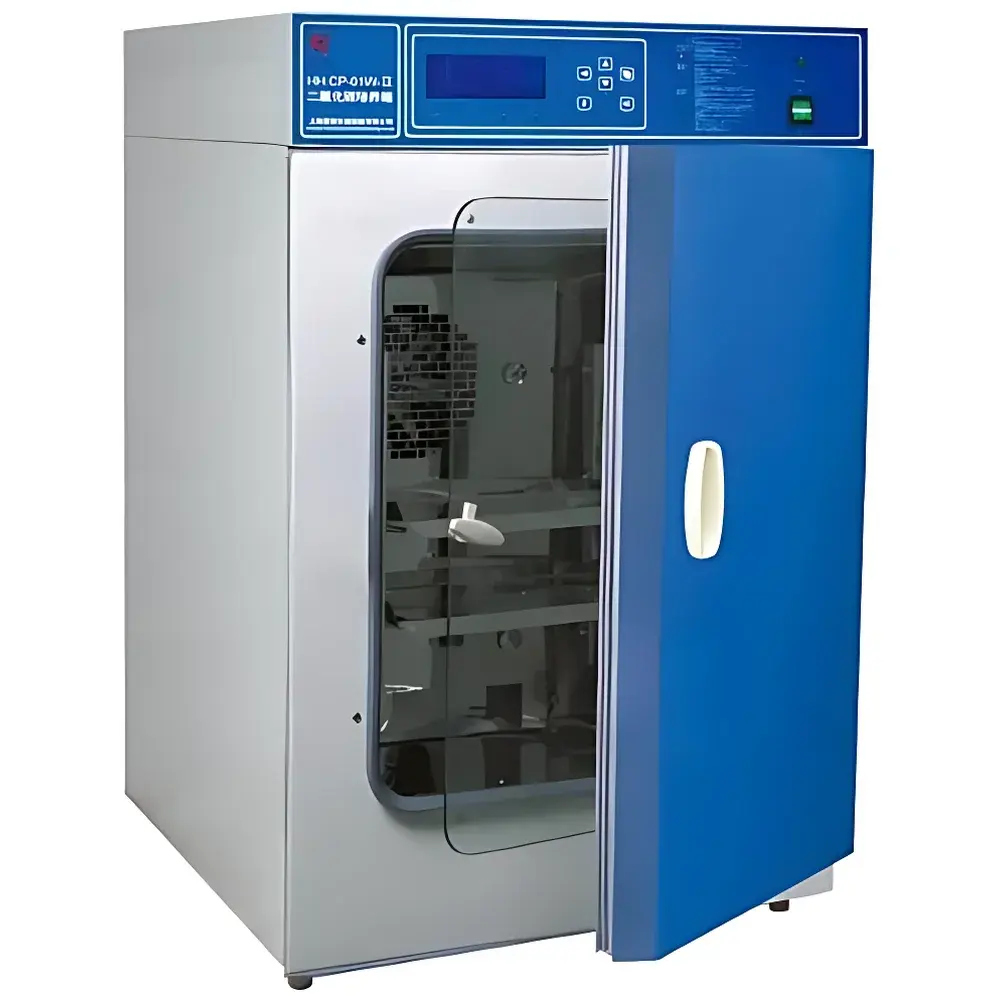
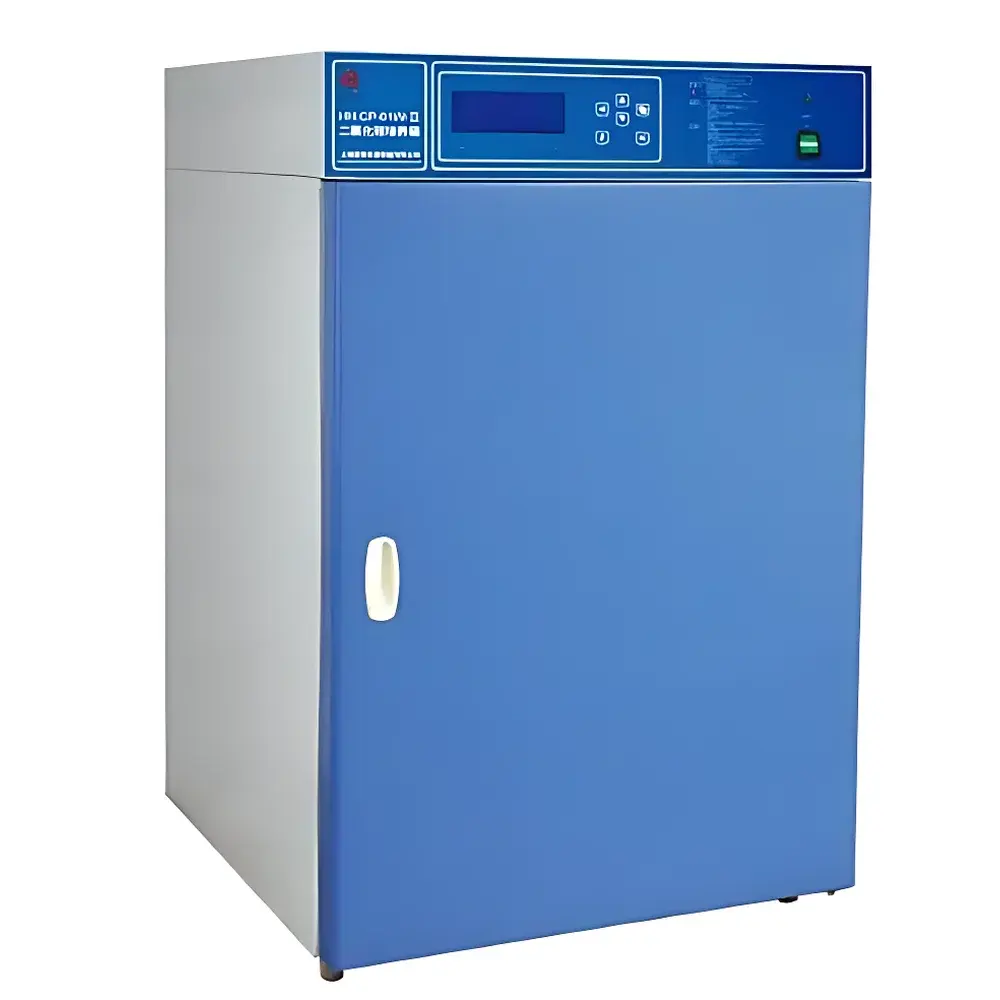
Chu Ding HH.CP-TW Water-Jacketed CO₂ Incubator
| Brand | Chu Ding |
|---|---|
| Model | HH.CP-TW |
| Type | Water-Jacketed Constant-Temperature CO₂ Incubator |
| Capacity | 80 L |
| Temperature Range | RT+5°C to 50°C |
| Temp. Uniformity | ±0.2°C |
| Temp. Resolution | 0.1°C |
| CO₂ Range | 0–20% |
| CO₂ Control | Infrared Sensor (IR) with Microprocessor Regulation |
| Heating Method | Water Jacket |
| Humidification | Natural Evaporation |
| Power Input | 680 W |
| Internal Dimensions (W×D×H) | 400×400×500 mm |
| External Dimensions (W×D×H) | 550×550×800 mm |
| Standard Shelves | 2 pcs |
| Filtration | 0.3 µm HEPA-grade CO₂ Inlet Filter (99.99% efficiency) |
| Door Heating System | Yes |
| Optional | UV Sterilization Lamp, Independent Over-Temp Alarm, Data Logging via RS485/USB |
Overview
The Chu Ding HH.CP-TW is a precision-engineered water-jacketed CO₂ incubator designed for long-term, contamination-sensitive mammalian cell culture under tightly controlled physiological conditions. Unlike forced-air (gas-jacketed) systems, its double-walled water-jacket architecture provides exceptional thermal stability and minimal temperature fluctuation—critical for maintaining consistent monolayer growth, stem cell differentiation, and primary cell viability over multi-day experiments. The unit operates on the principle of passive thermal mass buffering: heated water circulating within the jacket maintains uniform chamber temperature even during frequent door openings or ambient lab temperature drifts. Integrated infrared (IR) CO₂ sensing ensures gas concentration measurement independent of humidity and temperature gradients—enabling accurate, real-time feedback control without recalibration. This design conforms to core requirements for GLP-compliant cell culture workflows in academic research labs, biopharma QC facilities, and regenerative medicine development suites.
Key Features
- Water-jacketed thermal insulation delivering ±0.2°C temperature uniformity across the full 80 L workspace, validated per ISO 13408-1 Annex B protocols.
- Infrared CO₂ sensor with microprocessor-based proportional-integral-derivative (PID) control—achieving ≤5 min recovery to 5% CO₂ setpoint after 30-second door opening, as verified under ISO 14644-1 Class 5 cleanroom ambient conditions.
- 0.3 µm high-efficiency particulate air (HEPA)-grade CO₂ inlet filter with ≥99.99% retention efficiency for microbial and particulate contaminants, compliant with USP environmental control recommendations.
- Electrically heated inner glass door preventing condensation formation—eliminating moisture-mediated cross-contamination pathways between adjacent cultures.
- Stainless steel interior chamber with seamless, radius-rounded corners (R ≥15 mm) and removable, autoclavable stainless steel shelves—facilitating ISO 14644-1 compatible cleaning and validation.
- Intuitive backlit LCD interface displaying simultaneous real-time values for chamber temperature, CO₂ concentration, relative humidity estimate, and system status—supporting ISO/IEC 17025 traceable operation logs when paired with optional data export modules.
Sample Compatibility & Compliance
The HH.CP-TW supports standard T-25, T-75, and 100-mm Petri dishes, multi-well plates (6–96-well), roller bottles, and culture flasks up to 500 mL volume. Its water-jacketed construction eliminates airflow turbulence, making it suitable for shear-sensitive suspension cultures and low-adherence applications including organoid maintenance. The unit meets mechanical safety requirements per IEC 61010-1:2010 and electromagnetic compatibility standards per IEC 61326-1:2020. While not certified for ISO Class 5 cleanroom integration out-of-the-box, its sealed chamber design, HEPA-filtered CO₂ supply, and UV sterilization option (when installed) align with EU GMP Annex 1 (2022) provisions for grade B background environments supporting aseptic processing.
Software & Data Management
Optional RS485 or USB communication interfaces enable connection to laboratory information management systems (LIMS) or standalone PCs for continuous parameter logging. Exported datasets include timestamped records of temperature (°C), CO₂ (%), and operational events (door open/close, alarm triggers). When configured with audit-trail-enabled software, the system supports FDA 21 CFR Part 11 compliance through user authentication, electronic signatures, and immutable record generation—essential for regulated bioprocessing and clinical trial material production. All firmware updates are delivered via signed binary packages with SHA-256 hash verification.
Applications
- Long-duration adherent cell line expansion (e.g., HeLa, CHO-K1, HEK293) requiring stable pH (via 5% CO₂/bicarbonate buffer) and thermal consistency.
- Cryopreserved primary cell recovery and functional reactivation assays where transient thermal shock must be avoided.
- Co-culture systems involving stromal and epithelial compartments demanding spatially homogeneous gas exchange.
- Preclinical toxicology screening using human-derived 3D spheroids, where metabolic activity correlates directly with incubator stability metrics.
- Quality control release testing of cellular therapeutics under cGMP-aligned environmental monitoring frameworks.
FAQ
What distinguishes water-jacketed from gas-jacketed CO₂ incubators?
Water-jacketed units rely on thermal mass for stability, offering superior temperature uniformity and reduced power cycling—ideal for unattended overnight runs. Gas-jacketed models respond faster to setpoint changes but exhibit greater sensitivity to ambient fluctuations.
Is the IR CO₂ sensor factory-calibrated and field-serviceable?
Yes—the NDIR-based sensor is pre-calibrated at manufacture and includes a zero-point verification routine accessible via service mode; field recalibration requires certified gas standards (e.g., 5.00 ± 0.05% CO₂ in N₂) and is documented per ISO/IEC 17025 calibration procedures.
Can the incubator operate in rooms exceeding 35°C ambient temperature?
Operation is specified for 5–35°C ambient per IEC 60068-2-1/2. Sustained ambient >35°C may impair cooling capacity and compromise CO₂ regulation accuracy; supplemental HVAC conditioning is recommended.
Does the UV lamp option meet ISO 15858 germicidal efficacy requirements?
The 254 nm low-pressure mercury lamp delivers ≥100 µW/cm² irradiance at 1 m distance, satisfying ISO 15858 Annex A thresholds for airborne microorganism reduction in static air conditions.
Are shelf load limits defined for gravitational stability during transport or stacking?
Maximum distributed load per shelf is 15 kg; stacking (up to two units) requires use of original transit brackets and adherence to EN 1021-1:2013 structural loading specifications.




