
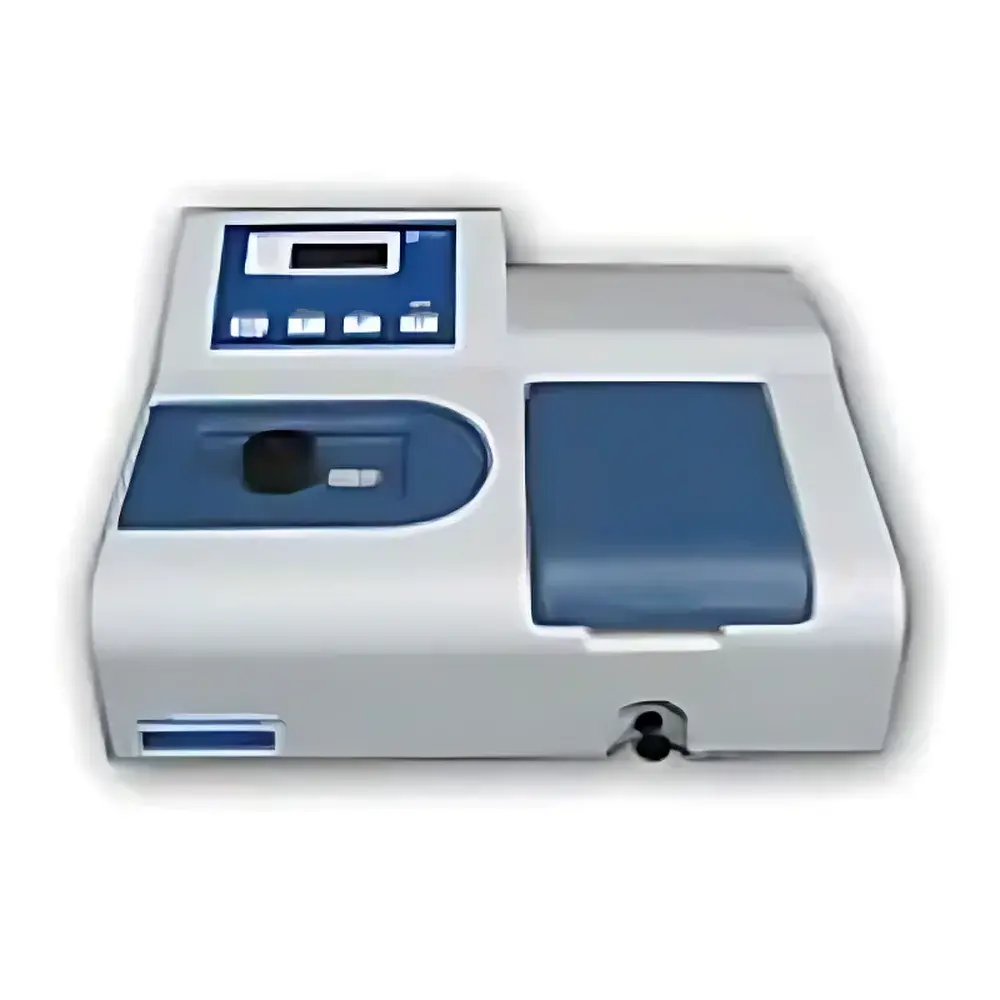
Chu Ding Tech 722N Visible Spectrophotometer
| Brand | Chu Ding Tech |
|---|---|
| Origin | Shanghai, China |
| Model | 722N |
| Wavelength Range | 320–1020 nm |
| Wavelength Accuracy | ±2 nm |
| Wavelength Repeatability | ≤1 nm |
| Spectral Bandwidth | 4 nm |
| Photometric Accuracy | ±0.5% T |
| Transmittance Range | 0–100% T |
| Absorbance Range | −0.097 to 1.99 A |
| Concentration Range | 0–1999 C (or F) |
| Stray Light | ≤0.3% T at 340 nm |
| Baseline Stability | ≤0.004 A/h at 500 nm (after 1 h warm-up) |
| Optical Path Length | 100 mm |
| Light Source | 6 V, 10 W imported tungsten lamp |
| Display | 4-digit LCD |
| Data Interface | RS-232C standard port |
| Power Supply | 220 V / 110 V AC, 50–60 Hz |
| Net Weight | 12 kg |
Overview
The Chu Ding Tech 722N Visible Spectrophotometer is a fixed-wavelength-range, single-beam optical instrument engineered for routine quantitative and qualitative analysis in the visible spectrum. It operates on the principle of Beer–Lambert law-based absorption photometry, utilizing a Czerny–Turner (CT) monochromator with a 1200-line/mm holographic grating to isolate discrete wavelengths across its operational range of 320–1020 nm. Designed for laboratories requiring cost-effective, reliable performance without compromising fundamental photometric integrity, the 722N delivers consistent transmittance (T), absorbance (A), and concentration (C/F) measurements under standardized conditions. Its mechanical and optical architecture prioritizes thermal stability and mechanical rigidity—critical for minimizing drift during extended batch analyses—making it suitable for environments where regulatory traceability is maintained through documented calibration and operator verification rather than full 21 CFR Part 11 compliance.
Key Features
- CT-type monochromator with 1200 lines/mm grating ensures reproducible wavelength selection and reduced higher-order diffraction effects
- High-stability 6 V, 10 W imported tungsten halogen lamp provides uniform spectral output across the visible and near-NIR range
- Optical path length fixed at 100 mm, compatible with standard 10 mm cuvettes and enabling direct correlation with published extinction coefficients
- Photometric accuracy of ±0.5% T meets ASTM E275 and ISO 6223 requirements for routine visible-spectrum spectrophotometric validation
- Stray light level ≤0.3% T at 340 nm supports accurate low-transmittance measurements in turbid or highly absorbing samples
- Baseline stability ≤0.004 A/h (at 500 nm, after 60 min warm-up) enables multi-hour analytical sessions without recalibration
- RS-232C serial interface allows integration with external data loggers, LIMS, or legacy PC-based acquisition software
Sample Compatibility & Compliance
The 722N accommodates standard rectangular quartz or optical glass cuvettes (10 × 10 × 45 mm) and accepts liquid, solution-phase samples with optical densities within its specified absorbance range (−0.097 to 1.99 A). It is routinely deployed in quality control workflows aligned with ISO/IEC 17025-accredited testing protocols for food colorant quantification, pharmaceutical excipient purity screening, environmental water nitrate/nitrite analysis (via diazotization), and industrial dye concentration monitoring. While not certified for GMP or GLP environments requiring audit trails or electronic signatures, its mechanical design and calibration traceability support adherence to internal SOPs referencing USP , EP 2.2.25, and CLSI EP10-A3 guidelines for instrument verification.
Software & Data Management
The 722N operates as a standalone instrument with embedded firmware controlling wavelength scanning, measurement mode selection (T/A/C), and zero/reference calibration. Data output via RS-232C follows ASCII protocol at 9600 baud, 8N1 configuration, enabling compatibility with custom Python- or LabVIEW-based acquisition scripts, Excel-based macros, or third-party terminal emulators (e.g., Tera Term, PuTTY). No proprietary software is bundled; users retain full control over data formatting, timestamping, and storage structure. The absence of onboard memory or user-accessible firmware updates reinforces deterministic behavior—a key consideration for laboratories maintaining validated methods under ISO 15197 or IEC 61010-1 safety frameworks.
Applications
- Quantitative determination of transition metal ions (e.g., Fe²⁺/Fe³⁺, Cu²⁺, Cr⁶⁺) using chromogenic reagents in environmental and wastewater labs
- Routine assay of vitamin B₂ (riboflavin), chlorophyll, and carotenoids in food and agricultural product testing
- Verification of cleaning agent concentrations in pharmaceutical manufacturing equipment rinse validation
- Educational use in undergraduate chemistry and biochemistry laboratories for enzyme kinetics (e.g., NADH oxidation) and equilibrium constant determination
- Colorimetric end-point detection in titration-based assays for phosphate, sulfate, and sulfide in industrial process streams
FAQ
Is the 722N compliant with FDA 21 CFR Part 11?
No—the instrument lacks electronic signature capability, audit trail logging, and secure user authentication required for Part 11 compliance. It is intended for non-GxP environments or as a secondary verification tool within validated workflows.
Can it measure absorbance below 320 nm?
No—the optical design and tungsten lamp output limit operation to 320–1020 nm. UV measurements require deuterium or xenon lamp sources and fused silica optics, as found in UV-Vis models such as the UV752N.
What cuvette materials are supported?
Standard 10 mm pathlength glass or quartz cuvettes are compatible. Plastic cuvettes are not recommended due to scattering and wavelength-dependent absorption above 350 nm.
Does it support kinetic or scanning modes?
No—the 722N is a fixed-wavelength or manual step-scan instrument. It does not perform continuous spectral scans or time-resolved kinetic profiling.
How often should the tungsten lamp be replaced?
Typical service life exceeds 1,000 hours under normal usage. Replacement is indicated when baseline noise increases >0.002 A or when photometric repeatability degrades beyond specification after recalibration.



