
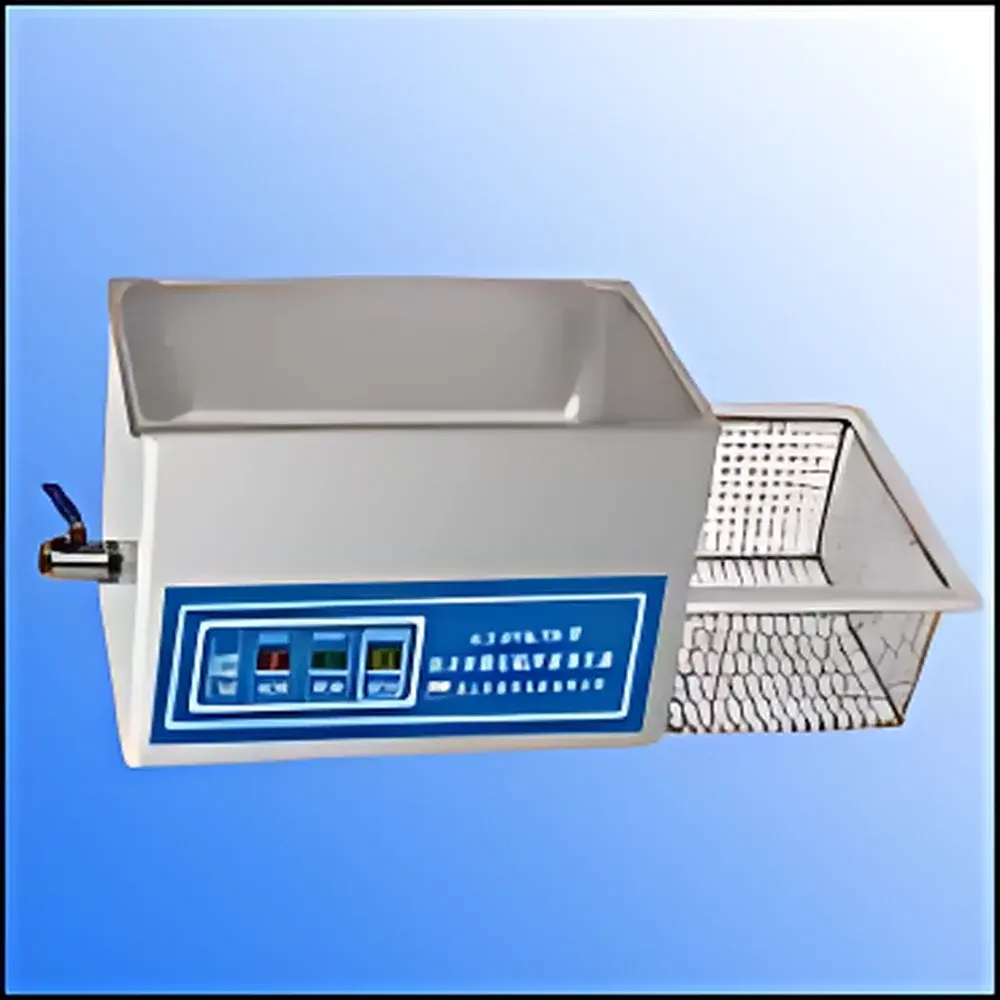
Chu Ding Technology KQ2200DE Digital Ultrasonic Cleaner
| Brand | Chu Ding Technology |
|---|---|
| Origin | Shanghai, China |
| Model | KQ2200DE |
| Dimensions (L×W×H) | 260×160×280 mm |
| Tank Interior Dimensions (L×W×H) | 230×140×100 mm |
| Capacity | 3 L |
| Ultrasonic Frequency | 40 kHz |
| Ultrasonic Power Output | 100 W |
| Power Adjustment Range | 40–99 % |
| Heating Power | 600 W |
| Temperature Control Range | 20–80 °C |
| Timer Range | 1–99 min |
| Stainless Steel Mesh Basket | Included |
| Sound-Dampening Lid | Included |
| Drain Valve | Included |
Overview
The Chu Ding Technology KQ2200DE Digital Ultrasonic Cleaner is a compact, benchtop laboratory instrument engineered for precision cleaning, degassing, dispersion, emulsification, and cell disruption applications. It operates on the principle of ultrasonic cavitation—generating high-frequency mechanical vibrations (40 kHz) via piezoelectric transducers bonded to the stainless-steel tank base. These vibrations propagate through the cleaning solution, inducing transient microbubbles that collapse violently near submerged surfaces, delivering localized energy sufficient to remove particulate contaminants, organic residues, and biofilms from delicate components such as optical lenses, semiconductor wafers, HPLC columns, surgical instruments, and biological sample vessels. Designed for consistent performance in QC labs, academic research facilities, and R&D environments, the KQ2200DE integrates digital control logic with thermal and acoustic safety protocols to ensure reproducible results across repeated cycles.
Key Features
- Digital microprocessor-based control panel with real-time display of set and actual ultrasonic duration, heating temperature, and power level.
- Adjustable ultrasonic output (40–99 % of nominal 100 W), enabling optimization for sensitive substrates or aggressive soil removal.
- Integrated 600 W heating system with precise ±1 °C temperature regulation over a 20–80 °C range—critical for temperature-dependent cleaning chemistries and enzymatic decontamination protocols.
- Stainless steel (304 grade) tank interior formed by deep-drawn stamping, ensuring structural integrity, corrosion resistance, and compatibility with aqueous and mild solvent-based solutions.
- Comprehensive safety monitoring: automatic shutdown triggered by low liquid level detection, over-temperature, over-voltage, and over-current conditions.
- Included accessories: perforated stainless steel mesh basket for sample containment and uniform energy distribution; hinged sound-dampening lid to reduce ambient noise and minimize solvent evaporation.
- Drain valve located at the tank base facilitates rapid, spill-free solution exchange—essential for multi-step cleaning workflows and regulatory-compliant residue management.
Sample Compatibility & Compliance
The KQ2200DE accommodates standard laboratory glassware (e.g., beakers, flasks, vials, cuvettes), metal tools, ceramic substrates, and polymer components up to 230 × 140 × 100 mm in dimension. Its 3 L capacity supports batch processing of multiple small parts without compromising cavitation uniformity. The unit complies with IEC 61000-6-3 (EMC emission standards) and IEC 61000-6-2 (immunity requirements). While not certified for sterile processing per ISO 13485 or FDA 21 CFR Part 820, it is routinely deployed in GLP-aligned laboratories where documented cleaning validation—including dwell time, temperature, and solution composition—is maintained per internal SOPs. For pharmaceutical applications, the device may support Stage 1 equipment qualification (IQ/OQ) when paired with calibrated thermometers and timer verification tools.
Software & Data Management
The KQ2200DE operates via embedded firmware without external PC connectivity or proprietary software. All operational parameters—time, temperature, and power—are stored in non-volatile memory and retained after power cycling, supporting repeatable method execution. While the unit lacks audit trail functionality or electronic record generation required under FDA 21 CFR Part 11, its digital interface enables manual entry into laboratory notebooks or LIMS-compatible spreadsheets. Users are advised to implement procedural controls—such as standardized log sheets recording batch number, solution type, cycle parameters, and operator ID—to satisfy traceability requirements in regulated environments.
Applications
- Cleaning of precision optics, microfluidic chips, and MEMS devices prior to metrology or assembly.
- Removal of flux residues from printed circuit boards (PCBs) and soldered components.
- Preparation of analytical standards and calibration samples in environmental and food testing labs.
- Cell lysis and homogenization of tissue suspensions for protein extraction (when used with appropriate buffers and cooling).
- Degassing of solvents prior to HPLC mobile phase preparation or vacuum filtration.
- Disruption of bacterial biofilms on medical device prototypes during antimicrobial efficacy studies.
- Supporting ASTM D2621 (ultrasonic cleaning of automotive parts) and ISO 16232-C (particle contamination analysis in hydraulic systems) sample preparation workflows.
FAQ
What is the recommended cleaning solution for use with the KQ2200DE?
Aqueous alkaline or neutral pH detergents are preferred for general labware cleaning. For organic residue removal, ethanol or isopropanol may be used—but only at temperatures below their flash points and with adequate ventilation. Chlorinated solvents and strong acids are not recommended due to material compatibility and safety concerns.
Can the KQ2200DE be operated without heating?
Yes. The heater can be disabled independently while maintaining ultrasonic operation, allowing cold cleaning for heat-sensitive samples or volatile solvents.
Is the stainless steel tank passivated?
The tank is fabricated from standard 304 stainless steel. Passivation is not performed at the factory but may be conducted onsite using nitric acid or citric acid solutions per ASTM A967 to enhance corrosion resistance in aggressive cleaning media.
How often should the ultrasonic transducers be serviced?
Under normal usage (≤4 hrs/day), no routine transducer maintenance is required. Visual inspection of the tank bottom for delamination or cracking is advised every six months. Performance degradation—evidenced by reduced cleaning efficiency despite correct settings—may indicate transducer aging and warrants evaluation by qualified technical personnel.
Does the unit include calibration documentation?
No factory calibration certificate is supplied. Users must perform periodic verification using NIST-traceable thermometers and calibrated timers. Calibration intervals should align with internal quality procedures or ISO/IEC 17025 requirements where applicable.



