
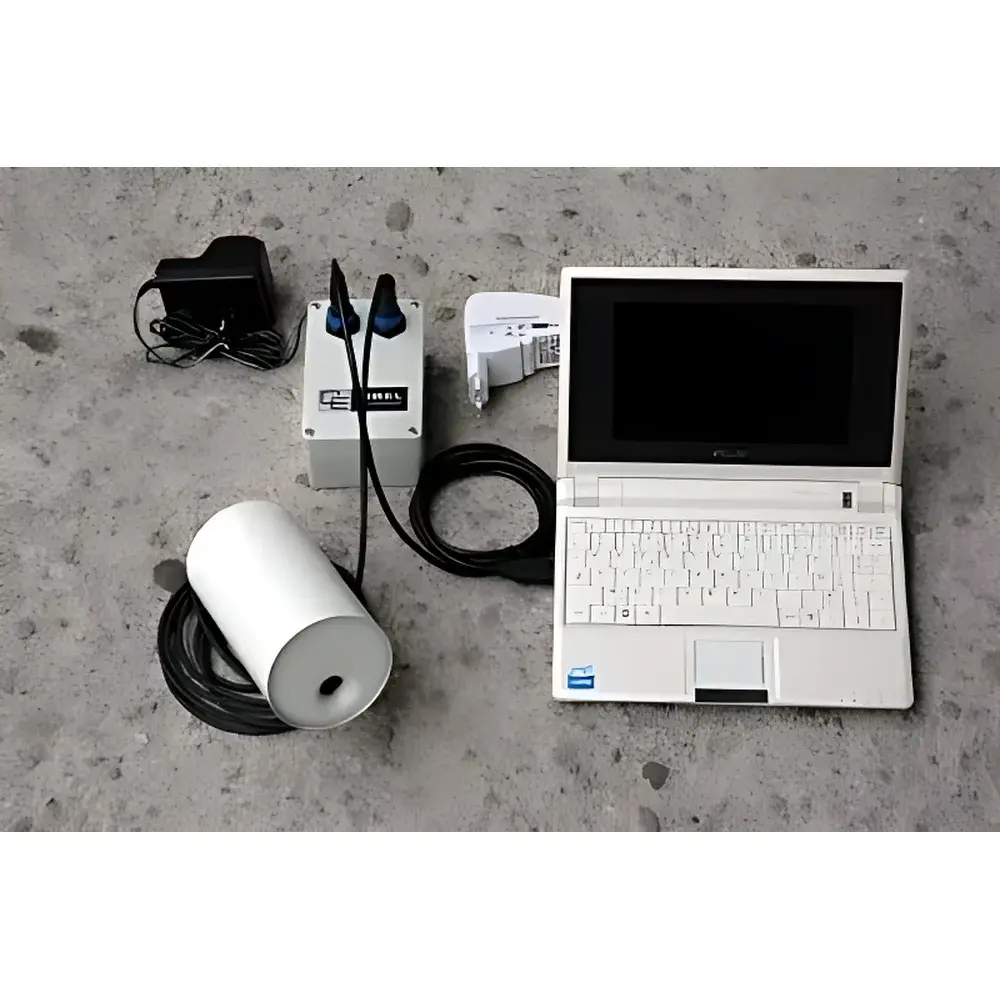
Cimel CE312 Ground-Based Multispectral Thermal Infrared Radiometer
| Brand | Cimel |
|---|---|
| Origin | France |
| Model | CE312 |
| Instrument Type | Portable Radiometric Sensor |
| Application Domain | Environmental Monitoring, Atmospheric Science, Remote Sensing Calibration |
| Spectral Configuration | CE312-1 (4-band) or CE312-2 (6-band) |
| Temperature Range | −80 °C to +60 °C |
| Temperature Resolution | 0.01 °C |
| Response Time | 1 s |
| Field of View | 10° |
| Operating Ambient Temperature | −20 °C to +50 °C |
| Power Supply | Integrated Rechargeable Battery (12 V), Optional Solar Panel |
| Data Storage | Internal Memory via Control Box |
| Measurement Modes | Manual Sampling, Programmable Timed Acquisition |
| Spectral Bands | CE312-1: 8–13 µm, 8.2–9.2 µm, 10.3–11.3 µm, 11.5–12.5 µm |
| CE312-2 | 8–13 µm, 8.1–8.5 µm, 8.5–8.9 µm, 8.9–9.3 µm, 10.3–11.0 µm, 11.0–11.7 µm |
Overview
The Cimel CE312 is a ground-based, multispectral thermal infrared radiometer engineered for high-fidelity radiance measurements in the atmospheric window (8–13 µm). It operates on the principle of calibrated narrowband spectral radiometry, utilizing thermopile or pyroelectric detectors (model-dependent) with temperature-stabilized optics and precision spectral filtering to quantify spectral radiance with traceable uncertainty. Designed for field deployment in unattended or semi-automated configurations, the CE312 serves as a reference-grade validation tool for satellite and airborne thermal sensors—supporting vicarious calibration campaigns compliant with CEOS/Cal/Val protocols. Its core function is the acquisition of absolute spectral radiance under natural sky conditions, enabling derivation of land surface temperature (LST), cloud emissivity, atmospheric downwelling longwave radiation, and surface energy balance components (e.g., net radiation, sensible/latent heat flux estimation via two-source energy balance models).
Key Features
- Modular dual-component architecture: detachable optical head and ruggedized control box for flexible deployment (tripod-mounted, vehicle-integrated, or tower-mounted)
- Selectable spectral configuration: CE312-1 (4-band) optimized for broad atmospheric window characterization; CE312-2 (6-band) enables finer discrimination of water vapor absorption features and surface emissivity variability
- High thermal stability: internal temperature regulation and blackbody reference tracking ensure radiometric drift <0.5 K over 24 h at ambient extremes (−20 °C to +50 °C)
- Sub-second temporal resolution: 1 s response time supports dynamic observation of cloud transients, diurnal thermal cycles, and irrigation-induced surface cooling events
- 0.01 °C temperature resolution coupled with ±0.2 °C absolute accuracy (traceable to NIST-certified blackbody sources)
- Integrated rechargeable battery system (12 V, >8 h continuous operation) with optional photovoltaic charging—designed for remote, off-grid stations
- Field-configurable acquisition modes: manual trigger, user-defined time-lapse intervals (1 min to 24 h), and external TTL/GPS-synchronized sampling
Sample Compatibility & Compliance
The CE312 is not a sample-contact instrument; it performs non-invasive, line-of-sight radiometric measurement of natural surfaces (soil, vegetation canopies, water bodies, snow/ice, urban infrastructure) and atmospheric columns. Its optical design conforms to ISO 18434-1:2008 (Condition monitoring and diagnostics of machines — Thermography — Part 1: General procedures) for environmental thermal imaging applications. Data output meets FAO-56 and WMO guidelines for evapotranspiration modeling inputs. When deployed in calibration transfer experiments, the CE312 adheres to CEOS Radiometric Calibration Working Group (RCWG) best practices and supports traceability to SI units through documented chain-of-custody blackbody calibrations performed annually at accredited metrology labs (e.g., LNE, PTB). The system is compatible with GLP-compliant data logging when used with timestamped, checksum-verified binary storage.
Software & Data Management
Data acquisition and configuration are managed via the CE312 Control Software Suite (Windows/Linux), which provides real-time spectral preview, dark-current subtraction, non-uniformity correction (NUC), and radiometric calibration coefficient application. Raw outputs are stored in IEEE 754-compliant binary format (.ce3) with embedded metadata (GPS coordinates, UTC timestamps, instrument temperature, filter ID, integration time). Export options include NetCDF-4 (CF-1.8 compliant), ASCII tab-delimited, and ENVI-compatible BIL formats—facilitating ingestion into atmospheric radiative transfer codes (e.g., MODTRAN, libRadtran) and Earth observation processing chains (e.g., ESA SNAP, NASA ARSET workflows). Audit trails, user access logs, and electronic signatures are supported for 21 CFR Part 11–aligned deployments in regulatory monitoring contexts.
Applications
- Agricultural monitoring: canopy temperature mapping for water stress detection, yield forecasting via thermal time integration, and deficit irrigation scheduling using crop water stress index (CWSI)
- Meteorological networks: surface longwave irradiance quantification for boundary layer modeling, cloud base height estimation via thermal contrast analysis, and validation of numerical weather prediction (NWP) model downward LW flux outputs
- Geothermal surveying: identification of anomalous surface thermal emissions linked to subsurface hydrothermal circulation and fault-zone permeability
- Oceanographic research: sea surface temperature (SST) validation for AVHRR, VIIRS, and SLSTR sensors; detection of upwelling fronts and river plume thermal signatures
- Remote sensing calibration: on-ground vicarious calibration of hyperspectral and multispectral thermal imagers aboard UAVs, aircraft (e.g., NASA’s MASTER), and satellites (e.g., Landsat 9 TIRS-2, Sentinel-3 SLSTR)
- Urban climate studies: surface emissivity mapping across building materials and impervious surfaces to parameterize urban canopy models
FAQ
What spectral calibration standards does the CE312 support?
The CE312 is factory-calibrated against cavity blackbodies traceable to national metrology institutes (NMI); users may perform field recalibration using portable reference blackbodies (e.g., CI Systems BB-300) with emissivity >0.999 and temperature stability ±0.05 °C.
Is the CE312 compatible with automated weather station (AWS) networks?
Yes—via RS-232/RS-485 serial interface or optional Ethernet module; it supports standard protocols including Modbus RTU and NMEA 0183 for synchronized time stamping and metadata exchange.
Can the CE312 operate unattended for extended periods?
Fully autonomous operation is supported for ≥30 days using the integrated battery + solar option, with watchdog timer reset and SD card overflow protection enabled by default.
Does the system provide real-time spectral radiance conversion?
Yes—the control software applies pre-loaded calibration coefficients (gain, offset, nonlinearity terms) in real time, outputting physical units (W·m⁻²·sr⁻¹·µm⁻¹) without post-processing.
What maintenance is required for long-term field reliability?
Annual verification of spectral bandpass (using monochromator-based linearity checks) and biannual cleaning of ZnSe/Ge windows with spectroscopic-grade solvents; no routine detector replacement is specified under normal operating conditions.
Related Products







