
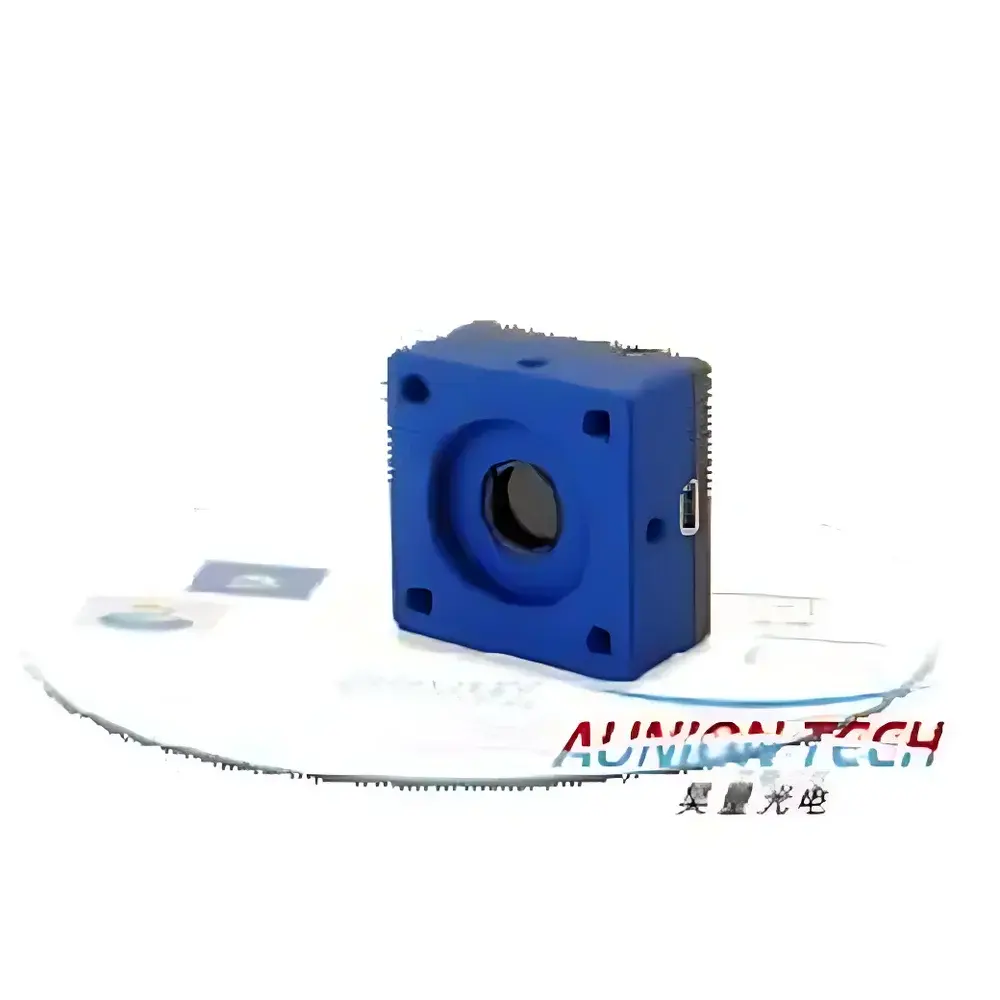
Cinogy CinAlign Telecommunications-Optimized Beam Profiler
| Brand | Cinogy |
|---|---|
| Origin | Shanghai, China |
| Manufacturer Type | Authorized Distributor |
| Product Origin | Domestic (China) |
| Model | CinAlign Beam Profiler |
| Price | Upon Request |
| Wavelength Range | 320–1610 nm |
| Spot Size Range | 1.1 µm – 4 mm |
| Sensor Types | CinCam CMOS-1202 (400–1350 nm), CinCam CMOS-1201-IR (1470–1610 nm) |
| Pixel Resolution | 1280 × 1024 |
| Pixel Pitch | 5.2–5.3 µm |
| Dynamic Range | >61 dB |
| Interface | USB 2.0 |
| Software | RayCi-Lite (upgradable to Standard/Pro) |
Overview
The Cinogy CinAlign Telecommunications-Optimized Beam Profiler is an engineered solution for quantitative characterization of laser beams used in fiber-optic communication systems. Based on high-fidelity CMOS imaging and calibrated optical detection principles, the system implements ISO 11146-compliant beam analysis methodology—including second-moment (D4σ) and knife-edge algorithms—to deliver traceable measurements of beam diameter, ellipticity, centroid position, beam propagation factor (M²), divergence angle, and pointing stability. Designed specifically for telecom-relevant wavelengths—850 nm (VCSELs), 1310 nm (O-band), and 1550 nm (C/L-bands)—the profiler supports both collimated and tightly focused beams across free-space and fiber-coupled configurations. Its dual-sensor architecture (CMOS-1202 and CMOS-1201-IR) ensures spectral coverage from deep UV (320 nm) through near-IR (1610 nm), enabling cross-platform validation of multimode and single-mode sources without wavelength-dependent recalibration.
Key Features
- Telecom-optimized spectral response: Dual-camera configuration covers 400–1350 nm (CMOS-1202) and 1470–1610 nm (CMOS-1201-IR), fully encompassing industry-standard optical communication bands.
- Extended dynamic range (>61 dB) with 8-bit digitization, supporting simultaneous measurement of low-intensity wings and high-intensity core regions under continuous-wave (CW) or pulsed operation (repetition rates up to 10 kHz).
- Modular optical path design: The near-field variant integrates interchangeable microscope objectives (10×, 20×, 40×) with calibrated working distances and focal lengths, enabling diffraction-limited resolution down to 1.1 µm at the focus plane.
- Real-time beam monitoring at up to 60 fps (full-frame), with timestamped parameter logging for long-duration stability assessment—critical for qualification testing per Telcordia GR-468-CORE and IEC 61280-2-9.
- Robust mechanical housing (40 × 40 × 20 mm) with passive thermal management, compliant with CE and RoHS directives; USB 2.0 interface ensures compatibility with industrial PCs in controlled lab environments.
Sample Compatibility & Compliance
The CinAlign system accommodates a broad range of telecom-grade light sources: edge-emitting lasers (EELs), vertical-cavity surface-emitting lasers (VCSELs), distributed feedback (DFB) lasers, electro-absorption modulated lasers (EMLs), and fiber-pigtailed modules. It supports both free-space and fiber-output configurations using optional mounting adapters and alignment stages. All measurements adhere to ISO 11146-1:2005 (laser beam widths, divergence angles, and beam propagation ratios) and ASTM F2792 (standard terminology for laser beam parameters). The RayCi software suite provides audit-ready reports with metadata embedding (wavelength, exposure time, attenuation OD, objective magnification), satisfying documentation requirements for ISO/IEC 17025-accredited calibration labs and GLP-regulated R&D workflows.
Software & Data Management
RayCi-Lite—the included base software—provides real-time visualization of beam profiles, 2D/3D intensity maps, line cuts, and live parameter tables (beam width X/Y, ellipticity, centroid drift, peak irradiance). Upgradable modules (RayCi Standard, RayCi Pro) add M² calculation via variable-aperture scanning, automated pass/fail thresholding against user-defined specs, batch processing for multi-wavelength datasets, and export to CSV, HDF5, or MATLAB .mat formats. The software implements full 21 CFR Part 11 compliance options—including electronic signatures, role-based access control, and immutable audit trails—for regulated manufacturing environments. Data timestamps are synchronized with system clock (±10 ms accuracy), and all raw images retain embedded EXIF metadata for traceability.
Applications
- Characterization of VCSEL arrays for short-reach datacom (e.g., 100G-SR4, 400G-SR8) including uniformity mapping and far-field pattern validation.
- Verification of single-mode fiber coupling efficiency by quantifying mode field diameter (MFD) mismatch and alignment sensitivity.
- Stability monitoring of DFB/EML transmitters during burn-in and accelerated life testing (ALT) per Telcordia GR-468.
- Optimization of lensed-fiber pigtails and micro-optic assemblies used in transceivers and active optical cables (AOCs).
- Root-cause analysis of beam distortion induced by thermal lensing, packaging stress, or hermetic seal degradation in TO-can and butterfly packages.
FAQ
Does the CinAlign system support M² measurement?
Yes—when upgraded to RayCi Pro, the system performs ISO 11146-compliant M² determination using a motorized aperture scan and iterative beam propagation modeling.
Can it measure pulsed lasers with nanosecond pulse widths?
Yes—provided average power remains within sensor damage thresholds (≤100 mW for near-field configuration) and pulse energy does not exceed saturation limits (≤1 µJ/pulse for CMOS-1202 at 1310 nm).
Is external triggering supported for synchronization with laser pulses?
No—USB 2.0 bandwidth limits hardware trigger implementation; however, software-triggered frame capture with sub-millisecond latency is available in RayCi Pro.
What calibration certificates are provided?
Each unit ships with NIST-traceable spatial calibration certificate (pixel-to-µm mapping at specified wavelength and magnification) and responsivity curve data for both sensors.
Can the same camera be used for both collimated and focused beam measurements?
Yes—the CinCam CMOS modules are removable and interchangeable between the alignment and near-field platforms, enabling unified calibration and consistent metrology across measurement modes.




