
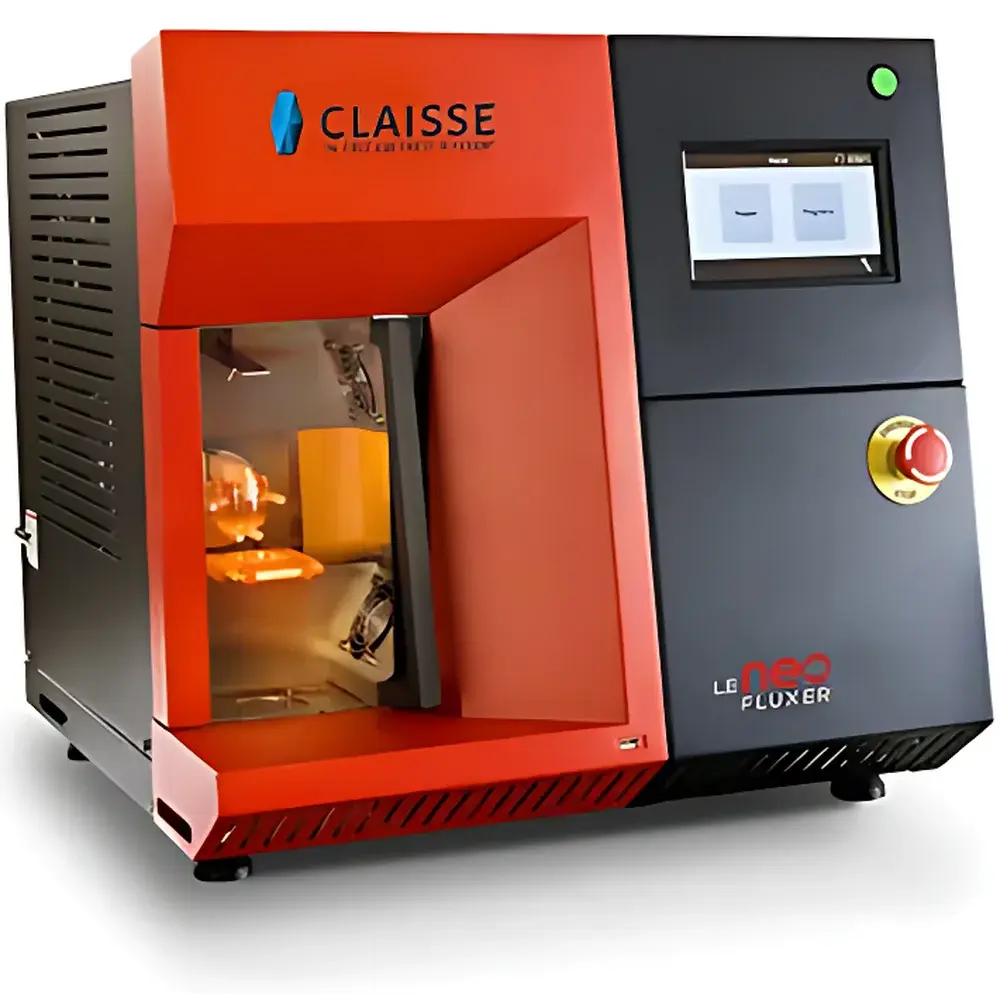
Claisse LeNeo / TheOx Advanced / Eagon 2 / M4 / LeDoser / LeDoser-12 Fusion Instruments by Malvern Panalytical
| Brand | Malvern Panalytical |
|---|---|
| Origin | Canada |
| Manufacturer | Claisse (a Malvern Panalytical company) |
| Instrument Type | Automated Flux Fusion System |
| Compliance | Designed for ISO/IEC 17025, ASTM E2627, ASTM D5630, USP <731>, and GLP/GMP environments |
| Certifications | CE, CSA, UL listed |
| Operating Modes | Fully automated electronic + gas-controlled fusion, programmable ramp/hold thermal profiles |
| Crucible Capacity | Supports Pt/Au, Pt/Rh, and graphite crucibles (standard 30–50 mL) |
| Maximum Temperature | Up to 1200 °C (LeNeo/TheOx), 1100 °C (Eagon 2), 1050 °C (M4) |
| Gas Compatibility | Argon, nitrogen, air, or custom mixed atmospheres (optional mass flow controller) |
| Safety | Integrated fume extraction interface, overtemperature cut-off, door interlock, real-time CO/NOₓ monitoring (optional) |
| Connectivity | Ethernet, RS-232, USB |
Overview
Claisse fusion instruments—engineered and manufactured in Canada by Malvern Panalytical—are fully automated, high-precision flux fusion systems designed for the reproducible preparation of homogeneous, glassy beads from geological, metallurgical, environmental, and industrial samples. These instruments operate on the principle of high-temperature molten flux dissolution: solid samples are mixed with alkali borate fluxes (e.g., lithium tetraborate, lithium metaborate, or mixed ratios), heated under controlled atmosphere to temperatures between 1050 °C and 1200 °C, and rapidly quenched to yield transparent, bubble-free discs suitable for wavelength-dispersive X-ray fluorescence (WDXRF), energy-dispersive XRF (EDXRF), and inductively coupled plasma (ICP) analysis. Unlike manual or semi-automated furnaces, Claisse systems integrate precise electronic temperature control, programmable gas management, dynamic crucible rotation (in LeNeo and TheOx Advanced), and real-time thermal profiling—ensuring stoichiometric homogeneity, minimal volatilization loss, and inter-laboratory comparability.
Key Features
- Multi-stage thermal programming: Independent ramp, hold, and cooling segments with ±1 °C stability across full operating range—critical for refractory oxide dissolution and volatile element retention.
- Automated flux and sample dosing: LeDoser and LeDoser-12 units deliver gravimetrically calibrated flux-to-sample ratios (0.1–10 g range) with ≤±0.5 mg repeatability, eliminating manual weighing errors and cross-contamination.
- Crucible motion control: LeNeo and TheOx Advanced feature motorized crucible rotation (0–60 rpm) during fusion to enhance melt homogenization and reduce phase segregation—validated per ASTM E2627 for fused bead certification.
- Atmosphere management: Programmable dual-gas (e.g., argon + air) or inert purge sequences suppress oxidation of Fe²⁺/Mn²⁺ and prevent platinum crucible degradation during repeated use.
- Robust safety architecture: Redundant thermocouples, pressure-relief vents, automatic door lock during operation, and optional integrated fume scrubbing interface compliant with local occupational exposure limits (OELs).
- Modular platform design: M4 serves as a compact, entry-level furnace for routine labs; Eagon 2 adds dual-zone heating for asymmetric crucible geometry; TheOx Advanced integrates optical pyrometry and closed-loop emissivity compensation for trace-element-sensitive applications.
Sample Compatibility & Compliance
Claisse fusion systems accommodate diverse matrices—including silicates, carbonates, sulfides, slags, fly ash, soils, polymers (after ashing), and high-purity metals—provided appropriate flux chemistry and dilution ratios are selected. All models support standard 30 mL and 50 mL Pt/Au (95/5) or Pt/Rh (90/10) crucibles, with optional graphite crucibles for fluoride-based fusions. Instruments are validated per ISO/IEC 17025 calibration requirements and routinely deployed in laboratories accredited to ASTM D5630 (for cementitious materials), USP (pharmaceutical excipients), and EPA Method 6010D (solid waste digestion). Full audit trails—including operator ID, method version, temperature log, gas flow rates, and crucible history—are retained locally and exportable for FDA 21 CFR Part 11 compliance when paired with Claisse FusionSuite software.
Software & Data Management
FusionSuite™ is the native control and data management platform for Claisse instruments. It provides role-based user access (administrator, analyst, supervisor), method library management with version control, and automated report generation (PDF/CSV) containing raw thermal curves, final bead mass, fusion duration, and deviation alerts. The software supports direct integration with LIMS via ASTM E1384-compliant XML schema and offers optional 21 CFR Part 11 modules—including electronic signatures, audit trail encryption, and immutable record archiving. All instrument logs are timestamped, digitally signed, and synchronized with NTP servers to ensure traceability across multi-site operations.
Applications
- Preparation of fused beads for major/minor/trace element quantification in exploration geochemistry (XRF) and ore grade control (ICP-OES/MS).
- Routine quality assurance of cement, limestone, clinker, and slag in construction materials testing labs.
- Homogenization of heterogeneous environmental samples (sediments, soils, dust filters) prior to regulatory compliance testing (e.g., TCLP, RCRA).
- Standard reference material (SRM) certification workflows requiring certified uncertainty budgets per ISO Guide 35.
- Development of customized fusion protocols for novel battery cathode materials (NMC, LFP) and rare earth concentrates where redox-sensitive elements (Ce³⁺/⁴⁺, V⁴⁺/⁵⁺) demand precise atmosphere control.
FAQ
What fluxes are compatible with Claisse fusion instruments?
Lithium tetraborate (Li₂B₄O₇), lithium metaborate (LiBO₂), and mixed ratios (e.g., 66.7% Li₂B₄O₇ + 33.3% LiBO₂) are standard. Ammonium nitrate and bromide-based fluxes may be used with appropriate ventilation and crucible selection.
Can Claisse instruments be integrated into an automated lab workflow?
Yes—via Ethernet-enabled OPC UA or Modbus TCP interfaces, they synchronize with robotic sample handlers, balance systems, and LIMS without middleware.
Is platinum crucible lifetime extended with Claisse gas control?
Independent studies show >30% increase in usable cycles when using argon purging during fusion of sulfur-rich or halogenated samples, verified by SEM-EDS crucible surface analysis.
How is method validation supported?
Each system ships with IQ/OQ documentation templates aligned with ISO/IEC 17025, plus pre-validated fusion methods for 12 common matrix types (e.g., bauxite, phosphate rock, stainless steel), all traceable to NIST SRMs.
What service and support options are available globally?
Malvern Panalytical offers on-site installation qualification, annual performance verification, remote diagnostics, and certified technician training—available in 42 countries through its regional service centers.



