
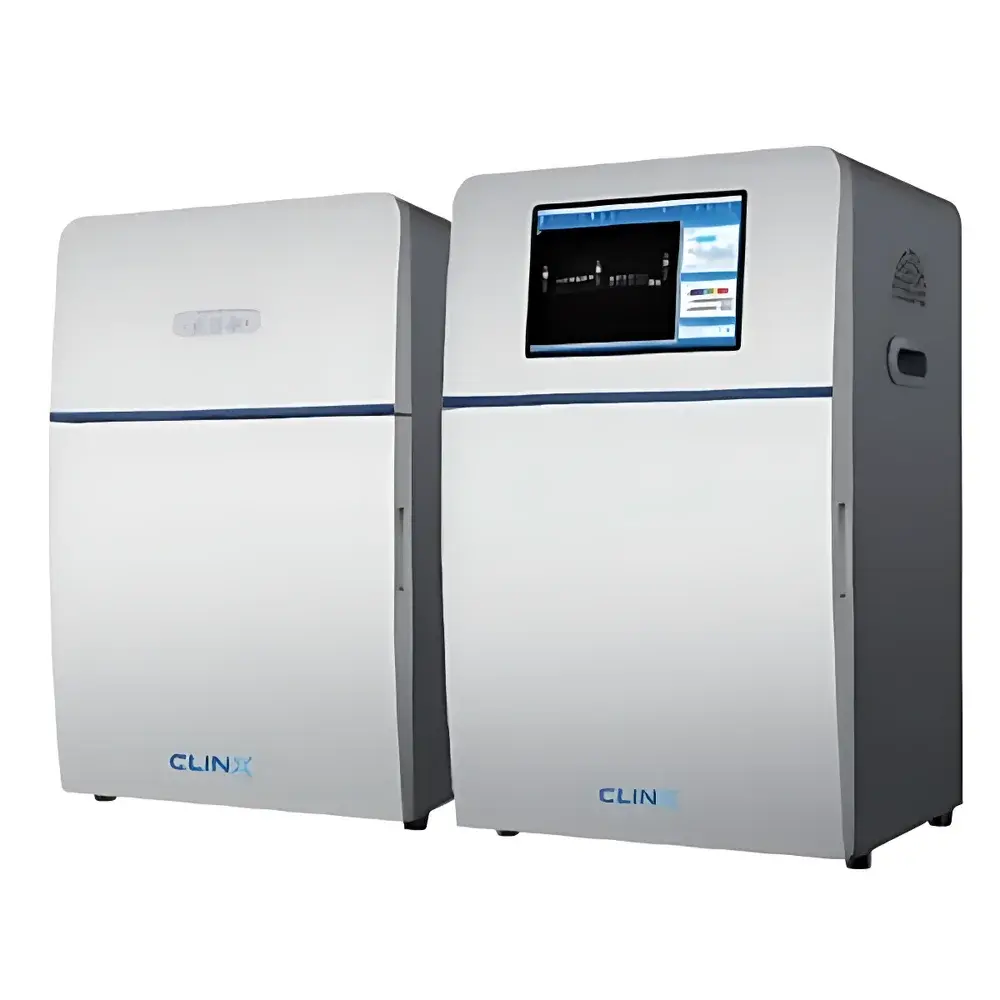
CLINX GenoSens 2150 Touch Gel Imaging System
| Brand | CLINX |
|---|---|
| Origin | Shanghai, China |
| Model | GenoSens 2150 Touch |
| Camera Resolution | 5.2 MP (2540 × 2048) |
| Bit Depth | 16-bit |
| Dynamic Range | 4.0 OD |
| Imaging Area | 19.5 cm × 24.5 cm |
| UV Transillumination | 302 nm / 365 nm LED |
| Blue Light Transillumination | 470 nm LED |
| White Light Transillumination | LED |
| Reflective Fluorescence Excitation | Selectable single-wavelength LEDs (365–730 nm) |
| Emission Filters | 460–810 nm bandpass options |
| Integrated Touch Interface | 10.1″ industrial-grade capacitive touchscreen |
| Software | GenoSens Image Acquisition & Analysis Suite |
Overview
The CLINX GenoSens 2150 Touch Gel Imaging System is a fully integrated, computer-controlled platform engineered for high-fidelity digital capture and quantitative analysis of nucleic acid and protein electrophoresis gels. Based on solid-state LED transillumination and reflective fluorescence excitation, the system employs a scientific-grade 16-bit CCD sensor with 5.2 megapixel resolution to deliver exceptional signal-to-noise ratio and linear dynamic range up to 4.0 optical density (OD). Unlike legacy systems relying on mercury-vapor lamps or halogen sources, this instrument utilizes long-life, spectrally stable LEDs—ensuring consistent illumination intensity (>90% uniformity across the imaging field), minimal thermal drift, and compliance with modern lab safety standards. Its modular optical architecture supports simultaneous multi-wavelength excitation and emission filtering, enabling reproducible detection of ethidium bromide, SYBR dyes, GelSignal reagents, Coomassie-stained proteins, silver-stained gels, and fluorescently labeled samples under standardized conditions aligned with ISO/IEC 17025 and GLP documentation requirements.
Key Features
- 16-bit true-depth CCD camera with 5.2 MP resolution (2540 × 2048), optimized for low-light sensitivity and quantitative densitometry
- Motorized auto-focus lens with real-time preview and pixel-precise focusing calibration
- Dual-mode LED transillumination: selectable 302 nm / 365 nm UV and 470 nm blue light, plus white LED for visible-stain applications
- Reflective fluorescence module with six discrete excitation wavelengths (365, 470, 530, 630, 660, 730 nm) and matched bandpass emission filters (460–810 nm)
- Integrated 10.1-inch industrial capacitive touchscreen with embedded GenoSens software—supports both standalone operation and seamless external PC integration via dual USB 2.0 ports
- Automated exposure control, background subtraction, and pixel binning (1×1 to 4×4) for adaptive signal amplification without saturation
- UV shielding compliant with IEC 62471 photobiological safety classification; >99.5% UV blocking in protective hood
Sample Compatibility & Compliance
The GenoSens 2150 Touch accommodates standard slab gels (up to 24.5 cm width), mini-gels, and blot membranes. It is validated for use with common nucleic acid stains including Ethidium Bromide, SYBR Green I/II, SYBR Gold, SYBR Safe, GelSignal Red/Green, and GelStar—each requiring specific excitation/emission pairings programmatically selected within the software. For protein detection, it supports Coomassie Brilliant Blue R-250, silver staining protocols, SYPRO Ruby, SYPRO Orange, and SYPRO Red. All imaging workflows adhere to analytical traceability principles: metadata (exposure time, gain, lens position, lamp status, user ID, timestamp) are embedded in TIFF headers and preserved during export. The system meets functional requirements for FDA 21 CFR Part 11-compliant environments when deployed with audit-trail-enabled account management and electronic signature modules.
Software & Data Management
GenoSens Image Acquisition & Analysis Software provides a unified interface for instrument control, image processing, and quantitative reporting. Core modules include:
- Acquisition: Real-time live preview, auto-exposure optimization, manual parameter override, multi-frame averaging, and pseudo-color mapping (e.g., Fire, Rainbow, Grayscale)
- Analysis: Automated lane and band detection with manual correction tools; background subtraction per lane; integrated molecular weight calibration using reference ladders; calculation of relative mobility (Rf), % intensity, concentration (via standard curve), and isoelectric point estimation for 2D gels
- Account Management: Role-based access control (Administrator, Supervisor, User) with session logging, image operation history, and PDF report generation containing raw image hash, acquisition parameters, and analyst credentials
- Data Export: Export of processed data to Excel (.xlsx), annotated images as TIFF/PNG/JPEG, and structured reports in PDF with embedded metadata and digital signatures
Applications
This system serves routine and regulated workflows across academic research, clinical diagnostics, and biopharmaceutical QC laboratories. Primary use cases include: DNA fragment sizing and quantification in PCR product verification; RNA integrity assessment via ribosomal band ratios; plasmid restriction digest validation; Western blot band normalization against housekeeping proteins; comparative proteomic profiling from 2D-PAGE; and rapid screening of CRISPR editing efficiency by T7E1 or Surveyor assays. Its compatibility with blue-light–excitable dyes also supports safer nucleic acid visualization in teaching labs and high-throughput screening facilities where UV exposure minimization is mandated.
FAQ
Does the GenoSens 2150 Touch support automated molecular weight calibration?
Yes—the software includes a lane-based calibration wizard that uses known ladder bands to generate polynomial regression curves for accurate MW interpolation across unknown samples.
Can the system be operated without the built-in touchscreen?
Yes—external PC control is fully supported via USB connection; all functions—including real-time preview, exposure adjustment, and analysis—are accessible through the desktop client.
Is the LED transillumination uniformity verified per ASTM E2594?
While not certified to ASTM E2594 (which applies to flat-panel displays), the system’s illumination uniformity (>90%) is measured per ISO 14889 Annex D methodology using calibrated photodiode array scanning across the active imaging area.
What file formats are natively supported for image import/export?
Raw acquisition format is 16-bit TIFF with EXIF metadata; export options include 8-/16-bit TIFF, PNG, JPEG, and PDF with embedded annotations and measurement overlays.
How is data integrity ensured during long-term archival?
All acquired images retain original bit depth and metadata; checksums (SHA-256) are generated upon save and logged in the audit trail, enabling forensic verification of file authenticity and tamper detection.
Related Products



