
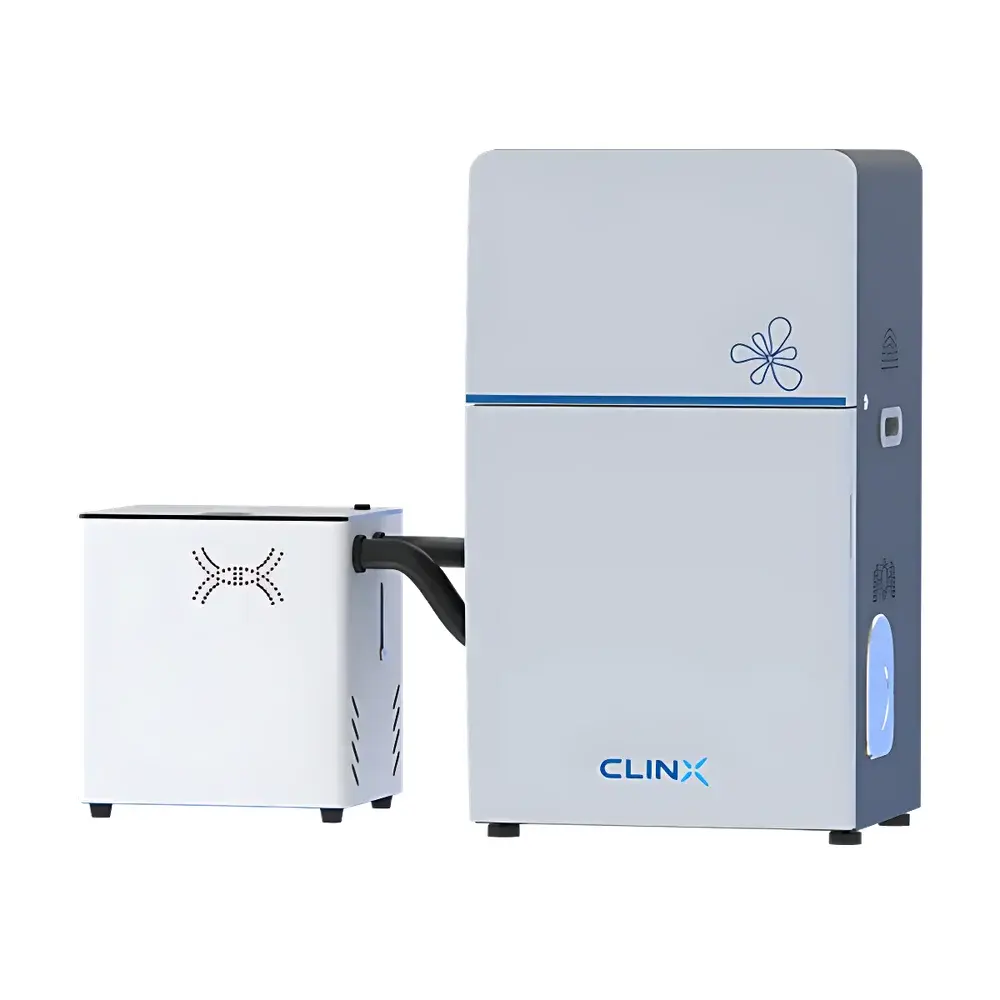
Clinx IVScope 7200 Plant In Vivo Imaging System
| Brand | Clinx |
|---|---|
| Model | IVScope 7200 |
| Camera | 6 MP front-illuminated cooled CCD |
| Pixel Size | 4.54 µm × 4.54 µm |
| Lens Aperture | f/0.8 motorized lens |
| Cooling Temperature | down to −90 °C (with optional water-circulating chiller) |
| Sample Stage | motorized height-adjustable stage |
| Reflectance Illumination | standard white-light, optional UV/Vis/NIR |
| Filter System | optional motorized filter wheel with multiple emission filters |
| Optional Modules | RGBW high-power LED illumination system, integrated temperature & humidity control, lateral imaging module |
Overview
The Clinx IVScope 7200 Plant In Vivo Imaging System is a dedicated bioluminescence and fluorescence detection platform engineered for non-invasive, longitudinal monitoring of gene expression, protein localization, and physiological dynamics in intact plants. Based on low-light photon detection principles—leveraging highly sensitive, deep-cooled CCD imaging under light-tight conditions—the system enables quantitative measurement of luciferase-based bioluminescence (e.g., firefly or Renilla luciferase reporters) and fluorescent proteins (e.g., GFP, YFP, mCherry) across whole seedlings, leaves, roots, or tissue explants. Its optical architecture is optimized for signal-to-noise ratio (SNR) preservation: the f/0.8 motorized lens maximizes photon collection efficiency, while the −90 °C thermoelectrically cooled CCD suppresses dark current and read noise, critical for detecting sub-picomolar luminescent activity over extended acquisition times (up to several minutes per frame). Unlike conventional microscopes requiring sectioning or fixation, the IVScope 7200 maintains plant viability throughout imaging sessions, supporting true in vivo experimental paradigms.
Key Features
- 6-megapixel front-illuminated scientific CCD sensor with 4.54 µm × 4.54 µm pixel pitch, delivering high spatial resolution without compromising sensitivity
- Deep-cooling capability down to −90 °C using optional water-circulating chiller—essential for ultra-low-background imaging of weak bioluminescent signals
- f/0.8 motorized lens with automated focus and aperture control, ensuring consistent illumination uniformity and optimal light throughput across variable sample heights
- Motorized, programmable Z-stage with preset height positions for rapid, repeatable sample positioning—critical for time-series experiments involving growth-dependent morphology changes
- Integrated white-light reflectance illumination for anatomical reference imaging; expandable with UV (365 nm), blue (470 nm), green (530 nm), and NIR (740 nm) excitation sources for multi-spectral fluorescence profiling
- Optional motorized filter wheel supporting up to 6 emission filters (e.g., 510/20 nm for GFP, 600/40 nm for RFP, 690/40 nm for Cy5.5), enabling spectral unmixing and multiplexed reporter quantification
Sample Compatibility & Compliance
The IVScope 7200 accommodates live Arabidopsis thaliana seedlings (rosettes, roots, inflorescences), Nicotiana benthamiana leaves, rice coleoptiles, maize seedlings, and detached tissue explants up to 25 cm × 20 cm. Sample chambers support ambient atmospheric control, and optional integrated temperature–humidity regulation (range: 15–35 °C, ±0.5 °C; RH: 30–80%, ±3%) ensures physiological stability during multi-day circadian or stress-response assays. The system complies with ISO/IEC 17025 general requirements for competence of testing and calibration laboratories, and its hardware architecture supports audit-ready metadata logging—including timestamped exposure parameters, filter selection, stage position, and environmental setpoints—facilitating GLP-compliant data traceability. All optical components meet RoHS directives and are calibrated per manufacturer specifications using NIST-traceable luminance standards.
Software & Data Management
Acquisition and analysis are performed via Clinx ImageStudio Pro—a modular, Windows-based application designed for life science imaging workflows. The software supports real-time preview, multi-channel overlay, region-of-interest (ROI) definition, background subtraction (rolling ball algorithm), and absolute radiance calibration (photons/sec/cm²/sr). Quantitative outputs include total flux (p/s), average radiance (p/s/cm²/sr), and normalized fold-change relative to control conditions. Export formats include TIFF (16-bit), CSV (tabular ROI statistics), and PDF reports with embedded metadata. For regulatory environments, optional 21 CFR Part 11 compliance packages provide electronic signature enforcement, user access tiers, and immutable audit trails for all acquisition and processing events.
Applications
- Temporal profiling of promoter activity (e.g., CAB2::LUC for circadian rhythm studies)
- Spatiotemporal mapping of pathogen colonization (e.g., Pseudomonas syringae expressing luxCDABE)
- Subcellular localization of fusion proteins tagged with fluorescent reporters under native promoters
- Quantitative assessment of abiotic stress responses (drought, salinity, heavy metals) via ROS-sensitive probes (e.g., H₂DCFDA) or stress-inducible promoters
- Protein–protein interaction validation using bimolecular fluorescence complementation (BiFC) or split-luciferase assays
- High-throughput screening of transgenic lines for stable expression patterns across developmental stages
FAQ
What is the minimum detectable photon flux for bioluminescence imaging?
The system achieves a theoretical detection limit of <100 photons/sec/cm² under optimal cooling (−90 °C) and 5-minute integration, validated using calibrated luminescent standards traceable to NIST SRM 2211.
Can the IVScope 7200 perform kinetic imaging over multiple days?
Yes—motorized stage repeatability (<±5 µm), environmental stabilization (optional temp/RH module), and automated acquisition scheduling enable unattended time-lapse imaging across 72+ hours with minimal phototoxicity.
Is spectral unmixing supported for co-expressed fluorescent reporters?
Yes—when equipped with ≥3 emission filters and corresponding excitation sources, linear unmixing algorithms in ImageStudio Pro resolve overlapping spectra (e.g., GFP/mCherry/Cy5) using reference spectra acquired from single-reporter controls.
Does the system support third-party analysis tools like Fiji or Python-based pipelines?
All raw TIFF exports retain full bit-depth and metadata headers compatible with Bio-Formats; users may import datasets into Fiji, MATLAB, or custom Python scripts using tifffile or ome-zarr libraries.
How is calibration maintained across long-term deployments?
A built-in LED-based photometric reference source enables daily intensity verification; factory calibration certificates (including QE curve and linearity verification) are provided with each instrument and remain valid for 12 months under standard operating conditions.




