
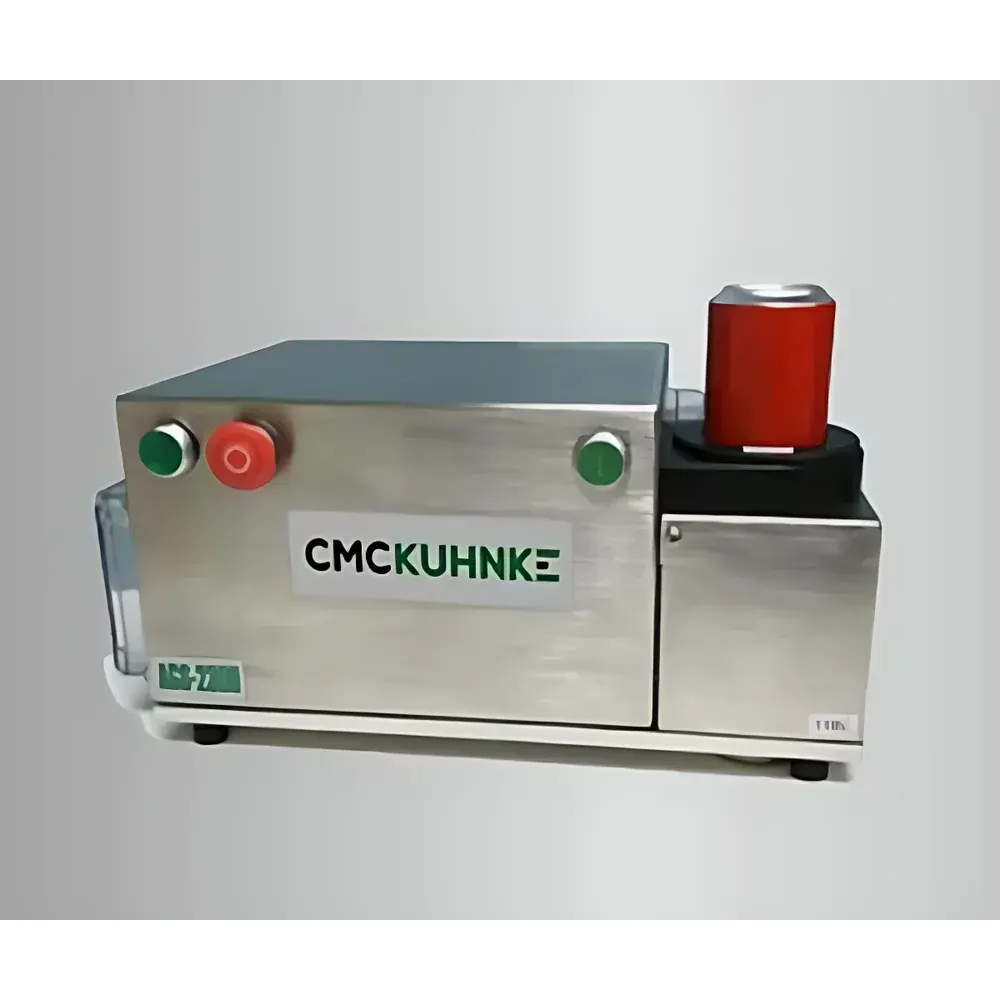
CMC KUHNKE AGS-2300 Silent Double-Seam Cross-Section Cutting Saw
| Brand | CMC KUHNKE |
|---|---|
| Origin | Germany |
| Model | AGS-2300 |
| Applicable Can Sizes | 200–307 |
| Can Diameter Range | 50–70 mm |
| Cap Type Compatibility | 200–300 series |
| Dimensions (L×W×H) | 400 × 400 × 250 mm |
| Cutting Speed | 2800 rpm |
| Power Supply | 220 V, 50–60 Hz |
| Blade Specification | 80 × 22 × 0.5 mm, High-Speed Steel (HSS) |
| Safety Features | Interlocked Guard with Safety Switch, Capacitive Can Presence Sensor, Dual-Redundant Control Circuitry |
| Noise Reduction | Fully Enclosed Acoustic Housing |
Overview
The CMC KUHNKE AGS-2300 Silent Double-Seam Cross-Section Cutting Saw is an engineered precision tool designed exclusively for the metallurgical and quality assurance laboratories of beverage can manufacturers, contract packers, and third-party testing facilities. It performs controlled, orthogonal cross-sectional cuts through the double seam of metal cans—specifically those conforming to standard US and ISO can body/cover configurations (e.g., 200–307 body codes). Unlike abrasive or thermal sectioning methods, the AGS-2300 employs dual parallel high-speed steel (HSS) circular blades operating in synchronized rotation to generate a distortion-free, burr-minimized radial cut plane perpendicular to the seam axis. This geometry preserves the true dimensional integrity of the body hook, cover hook, overlap, tightness, and thickness parameters—critical inputs for optical projection analysis per ASTM D6179, ISO 10735, and CANMET validation protocols. Its fully enclosed acoustic housing eliminates airborne noise transmission, reducing operational sound pressure levels to <65 dB(A) at 1 m—meeting EU Machinery Directive 2006/42/EC requirements for low-noise industrial equipment.
Key Features
- Fully interlocked, acoustically sealed enclosure with quick-release guard system compliant with EN ISO 13857 safety distances and EN 60204-1 electrical safety standards.
- Dual-blade kinematic configuration: One blade aligned precisely along the can’s central diameter plane ensures planar cut fidelity without angular deviation or hook-length compression during slicing.
- Capacitive can presence detection at the feed port—operation is only enabled when a can is fully seated and centered, eliminating risk of hand intrusion during activation.
- Redundant safety circuitry: Independent mechanical and electronic interlocks prevent actuation if the guard is removed or misaligned—fully traceable via internal diagnostic logging.
- Modular tooling design enables rapid reconfiguration between can families (200–307 series) using standardized adapter kits; no recalibration required.
- Robust cast-aluminum frame with vibration-damped mounting feet ensures long-term dimensional stability and zero-drift performance across >10,000 cutting cycles.
Sample Compatibility & Compliance
The AGS-2300 accommodates all standard two-piece aluminum and tinplate steel beverage cans within the 50–70 mm outer diameter range, including but not limited to 200, 202, 206, 300, 307, and equivalent international body codes. It supports both easy-open end (EOE) and sanitary lid configurations. All cut surfaces meet the surface roughness (Ra ≤ 0.8 µm) and flatness tolerance (≤ ±5 µm over 5 mm) prerequisites for high-magnification digital seam analysis systems (e.g., VisionGauge®, SeamScan™). The device complies with CE marking requirements under the EU Machinery Directive, RoHS 2011/65/EU, and conforms to the functional safety principles outlined in IEC 62061 for Category 3 PLd control systems. Documentation includes full Declaration of Conformity, EC Type Examination Certificate, and traceable calibration records for blade alignment verification.
Software & Data Management
While the AGS-2300 operates as a standalone electromechanical instrument without embedded firmware or touchscreen interface, it integrates seamlessly into regulated laboratory environments via its deterministic I/O architecture. A dedicated dry-contact output signal (24 V DC, opto-isolated) logs each completed cut cycle for synchronization with external LIMS or MES platforms (e.g., LabWare LIMS, Siemens Opcenter). Optional RS-485 Modbus RTU interface enables remote status monitoring (guard position, motor run state, fault codes) and supports audit trail generation in accordance with FDA 21 CFR Part 11 requirements when paired with validated SCADA middleware. All mechanical adjustments—including blade parallelism and feed-depth indexing—are documented using calibrated torque wrenches and certified gauge blocks, ensuring full GLP/GMP traceability.
Applications
- Quality control laboratories performing routine double seam integrity verification prior to sterilization or filling.
- Process validation studies assessing seam geometry changes following retort cycling, carbonation pressure exposure, or shelf-life aging.
- Root cause analysis of seam-related failures (leakage, bulging, false seams) in collaboration with scanning electron microscopy (SEM) or micro-CT workflows.
- Supplier qualification audits requiring physical seam sectioning per contractual specifications (e.g., Coca-Cola SPS-2, PepsiCo QSP-4).
- Educational use in packaging engineering programs for hands-on demonstration of can manufacturing metrology principles.
FAQ
Is the AGS-2300 compatible with 202 and 300-series cans?
Yes—it supports all standard US and European can bodies from 200 through 307, including 202 and 300, via interchangeable positioning inserts.
Does the saw require periodic calibration?
No scheduled calibration is mandated; however, blade parallelism and centerline alignment should be verified annually using CMC KUHNKE’s certified alignment jig (Part No. AK-AGS-ALG-01) and documented per ISO/IEC 17025.
Can the AGS-2300 be integrated into an automated production line?
It is designed for benchtop manual operation but offers discrete I/O signals suitable for integration into semi-automated QA cells with robotic part handling.
What maintenance is required for long-term reliability?
Blades should be replaced after ~500 cuts or upon visible wear; spindle bearings are lifetime-lubricated and require no servicing for ≥5 years under typical lab usage.
Is technical support available outside Germany?
Yes—CMC KUHNKE maintains authorized service partners in North America, APAC, and EMEA regions with certified field engineers trained on AGS-series diagnostics and repair procedures.



