
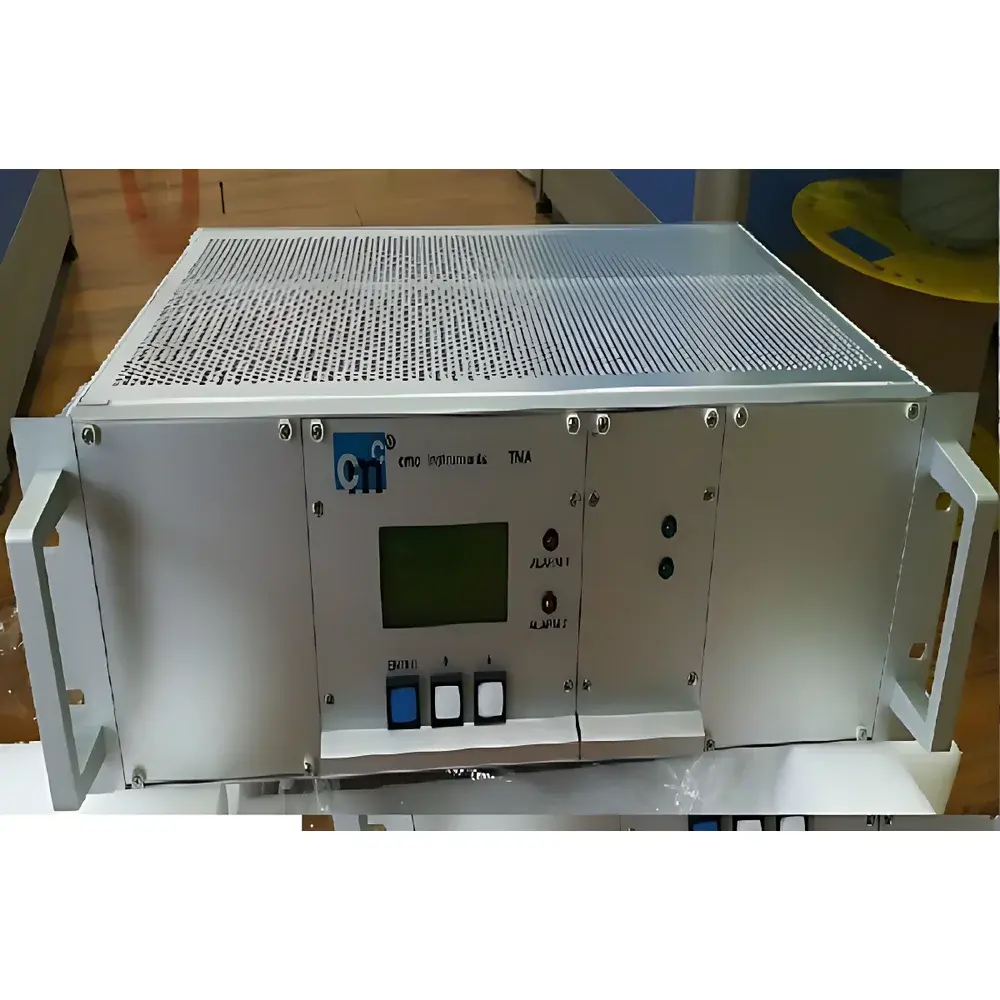
CMC TMA-202 Electrolytic P₂O₅ Online Moisture Analyzer for Chlorine and Hydrogen Chloride
| Brand | CMC |
|---|---|
| Origin | Germany |
| Model | TMA-202 |
| Principle | Electrolytic (P₂O₅ sensor) |
| Operating Temperature | -20–80 °C |
| Accuracy | ±0.2 ppm(v) |
| Repeatability | ±0.1 ppm(v) |
| Measurement Range | 0–10 / 100 / 1000 / 2500 ppm(v), auto-ranging |
| Response Time (T₉₀) | <1 s |
| T₅₀ Response | <8 s |
| Sample Flow Rate | 20 NL/h |
| Recommended Sample Pressure | 0.1–0.5 barg |
| Sample Temperature Range | 5–150 °C |
| Ambient Temperature | 5–65 °C |
| Display | Backlit LCD |
| Analog Output | 4–20 mA or 0–10 V |
| Alarm Outputs | 2 relay outputs |
| Cable Length | Standard 3 m, up to 300 m optional |
| Dimensions (Rack-mount) | 482 × 133 × 350 mm |
| (Wall-mount) | 300 × 260 × 280 mm |
| (Desktop) | 257 × 160 × 316 mm |
Overview
The CMC TMA-202 is a high-integrity, electrolytic phosphorus pentoxide (P₂O₅) online moisture analyzer engineered for continuous, real-time trace water measurement in aggressive and reactive industrial process gases—particularly chlorine (Cl₂), hydrogen chloride (HCl), sulfur dioxide (SO₂), hydrogen sulfide (H₂S), and other highly corrosive acid gases. Unlike optical or capacitive methods, the TMA-202 employs a fundamental electrochemical principle: water vapor in the sample stream is quantitatively decomposed via electrolysis across a hygroscopic P₂O₅-coated sensor cell. The resulting electrolytic current is stoichiometrically proportional to the water concentration, enabling direct, absolute measurement without calibration drift under stable operating conditions. This principle ensures long-term stability, minimal zero drift, and immunity to interference from hydrocarbons, inert gases, or non-reactive vapors—making it the reference method for ultra-trace moisture analysis (<1 ppmv) in critical gas purification, semiconductor feedstock handling, and chlor-alkali production environments.
Key Features
- Electrolytic P₂O₅ sensing cell with platinum or rhodium electrodes and ultra-thin H₃PO₄ electrolyte film—optimized for chemical resistance and signal linearity in Cl₂ and HCl streams
- True real-time response: T₉₀ < 1 second, T₅₀ < 8 seconds—enabling rapid detection of moisture excursions during process upsets or valve switching
- Auto-ranging capability across four decades (0–10, 0–100, 0–1000, 0–2500 ppmv) with seamless range switching and full-scale accuracy maintained at each span
- Microprocessor-based control architecture with built-in self-diagnostic routines—including sensor health check, power supply verification, and analog output integrity validation at startup and during operation
- NAMUR-compliant design (NE 43/NE 21) for integration into SIL-2-capable safety instrumented systems; all electrical interfaces meet ATEX/IECEx Zone 1 requirements when configured with appropriate barriers
- Modular mechanical configurations: 19-inch rack-mount (TMA-202-19″), wall-mount (TMA-202-W), and desktop (TMA-202-D) variants—each with IP65-rated enclosures for harsh plant environments
Sample Compatibility & Compliance
The TMA-202 is validated for use with high-purity and chemically aggressive gases where conventional sensors fail—including Cl₂, HCl, SO₂, H₂S, F₂, PH₃, and SF₆. Its P₂O₅ sensor avoids catalytic decomposition or surface adsorption artifacts common in metal-oxide or quartz-crystal technologies. Gas compatibility is governed by thermodynamic inertness toward concentrated phosphoric acid and electrode materials; gases known to react with P₂O₅ (e.g., NH₃, amines, strong reducing agents) are excluded per manufacturer specification. The analyzer conforms to ISO 8573-8:2019 for compressed air purity class assessment and supports compliance with ASTM D7443 (trace moisture in liquefied petroleum gas) and IEC 62271-4 (moisture in SF₆-insulated switchgear). All firmware and data logging functions comply with FDA 21 CFR Part 11 requirements when paired with CMC’s optional audit-trail-enabled software package.
Software & Data Management
The TMA-202 operates autonomously but integrates seamlessly with distributed control systems (DCS) and SCADA platforms via isolated 4–20 mA analog output or optional RS-485 Modbus RTU interface. Local configuration and diagnostics are accessible through the backlit LCD interface with intuitive menu navigation. Optional CMC DataLink software enables remote monitoring, historical trend export (CSV/Excel), alarm event logging with timestamps, and sensor performance tracking—including cumulative electrolysis charge, zero-stability history, and range-switch frequency. All stored data retain GLP/GMP-compliant metadata: operator ID, calibration date, environmental conditions, and firmware revision. Audit trails are immutable and timestamped to UTC, satisfying regulatory requirements for pharmaceutical-grade gas qualification (e.g., USP , EP 2.5.27).
Applications
- Continuous moisture monitoring in chlorine liquefaction and cylinder-filling lines—ensuring compliance with ISO 8573-1 Class 1 (≤0.1 ppmv) for electronics-grade Cl₂
- In-line verification of HCl purity in PVC monomer synthesis and semiconductor etch gas delivery systems
- Moisture guard monitoring upstream of catalytic converters in sulfuric acid plants processing SO₂-rich off-gas
- Quality assurance for SF₆ reclamation units in high-voltage substation maintenance
- Validation of dryer performance in bulk gas supply networks serving photovoltaic wafer fabrication facilities
- Leak detection support in closed-loop fluorination reactors using F₂ or HF carrier streams
FAQ
What gases are incompatible with the TMA-202’s P₂O₅ sensor?
Gases containing nucleophiles (e.g., NH₃, methylamine), strong reductants (e.g., silane, diborane), or species that form stable phosphates (e.g., alkali metal vapors) will degrade the P₂O₅ electrolyte layer and must be excluded from analysis.
Does the TMA-202 require periodic calibration with certified moisture standards?
While the electrolytic principle provides inherent zero stability, CMC recommends quarterly verification using NIST-traceable chilled-mirror or coulometric reference standards—especially after extended exposure to high-moisture events or process upsets.
Can the TMA-202 operate at elevated sample temperatures above 100 °C?
Yes—the sensor head is rated for continuous operation at sample temperatures up to 150 °C; however, thermal management of the electronics enclosure must ensure ambient temperature remains within 5–65 °C per IEC 60529.
Is the analog output intrinsically safe for hazardous area installation?
The standard 4–20 mA output is non-incendive; for Zone 0/1 applications, it must be connected through an approved galvanic isolator or Zener barrier meeting IEC 60079-11 requirements.
How is sensor lifetime affected by high-concentration moisture exposure?
Prolonged exposure >1000 ppmv accelerates electrolyte depletion; CMC specifies a minimum service life of 18 months under typical Cl₂/HCl process conditions (≤50 ppmv average), extendable to >36 months with proper sample conditioning and particulate filtration.





