
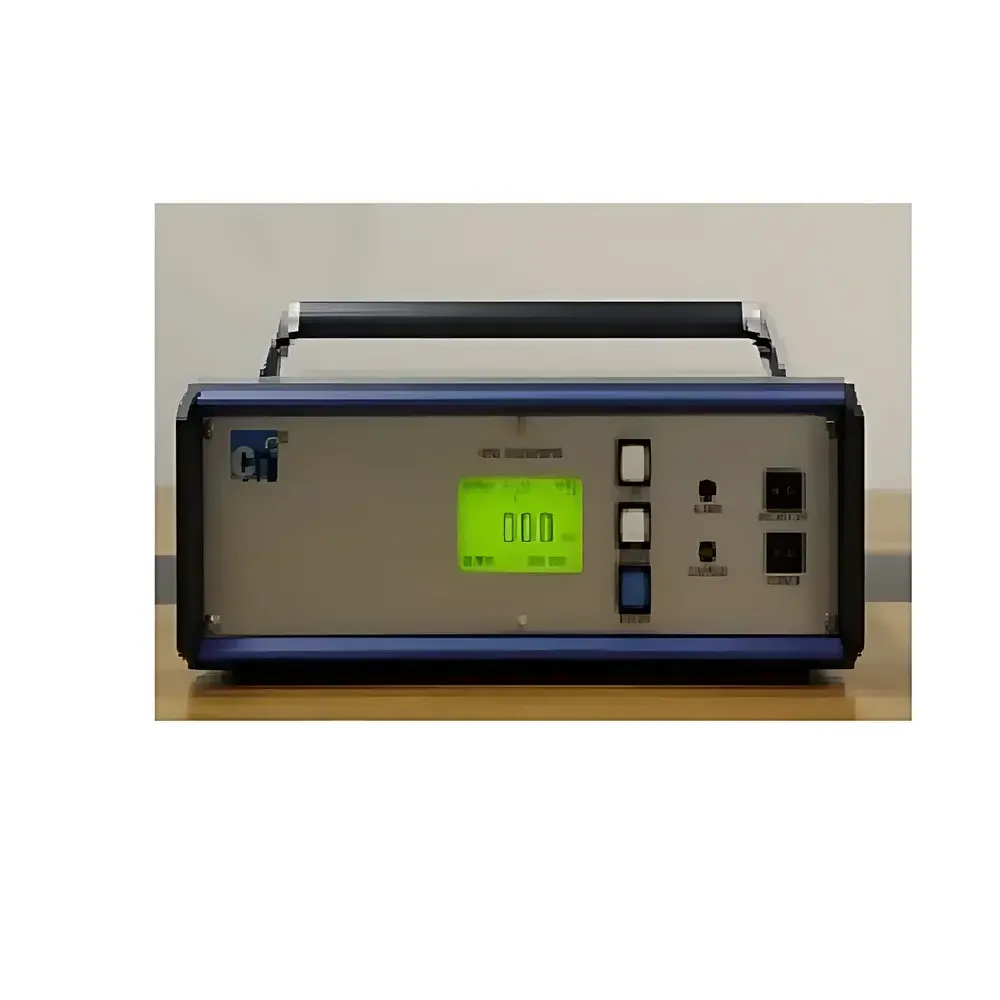
CMC TMA-210 Electrolytic Trace Moisture Analyzer
| Origin | Germany |
|---|---|
| Manufacturer Type | Authorized Distributor |
| Origin Category | Imported |
| Model | TMA-210 |
| Product Type | Online Dew Point Analyzer |
| Measurement Principle | Electrolytic (P2O5 Sensor) |
| Operating Temperature | -20 to +50 °C |
| Accuracy | ±1 ppmv |
| Repeatability | ±1 ppmv |
| Sample Flow Rate | 20 Nl/h |
| Recommended Sample Pressure | 0.1–0.5 barg |
| Sample Temperature Range | 5–150 °C |
| T50 Response Time | <8 s |
| Environmental Operating Temperature | 5–65 °C |
| Standard Cable Length | 3 m (up to 300 m optional) |
| Display | Backlit LCD |
| Analog Output | 4–20 mA or 0–10 V |
| Alarm Outputs | 2 relay outputs |
| Dimensions (Desktop) | 257 × 160 × 316 mm |
Overview
The CMC TMA-210 Electrolytic Trace Moisture Analyzer is a high-stability, field-deployable instrument engineered for continuous, real-time measurement of trace moisture (H₂O) in industrial process gases at sub-ppmv levels. Based on the well-established phosphorus pentoxide (P₂O₅) electrolytic detection principle, the TMA-210 operates by quantifying the electrical current generated when water vapor is irreversibly electrolyzed across a hygroscopic P₂O₅ film deposited on dual platinum or rhodium electrodes. This electrochemical conversion yields a linear, stoichiometric relationship between current and water concentration—enabling direct, absolute measurement without calibration drift under stable operating conditions. Designed specifically for low-flow gas streams (<20 Nl/h), the TMA-210 delivers robust performance in demanding environments including chlorine-alkali production, semiconductor purge gas monitoring, SF₆ insulation gas analysis, and high-purity nitrogen/hydrogen distribution systems. Its compact desktop form factor and modular sensor architecture support both temporary verification tasks and long-term unattended operation when paired with compatible CMC probe variants.
Key Features
- Electrolytic P₂O₅ sensing technology with inherent zero-drift stability and no consumable reagents beyond periodic sensor replacement
- True trace-level resolution down to 1 ppmv with ±1 ppmv accuracy and repeatability across full operational range
- Modular, field-replaceable sensor cartridges (TMS-XX-X-100 series) constructed from chemically resistant materials—including stainless steel, Monel®, Hastelloy®, borosilicate glass, and PFA—to match aggressive sample matrices (e.g., Cl₂, HCl, HF, NH₃)
- Fast analytical response: T50 < 8 seconds; full stabilization < 60 seconds after step change
- Backlit LCD interface with intuitive menu navigation, real-time concentration display, and status indicators for sensor health, flow, and alarm conditions
- Dual programmable relay outputs for high/low limit alarms, sensor fault alerts, or system interlock signaling
- Standard 4–20 mA isolated analog output with user-selectable range mapping; optional 0–10 V output available
- Ruggedized enclosure rated for industrial indoor environments (IP54 equivalent); operating ambient temperature range: 5–65 °C
Sample Compatibility & Compliance
The TMA-210 is validated for use with non-condensing, non-corrosive (or appropriately conditioned) process gases including nitrogen, hydrogen, argon, helium, oxygen, air, SF₆, and synthesis gas. When configured with corrosion-resistant sensor variants (e.g., TMS-H-R-100 for Hastelloy® housing + rhodium electrodes), it maintains metrological integrity in presence of halogenated compounds and acidic species common in chlor-alkali and petrochemical off-gas streams. All sensor modules comply with IEC 61000-6-2 (EMC immunity) and IEC 61000-6-4 (EMC emissions). The analyzer supports audit-ready data integrity protocols when integrated into GLP/GMP environments—its analog output and relay logic are compatible with DCS/SCADA systems requiring 21 CFR Part 11-compliant archiving via external historian solutions. While not intrinsically safe, the unit may be installed in Zone 2/Class I Div 2 areas when housed in appropriate enclosures per ATEX/IECEx guidelines.
Software & Data Management
The TMA-210 operates as a standalone, microprocessor-controlled analyzer with embedded firmware handling signal conditioning, temperature compensation, flow normalization, and sensor diagnostics. No proprietary PC software is required for basic operation; however, CMC provides optional configuration utilities (via RS-232 or USB-to-serial adapter) for advanced parameter tuning—including zero/span adjustment offsets, alarm hysteresis, damping filters, and output scaling. All configuration changes are logged with timestamp and operator ID (if enabled via external authentication layer). For regulatory compliance, raw analog output signals can be routed to third-party data acquisition systems supporting electronic signature, audit trail, and secure storage per FDA 21 CFR Part 11 requirements. Firmware updates are delivered as signed binary packages and require physical access and authenticated upload procedure.
Applications
- Continuous monitoring of moisture in chlorine and caustic soda production purge streams
- Verification of dryness in high-purity carrier gases for semiconductor CVD and etching tools
- Quality assurance of SF₆ dielectric gas in high-voltage switchgear and GIS systems
- In-line verification of desiccant dryer efficiency in compressed air and instrument air networks
- Trace moisture control in hydrogen fueling station supply lines (ISO 8573-1 Class 1.1.1 compliant)
- Research-grade validation of cryogenic gas purification systems (e.g., LNG boil-off gas treatment)
FAQ
What sensor materials are available for the TMA-210, and how do I select the appropriate one?
CMC offers six sensor housing options—stainless steel, Monel®, Hastelloy®, borosilicate glass, and PFA—paired with either platinum or rhodium electrodes. Selection depends on chemical compatibility: Hastelloy®/rhodium is recommended for Cl₂, HCl, or HF; glass/rhodium for ammonia or amine-containing streams; PFA/platinum for ultra-high purity inert gases.
Does the TMA-210 require regular calibration with certified gas standards?
While the P₂O₅ electrolytic principle provides inherent zero stability, CMC recommends quarterly verification using NIST-traceable moisture standards (e.g., permeation tubes or dynamic dilution systems) to confirm linearity and span accuracy—especially after sensor replacement or exposure to condensation events.
Can the TMA-210 be used for liquid-phase moisture analysis?
No. The TMA-210 is strictly a gas-phase analyzer. Liquid samples must be fully vaporized and dried upstream of the sensor inlet; any entrained aerosol or condensate will damage the P₂O₅ film and invalidate measurements.
Is remote diagnostics supported?
The TMA-210 does not include Ethernet or wireless connectivity. Remote access requires integration via its 4–20 mA output and relay status signals into an existing plant network using a compatible gateway or PLC with Modbus RTU capability (optional accessory).
Related Products






