
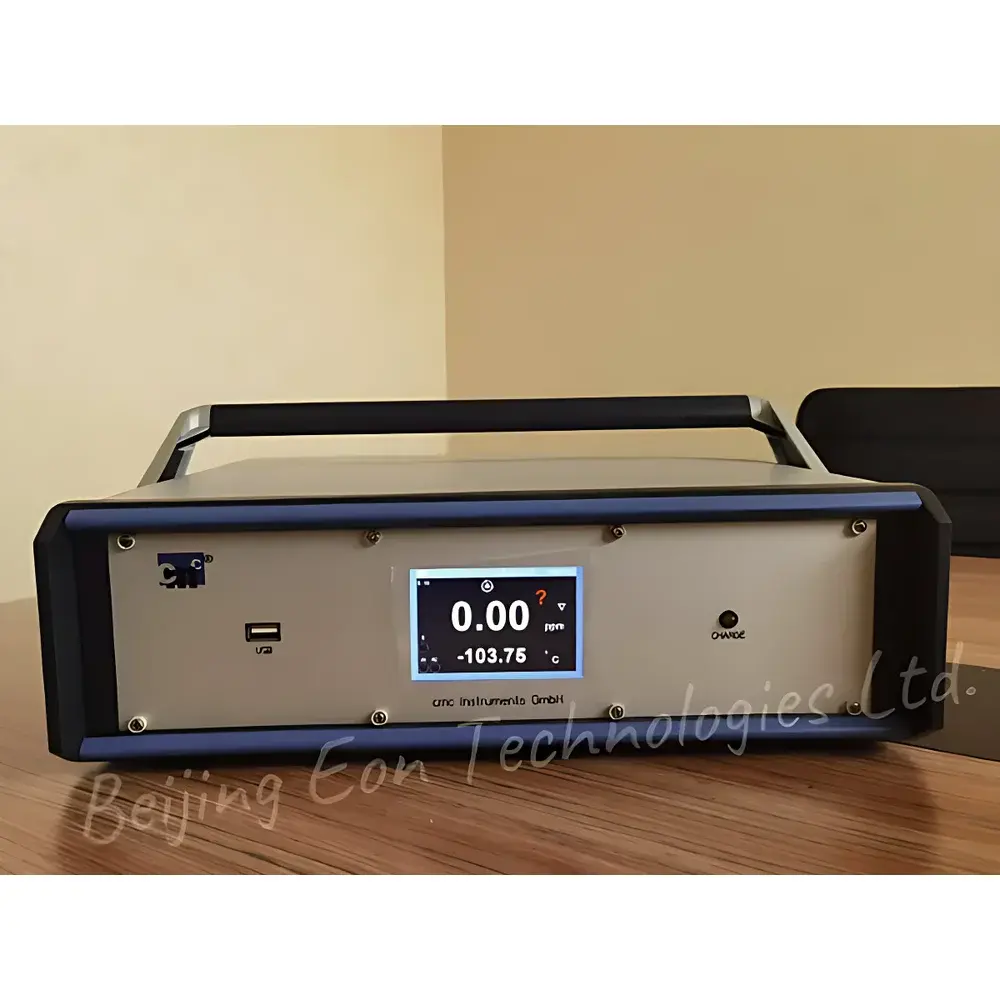
CMC TMA-210-P-Ex Portable Electrolytic Dew Point Analyzer
| Brand | CMC (Himsy) |
|---|---|
| Origin | Germany |
| Model | TMA-210-P-Ex |
| Type | Portable Dew Point Analyzer |
| Principle | Phosphorus Pentoxide (P₂O₅) Electrolytic Method |
| Operating Temperature Range | 5–150 °C |
| Accuracy | ±1% of full scale |
| Repeatability | ±1% of full scale |
| Measurement Ranges | 0–10 ppm / 0–100 ppm / 0–1000 ppm / 0–2500 ppm (auto/manual range switching) |
| Sensitivity | ±0.1% of full scale |
| Display | Touchscreen with multilingual UI (including Chinese) |
| Alarm Outputs | High/Low configurable relay outputs |
| Analog Output | 0/4–20 mA (user-configurable) |
| Intrinsic Safety | Integrated Zener barrier |
| Power Supply | Rechargeable Li-ion battery or 80–230 VAC, 50–60 Hz |
| Power Consumption | 8 W |
| Ambient Operating Temperature | −10 to +50 °C |
| Enclosure Rating | IP20 |
| Dimensions | 363 × 115 × 377 mm (W × H × D) |
| Weight | ~6 kg |
Overview
The CMC TMA-210-P-Ex is a portable, intrinsically safe electrolytic dew point analyzer engineered for trace moisture measurement in demanding industrial gas streams. It employs the well-established phosphorus pentoxide (P₂O₅) electrolytic principle — a primary reference method recognized for its absolute, calibration-free quantification of water vapor concentration. Within the sensor cell, a thin film of phosphoric acid (H₃PO₄) is deposited between two parallel electrodes (typically platinum or rhodium) mounted on a fused silica cylinder. When sample gas passes over the sensing surface, water molecules are electrolyzed into hydrogen and oxygen; the resulting P₂O₅ layer continuously absorbs moisture from the gas stream, establishing a dynamic equilibrium. The magnitude of the electrolytic current required to maintain this equilibrium is directly proportional to the partial pressure of water vapor — enabling linear, stoichiometric determination of moisture content down to sub-ppm levels. Unlike optical or capacitive methods, this technique provides true absolute measurement without drift-induced recalibration requirements, making it particularly suited for high-purity and chemically aggressive process gases.
Key Features
- Intrinsically safe design certified for hazardous areas (Ex classification per ATEX/IECEx), featuring integrated Zener barrier to eliminate spark and thermal ignition risks at the measurement point.
- True absolute measurement principle — no periodic calibration needed under stable operating conditions; sensor regeneration is rapid and field-performed via controlled electrochemical reversal.
- Four auto-switching measurement ranges (0–10, 0–100, 0–1000, 0–2500 ppmv H₂O) ensure optimal signal-to-noise ratio across diverse applications — from ultra-high-purity carrier gases to moderately moist industrial streams.
- Robust P₂O₅ sensor architecture with selectable electrode materials (Pt/Rh) enables reliable operation in corrosive gas matrices including Cl₂, HCl, SO₂, H₂S, and HF — where conventional sensors degrade rapidly.
- Full microprocessor control with self-diagnostics: automatic power-on system check, real-time sensor health monitoring, and fault logging compliant with NAMUR NE 43 standards.
- High-resolution touchscreen interface supporting multiple languages (including English, German, and Chinese); intuitive navigation for setup, calibration verification, and data review.
Sample Compatibility & Compliance
The TMA-210-P-Ex is validated for quantitative moisture analysis in inert, reactive, and corrosive gases — including but not limited to He, Ar, Kr, Xe, N₂, O₂, H₂, CO₂, CH₄, SF₆, C₂H₂, Freon variants, natural gas, and high-purity acid gases. Its P₂O₅ sensor exhibits minimal cross-sensitivity to common interferents such as CO, NOₓ, and hydrocarbons. However, gases that react chemically with phosphoric acid (e.g., strong alkalis like NH₃ or highly oxidizing species such as ozone beyond trace concentrations) require pre-conditioning or alternative methodology. The instrument complies with IEC 60079-0/-11 (intrinsic safety), EN 61000-6-2/-6-4 (EMC), and meets mechanical robustness requirements per IEC 60529 (IP20 enclosure). While not explicitly certified to GLP or FDA 21 CFR Part 11, its audit-ready data logging, user-accessible calibration history, and non-volatile memory support traceability in regulated environments.
Software & Data Management
Data acquisition and configuration are managed via embedded firmware with timestamped storage of up to 10,000 measurement records. All logged entries include date/time stamp, measured value, active range, sensor status flag, and ambient temperature. The device supports export via USB-C to CSV format for post-processing in LIMS or statistical analysis platforms. Analog output (4–20 mA) is fully scalable and assignable to any active range; alarm relays provide dry-contact outputs for integration into DCS or PLC systems. Configuration parameters — including alarm thresholds, zero/span verification prompts, display brightness, and language selection — are password-protected and retained during battery replacement or power cycling.
Applications
- Monitoring moisture in semiconductor-grade process gases (e.g., Cl₂, HCl, SiH₄) to prevent wafer oxidation and chamber contamination.
- Quality assurance in cryogenic air separation units (ASUs), ensuring dew point compliance prior to liquefaction and distribution.
- Verification of dryness in SF₆-insulated switchgear to mitigate arcing and dielectric breakdown.
- On-site verification of purge gas dryness in pharmaceutical nitrogen blanketing systems (aligned with USP guidance).
- Field validation of dryer performance in petrochemical feed gas conditioning skids handling sour gas streams.
- Research and development labs requiring trace-level moisture profiling in novel gas mixtures or catalyst evaluation setups.
FAQ
Does the TMA-210-P-Ex require routine calibration?
No — the P₂O₅ electrolytic principle is an absolute measurement method. Calibration is only necessary after sensor regeneration or if long-term exposure to extreme contaminant loads is suspected. Verification using NIST-traceable moisture standards is recommended annually or per internal QA protocol.
Can the analyzer measure moisture in hydrogen sulfide (H₂S) without sensor degradation?
Yes — the Rh-coated electrode variant is specifically optimized for continuous operation in H₂S-containing streams up to 5,000 ppmv, provided sample gas is free of particulate and liquid condensate.
What is the typical sensor lifetime under normal operating conditions?
With proper sample conditioning (particulate filtration, coalescing, and dew point control upstream), the P₂O₅ sensor demonstrates operational stability exceeding 24 months in continuous service.
Is the analog output isolated and configurable?
Yes — the 4–20 mA output is galvanically isolated and programmable for any selected range; scaling and failure-mode behavior (e.g., live-zero vs. fail-low) are user-definable.
How is intrinsic safety maintained during battery charging?
Charging occurs exclusively via the isolated AC adapter; the internal Li-ion battery is disconnected from all hazardous-area circuits during charge cycles, preserving Ex certification integrity at all times.




