
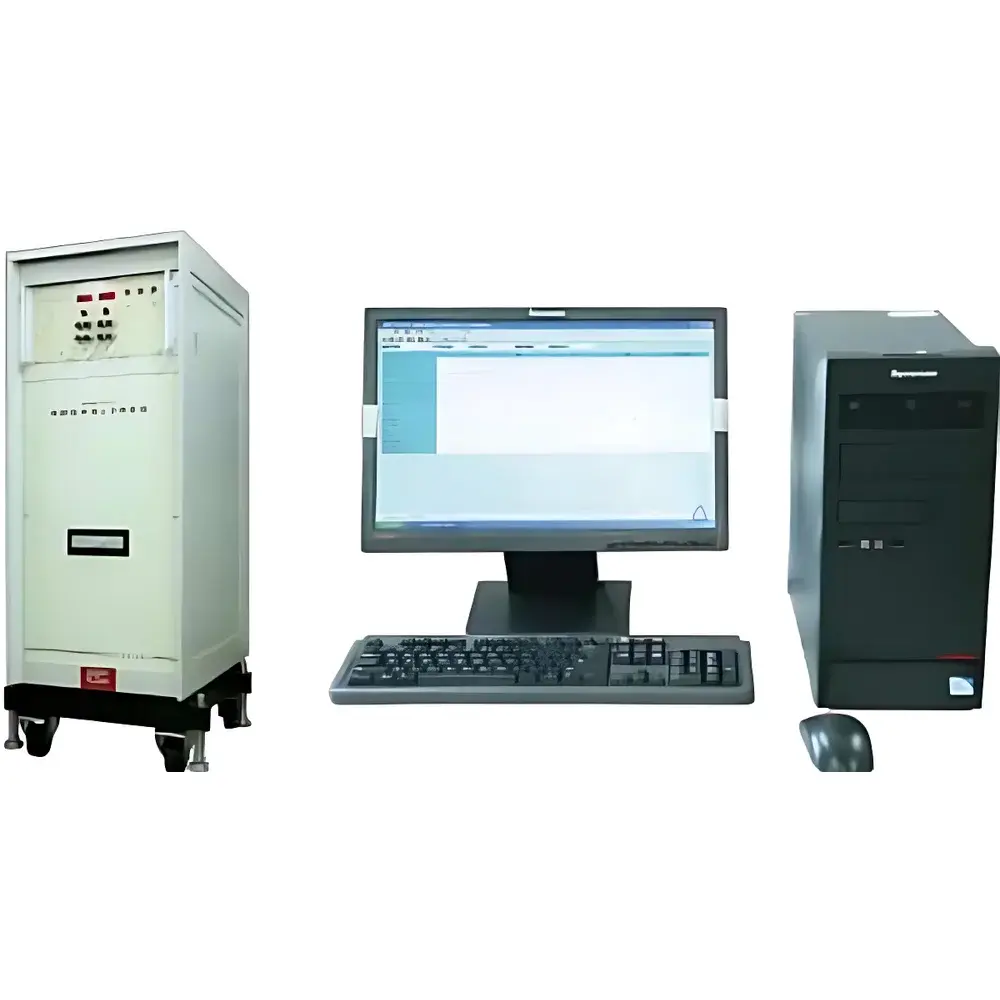
CNC-BH1216III Low-Background Alpha/Beta Liquid Scintillation Spectrometer
| Brand | CNC (China Nuclear Control System) |
|---|---|
| Origin | Beijing, China |
| Model | BH1216III |
| Instrument Type | Laboratory-grade dual-channel liquid alpha/beta spectrometer |
| Detector Type | Plastic scintillator (ST-1221 main |
| Measurement Medium | Aqueous samples |
| Detection Efficiency | α ≥88% (²³⁹Pu, 2π geometry, Φ30 mm), β ≥55% (⁹⁰Sr–⁹⁰Y, 2π, Φ20 mm) |
| Background Count Rate | α ≤0.005 cm⁻²·min⁻¹, β ≤0.15 cm⁻²·min⁻¹ |
| Minimum Detectable Activity | α = 5×10⁻³ Bq, β = 1×10⁻² Bq |
| Anti-coincidence Efficiency | >99% |
| Shielding | 100 mm lead + 10 mm steel (total mass ≈500 kg) |
| Operating Temperature | 5–35 °C ±2 °C |
| Humidity | ≤85% RH at 30 °C |
| Dimensions | 605 × 541 × 1244 mm |
| Weight | ~500 kg |
| Compliance | Meets GB/T 11682–2021 (Chinese National Standard for Low-Background Alpha/Beta Counters, Level II) |
Overview
The CNC-BH1216III is a laboratory-based, dual-channel low-background alpha/beta liquid scintillation spectrometer engineered for high-sensitivity quantification of gross alpha and gross beta activity in aqueous environmental and regulatory samples. It operates on the principle of pulse-shape discrimination (PSD) coupled with active anti-coincidence shielding—enabling simultaneous, independent measurement of two samples under ultra-low background conditions. The system employs plastic scintillation detection: primary measurements are performed using ST-1221 low-background plastic scintillators optically coupled to CR120 low-noise photomultiplier tubes (PMTs), while cosmic-ray-induced background is suppressed via a dedicated ST-401 parallel-plate plastic scintillator anti-coincidence detector array (three CR119 PMTs). Its 100 mm lead + 10 mm steel passive shielding—integrated into a modular 605 × 541 × 1244 mm cabinet—achieves a measured background of ≤0.005 cm⁻²·min⁻¹ for alpha and ≤0.15 cm⁻²·min⁻¹ for beta, meeting the stringent requirements of GB/T 11682–2021 Level II certification. Designed for routine compliance testing, the BH1216III delivers stable 2π detection efficiency (>88% for ²³⁹Pu alpha; >55% for ⁹⁰Sr–⁹⁰Y beta) with cross-talk <3% (alpha in beta channel) and <0.5% (beta in alpha channel), ensuring metrologically traceable results in radiation protection, drinking water monitoring, nuclear facility effluent control, and environmental radioecology.
Key Features
- Dual independent measurement channels—enables concurrent analysis of two liquid samples without cross-contamination or time multiplexing.
- Modular ST-1221 plastic scintillator detectors with selectable active areas (Φ30 mm / Φ45 mm / Φ52 mm), optimized for reproducible 2π geometry and resistance to surface contamination—cleanable, durable, and cost-effective.
- High-efficiency anti-coincidence system: ST-401 plastic scintillator panel (200 × 30 mm) with triple-CR119 PMT readout achieves >99% muon veto efficiency, significantly reducing cosmogenic background.
- Robust passive shielding: 100 mm low-activity lead (≤1 Bq/kg U/Th) + 10 mm structural steel, total mass ≈500 kg; top/bottom shield thickness: 100 mm; upper chamber removable for detector servicing.
- Stability-optimized electronics: Integrated low-voltage/high-voltage power supplies and digital control unit ensure <10% efficiency drift over 24-hour continuous operation and background stability within Nb ± 3σ over 100-minute acquisitions.
- Compliance-ready architecture: Fully supports audit trails, user access levels, and data integrity protocols aligned with GLP and ISO/IEC 17025 laboratory accreditation frameworks.
Sample Compatibility & Compliance
The BH1216III is validated for direct measurement of evaporated or precipitated aqueous samples—including drinking water, groundwater, seawater, rainwater, wastewater, and biological digests—without requiring chemical separation. Sample preparation follows standard EPA Method 900.0 and ISO 10703 protocols for gross alpha/beta determination. Its performance satisfies GB/T 11682–2021 Level II specifications and exceeds typical international benchmarks for background-limited detection. While not FDA 21 CFR Part 11–certified out-of-the-box, its software architecture supports electronic signature implementation, audit trail logging, and secure user authentication—facilitating adaptation to GMP/GLP environments upon site-specific validation. All electrical components meet IEC 61010-1 safety standards; insulation resistance ≥2 MΩ; dielectric strength >1500 V AC.
Software & Data Management
The instrument includes CNC-AlphaBeta v3.x acquisition and analysis software—fully localized in English with intuitive GUI navigation, real-time spectrum display, and automated protocol execution. Software functions include: multi-point energy calibration (using ²⁴¹Am, ⁹⁰Sr–⁹⁰Y, and ¹³⁷Cs reference sources), automatic background subtraction, decay correction, and customizable reporting templates compliant with national reporting formats (e.g., CNIC Form R-02). Raw spectral data (counts vs. pulse height) and processed results (Bq/L, DPM, MDA) are stored in ASCII and SQLite formats, enabling third-party integration with LIMS systems. Audit logs record operator ID, timestamp, sample ID, calibration history, and parameter modifications—supporting traceability per ISO/IEC 17025 Clause 7.7.
Applications
- Regulatory compliance testing of drinking water per WHO Guidelines and China’s GB 5749–2022 (gross alpha ≤0.5 Bq/L; gross beta ≤1 Bq/L).
- Environmental surveillance around nuclear power plants, uranium processing facilities, and radioactive waste repositories.
- Radioecological studies: sediment porewater, plant tissue leachates, and soil extract analyses.
- Pharmaceutical and radiopharmaceutical quality control—monitoring for unintended alpha/beta impurities in isotopic reagents.
- Research applications in low-level radiochemistry, including natural radionuclide (²¹⁰Po, ²²⁶Ra, ⁴⁰K) partitioning studies and fallout chronology.
FAQ
What sample preparation methods are recommended for optimal alpha/beta separation?
Evaporation to dryness followed by gentle ashing (if organic matrix present) is standard. For high-salt samples, co-precipitation with BaSO₄ or Fe(OH)₃ may be used to concentrate radionuclides and reduce quenching.
Can the BH1216III measure solid samples directly?
No—it is designed exclusively for liquid or evaporated-residue measurements. Solid samples require acid digestion or leaching prior to analysis.
Is the system compatible with external gamma spectroscopy validation?
Yes. The BH1216III’s sample planchets are standardized (Φ30/45/52 mm), enabling direct transfer to HPGe or NaI(Tl) gamma counters for isotopic verification (e.g., distinguishing ²²⁶Ra from ²¹⁰Po via gamma lines).
How often must the anti-coincidence veto be recalibrated?
Veto efficiency remains stable for ≥12 months under normal operation; annual verification using a calibrated cosmic-ray muon source or ²²Na coincidence source is recommended.
Does the instrument support remote diagnostics or networked operation?
Yes—Ethernet interface enables remote monitoring, firmware updates, and centralized data export via TCP/IP; however, remote control of measurement initiation requires local operator authentication per security policy.
Related Products







