
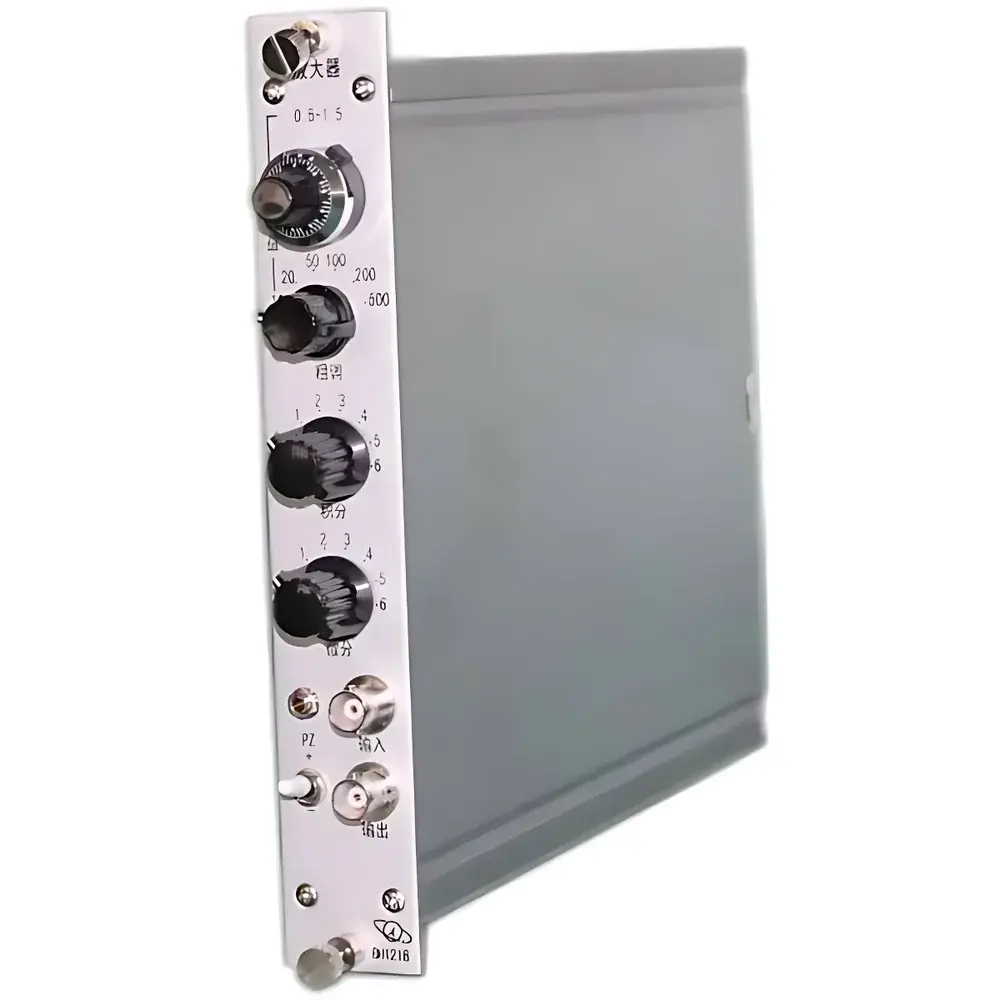
CNCS BH1218 Linear Amplifier
| Brand | CNCS |
|---|---|
| Origin | Beijing, China |
| Manufacturer Type | Authorized Distributor |
| Product Origin | Domestic (China) |
| Model | BH1218 |
| Pricing | Upon Request |
| Gain Range | 5–750× (continuously adjustable) |
| Long-term Gain Stability | ≤0.1% (over 8 h) |
| Temperature Coefficient of Gain | ≤0.015%/°C |
| Integral Nonlinearity | ≤0.2% |
| Input-Referred Noise | ≤15 µV RMS |
| Overload Recovery | Recovers to within 2% of baseline at 2.5× nominal pulse width after 200× overload |
| Input Polarity | Positive or Negative |
| Output Polarity | Positive |
| Output Impedance | 50 Ω |
| Shaping Time Constants | 0, 0.5, 1, 2, 3, 4, 5, 6 µs |
| Operating Temperature | 0–50 °C |
| Relative Humidity | ≤90% at +40 °C |
| Power Supply | ±24 V / 30 mA, ±12 V / 10 mA |
| Power Consumption | 2 W |
Overview
The CNCS BH1218 Linear Amplifier is a precision NIM-standard (Nuclear Instrumentation Module) single-width module engineered for high-fidelity signal conditioning in nuclear radiation detection systems. Designed specifically for use with scintillation detectors, proportional counters, fission chambers, and semiconductor-based radiation sensors, the BH1218 performs low-noise pulse amplification and shaping with exceptional linearity and thermal stability. Its operational principle relies on wide-bandwidth, DC-coupled analog amplification combined with selectable CR-RC pulse shaping networks—enabling optimal signal-to-noise ratio and pulse height fidelity across diverse detector types and counting rates. Unlike legacy modules such as the FH1001A and FH1002A, the BH1218 incorporates refined feedback topology and thermally compensated gain stages, resulting in measurable improvements in long-term drift performance and integral nonlinearity—making it suitable for quantitative spectroscopy, coincidence timing, and multi-channel pulse-height analysis applications requiring traceable calibration stability.
Key Features
- Continuously adjustable voltage gain from 5× to 750×, calibrated via front-panel multi-turn potentiometer with mechanical lock
- Ultra-low input-referred noise of ≤15 µV RMS (typical, measured over 10 kHz–1 MHz bandwidth), preserving energy resolution in low-amplitude pulse detection
- Eight discrete shaping time constants (0, 0.5, 1, 2, 3, 4, 5, 6 µs) selectable via rotary switch, supporting optimization for both fast-timing and high-resolution spectroscopic configurations
- Gain stability ≤0.1% over 8 hours under constant ambient conditions—validated per IEC 61526 Annex B for radiation measurement instrumentation
- Temperature coefficient of gain ≤0.015%/°C, enabling reliable operation across laboratory and field-deployed NIM crates without recalibration
- Fully differential power input compliance with NIM standard ±24 V / ±12 V rails; total power dissipation limited to 2 W for thermal management in densely populated crates
- 50 Ω matched output impedance compatible with 50 Ω coaxial cabling and standard digitizers or multichannel analyzers (MCAs)
- Robust overload recovery: maintains baseline integrity even after 200× transient overdrive, returning to within 2% of baseline at 2.5× nominal pulse width
Sample Compatibility & Compliance
The BH1218 interfaces directly with standard NIM-compatible detectors—including NaI(Tl), LaBr₃(Ce), HPGe preamplifier outputs, gas-filled proportional tubes, and silicon surface-barrier or planar detectors. It supports both positive- and negative-polarity input signals, eliminating need for external polarity inversion circuits. The module conforms to ANSI N42.22-1995 (Radiation Protection Instrumentation—Electronic Pulse Processing Equipment) for linearity, noise, and dynamic range specifications. While not certified for safety-critical nuclear plant control systems, it meets GLP-compliant laboratory requirements for radiometric assay validation when integrated into ISO/IEC 17025-accredited measurement chains. No CE, UKCA, or FCC markings apply, as the unit is intended exclusively for integration into larger NIM-based instrumentation systems—not standalone end-user deployment.
Software & Data Management
As a hardware-only analog signal processor, the BH1218 does not incorporate embedded firmware, USB interfaces, or digital control buses. Configuration is entirely manual via front-panel controls. However, its stable analog output enables seamless integration with third-party data acquisition platforms—including CAEN DT57xx series digitizers, Struck SIS3316 modules, and ORTEC ASPEC-927 MCA systems—that support IEEE 1159-compliant trigger and gate synchronization. When used in conjunction with software packages compliant with FDA 21 CFR Part 11 (e.g., GammaVision-32 v7.0+, Maestro v8.1+), the BH1218 contributes to audit-trail-capable spectral acquisition workflows where analog gain settings are logged alongside raw histogram data and calibration metadata.
Applications
- Gamma-ray and X-ray spectroscopy using scintillation and semiconductor detectors
- Neutron flux monitoring via fission chamber signal amplification in research reactors
- Pulse-height analysis in low-background underground laboratories (e.g., CDEX, PandaX environments)
- Time-of-flight measurements requiring precise leading-edge discrimination and minimal pulse walk
- Quality assurance testing of radiation detector assemblies prior to system integration
- Educational nuclear physics labs requiring reproducible, maintenance-free amplification modules meeting AAPM TG-180 educational instrumentation guidelines
FAQ
Is the BH1218 compatible with CAMAC or VME crate systems?
No—it is strictly a NIM-standard module (22.1 cm × 8.5 cm × 4.4 cm) and requires a NIM power supply and mechanical frame.
Can the BH1218 be used with photomultiplier tube (PMT) anode outputs?
Yes, provided the PMT output is DC-coupled and falls within the input voltage range (±2 V max); for dynode or divider-chain outputs, verify impedance matching to avoid loading effects.
Does the module include factory calibration documentation?
Each unit ships with a test report listing measured gain accuracy, noise floor, and linearity at three gain settings (50×, 250×, 750×), traceable to CNCS internal standards accredited to ISO/IEC 17025.
What is the recommended warm-up time before achieving specified stability?
Minimum 30 minutes at constant ambient temperature (23 ± 2 °C) is required to meet the ≤0.1% 8-hour drift specification.
Is there an extended warranty or repair service available outside China?
CNCS authorizes select international distributors to provide technical support and return-for-repair services under contractual SLA; direct OEM service is limited to Beijing-based facilities.




